
Bacterial canker of tomato
Bacterium (Clavibacter michiganensis subsp. michiganensis)
| Type | Bacteria |
|---|---|
| Cause | Bacterium (Clavibacter michiganensis subsp. michiganensis) |
| When | Early to midsummer, often starting soon after transplanting. |
About
A serious tomato disease that gets into the plant's water-conducting tissue and can wilt and kill whole plants. It usually arrives on infected seed or transplants, and no tomato variety resists it.
Also called bacterial canker of tomato, tomato bacterial canker, Clavibacter, bird's-eye spot
How to recognize it
Symptoms
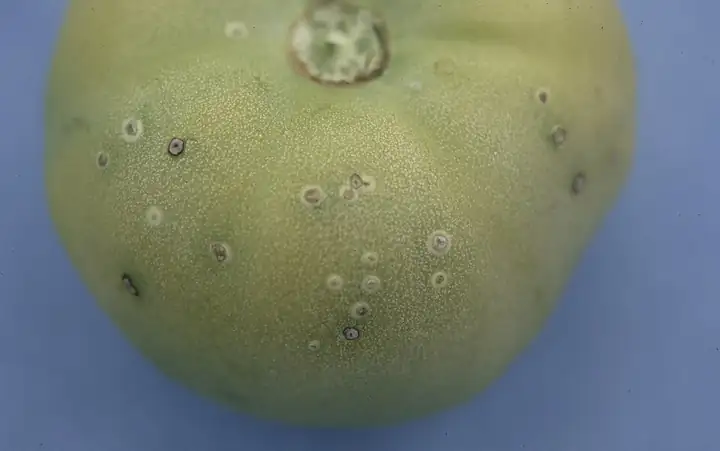
Leaf edges brown and scorch with a yellow border, and lower leaves often wilt on one side of the plant. Cut stems show brown streaks inside, and stems may split into long brown cankers that ooze yellow goo when squeezed. Fruit can get small raised white spots with brown centers, called bird's-eye spots.
Often confused with
The wilting looks like Fusarium or Verticillium wilt, and bacterial speck also spots leaves, but speck spots are smaller and don't spread inside the plant. A lab test is the only sure way to tell.
Worse when
Warm weather (about 75 to 90°F) with high humidity, and handling, pruning or staking plants while they're wet.
How it spreads
Infected seed and transplants bring it in; it then spreads on hands, pruning tools, stakes and splashing water, and it survives at least two years in tomato debris and for months on stakes.
When
Early to midsummer, often starting soon after transplanting.
What to do, gentlest first
Prevention works best; most sprays only protect healthy leaves and can't cure infected ones. Always read and follow the product label.
Clean seed and transplants Prevent
Buy seed from a reputable supplier and choose transplants with no spots. If you save seed, a hot-water soak at 122°F for 25 minutes reduces the bacteria.
Seed treatment lowers the risk but doesn't remove all the bacteria; keep watching seedlings.
Rotate and clean supports Prevent
Don't plant tomatoes, peppers, eggplant or potatoes where any of them grew in the past 3 to 4 years. Scrub and disinfect stakes and cages each year, or replace wooden stakes and string.
Keep leaves dry Prevent
Water at the base with drip or a soaker hose in the morning, space plants for air flow, and stay out of the patch when plants are wet.
Remove sick plants and clean tools By hand
Pull wilting plants, roots and all, and clean up all tomato debris at season's end. Wipe pruners with 70% alcohol between plants.
Copper (prevention only) Organic spray
Copper sprayed on seedlings before transplanting can help keep the disease from getting started.
Copper does not stop the disease once it is in the plant, and Utah State found it did not work in the field after transplanting. Follow the label.
Plants it affects
Sources
Photo: Photo: Mary Ann Hansen, Virginia Polytechnic Institute and State University, Bugwood.org / Wikimedia Commons, CC BY 3.0 US (CC BY 3.0 US). Photo resized for the web.

Planting dates and advice are general guidance; check with your local Cooperative Extension office for your area.