
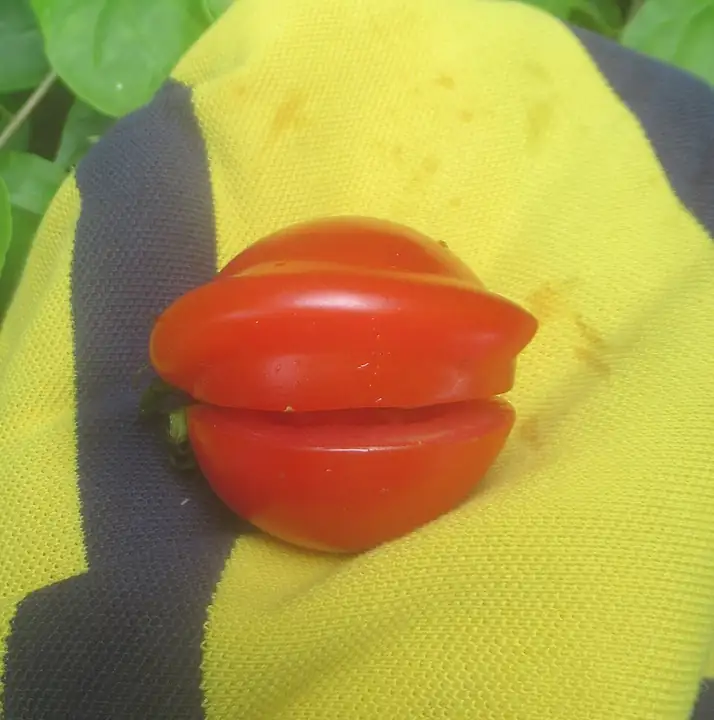
Catfacing
Not an infection: flowers are disturbed while forming, most often by cool nights, so the fruit grows lumpy and scarred
| Type | Not an infection |
|---|---|
| Cause | Not an infection: flowers are disturbed while forming, most often by cool nights, so the fruit grows lumpy and scarred |
| When | Early summer, on fruit from the first clusters. |
About
Tomatoes with puckered, scarred bottoms and deep folds. It hits large-fruited tomatoes on the first clusters after a cool spring.
Also called catfacing, catface, cat facing, catfaced tomatoes
How to recognize it
Symptoms
Fruit is badly misshapen, often flattened, with deep creases, holes and brown corky scar tissue at the blossom end. Early clusters are worst. Plum tomatoes get it less, and cherry and grape tomatoes seldom do.
Often confused with
Zippering is a narrow scar running up the side of the fruit. Blossom end rot is a dark, sunken, leathery patch, not a corky scar. Hormone-type weed killer drift (see Herbicide injury) can also cause catfacing; damage that fades away from one edge of the garden points to drift.
Worse when
Nights at or below about 54°F while flower buds are forming (catfaced fruit shows up 3 to 4 weeks later), planting out too early, large-fruited and older varieties, and heavy pruning of indeterminate plants.
How it spreads
It does not spread.
When
Early summer, on fruit from the first clusters.
What to do, gentlest first
This is not an infection, so sprays for diseases won't help. Fix the cause below.
Plant after it warms up Prevent
Wait to set out tomatoes until 1 to 2 weeks after your last spring frost, when nights are warmer.
Choose less-prone varieties Prevent
If catfacing keeps showing up, switch to smaller-fruited or less-prone varieties, and go easy on pruning.
Pick off damaged fruit By hand
Remove catfaced fruit early so the plant puts its energy into good fruit.
Mildly catfaced tomatoes are safe to eat if no rot has moved into the cracks; just cut away the scar.
Plants it affects
Sources
Photo: Photo: P1898 / Wikimedia Commons, CC BY 4.0 (CC BY 4.0). Photo resized for the web.

Planting dates and advice are general guidance; check with your local Cooperative Extension office for your area.