
Dutch elm disease
Fungi (Ophiostoma novo-ulmi and Ophiostoma ulmi) carried by elm bark beetles
| Type | Fungus |
|---|---|
| Cause | Fungi (Ophiostoma novo-ulmi and Ophiostoma ulmi) carried by elm bark beetles |
About
Dutch elm disease is a deadly wilt of elms, spread by bark beetles and through roots grafted to neighboring elms. American, slippery and rock elms are very susceptible, while Asian elms and many newer hybrid and American elm selections hold up far better.
Also called Dutch elm disease, dutch elm disease, DED, elm wilt
How to recognize it
Symptoms
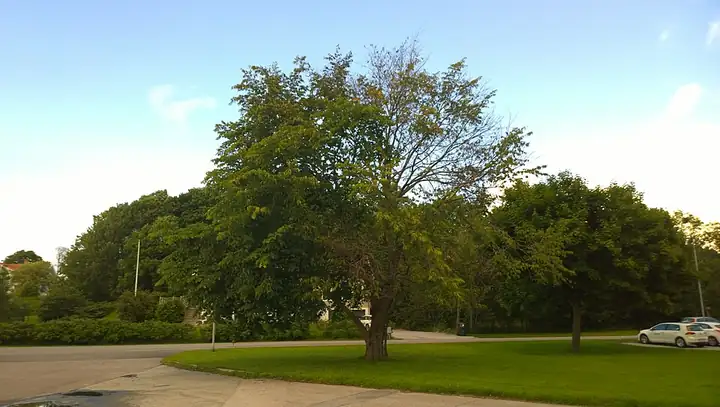
Leaves on one or more branches in the outer crown turn yellow, wilt and then brown (called flagging), often in late spring or early summer. The wilting moves down the branch toward the trunk and on through the tree, killing it in one season or over several years. Peeling the bark on a wilted branch shows brown streaks in the outer wood.
Often confused with
Other elm wilt and canker problems look similar, so a lab test is needed. Bacterial leaf scorch on elm browns leaf edges in late summer, starting low in the tree and moving up, rather than wilting whole outer branches.
Worse when
Dead or dying elm wood with bark still on it, where the beetles breed, and elms growing close enough for their roots to graft together.
How it spreads
Beetles pick up spores where they breed under the bark of dead elms and firewood, then carry them to healthy elms they feed on; the fungus also moves quickly through grafted roots between neighboring elms.
When
Symptoms show most often in late spring and early summer, but can appear any time in the growing season.
Where
First found in Ohio in 1930 and spread through most of the U.S. by the 1980s.
What to do, gentlest first
Prevention works best; most sprays only protect healthy leaves and can't cure infected ones. Always read and follow the product label.
Plant resistant elms or other trees Prevent
Resistant choices include American elms 'Princeton', 'Valley Forge', 'New Harmony', 'Independence' and the American Liberty elms, hybrids such as 'Accolade', 'New Horizon', 'Regal' and 'Frontier', and Chinese elm (Ulmus parvifolia) or Japanese zelkova.
Resistance is not immunity: these can still get infected, but they decline slowly or recover.
Get rid of beetle breeding wood Prevent
Promptly remove dead and dying elm wood that still has bark. Chip, debark, bury or burn it where allowed, and do not keep it as firewood unless the bark is stripped and the pile is tarped with the edges buried.
Prune out early infections By hand
If only a small part of the tree is wilting (under about 5%), cut infected branches at least 5 to 10 feet below the last brown streaking in the wood, before the fungus reaches the trunk. Badly infected trees should be removed.
Before removing an infected elm, have an arborist break root grafts to nearby elms with a vibratory plow or trencher, or the fungus can spread through the roots. Disinfect tools between cuts with 70% alcohol or 10% bleach.
Preventive trunk injection (arborist only) Conventional spray
Propiconazole or thiabendazole injected by a trained arborist can protect valuable healthy elms from beetle-carried infection. Treatments are repeated every 1 to 3 years, depending on the product.
Injections do little for trees already badly infected or for spread through grafted roots. Follow the label.
Sources
Photo: Photo: Ingwik / Wikimedia Commons, CC BY-SA 4.0 (CC BY-SA 4.0). Photo resized for the web.

Planting dates and advice are general guidance; check with your local Cooperative Extension office for your area.