
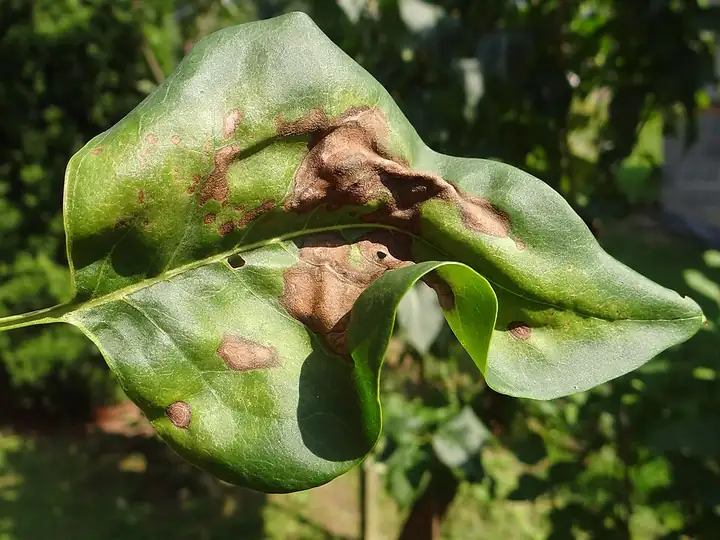
Bacterial blight of lilac
Bacterium (Pseudomonas syringae pv. syringae)
| Type | Bacteria |
|---|---|
| Cause | Bacterium (Pseudomonas syringae pv. syringae) |
| When | Early spring through late spring, during rainy weather. |
About
Bacterial blight blackens young lilac shoots, leaves and flower clusters in cool, wet springs, often right after a frost. It can blacken a whole season's flower clusters.
Also called bacterial blight of lilac, lilac bacterial blight, lilac blight, Bacterial blight, Pseudomonas blight, shoot blight of lilac
How to recognize it
Symptoms
In early spring, brown spots, sometimes with a yellow halo, appear on young leaves and shoots and quickly turn black in rainy weather. Young shoots bend over at a black lesion and wither above it, young leaves blacken in a wedge from the edge, and flower clusters and buds turn black and die.
Often confused with
Blackened buds can look like winter injury; bacterial blight keeps spreading on new shoots and leaves in wet weather.
Worse when
Cool, wet spring weather, frost injury, wounds, and soft growth from too much or late fertilizer.
How it spreads
The bacteria live through winter in old cankers and on buds, bark and leaves, and spread by rain, wind, insects, tools and infected nursery plants.
When
Early spring through late spring, during rainy weather.
What to do, gentlest first
Prevention works best; most sprays only protect healthy leaves and can't cure infected ones. Always read and follow the product label.
Choose resistant lilacs Prevent
Most common lilac cultivars are susceptible. Species such as Syringa josikaea, S. komarowii, S. pekinensis and S. reflexa resist it, and common lilac cultivars such as 'Edith Cavell', 'Glory' and 'Pink Elizabeth' have shown less disease in gardens.
Air, spacing and careful feeding Prevent
Space lilacs and thin them so air moves through. Do not fertilize late in the season or overfeed young plants.
Prune out blighted shoots By hand
Cut out blackened shoots and flower clusters well into healthy wood as soon as you see them, in dry weather, and destroy them.
Clean pruners between cuts so you do not spread the bacteria.
Copper (such as Bordeaux mixture) Organic spray
Spray before fall rains and again before buds break in spring. Bordeaux mixture can still work on bacteria that resist other copper products.
Copper can injure lilac leaves early in the season, and overuse breeds copper-resistant bacteria. WSU's bee guide rates Bordeaux highly toxic to bees and copper hydroxide toxic, so do not spray when bees are around. Follow the label.
Plants it affects
Sources
Photo: Photo: Jerzy Opioła / Wikimedia Commons, CC BY-SA 4.0 (CC BY-SA 4.0). Photo resized for the web.

Planting dates and advice are general guidance; check with your local Cooperative Extension office for your area.