
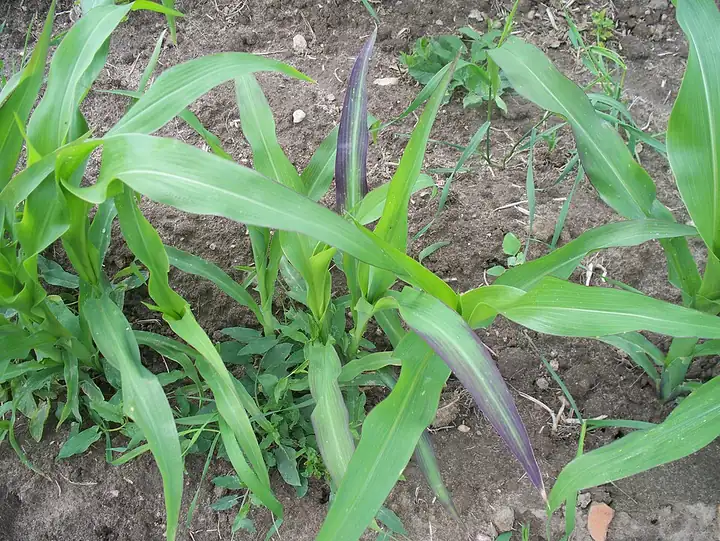
Phosphorus deficiency
Not an infection: the plant is not getting enough phosphorus, most often because cold soil or a pH problem keeps roots from taking it up
| Type | Not an infection |
|---|---|
| Cause | Not an infection: the plant is not getting enough phosphorus, most often because cold soil or a pH problem keeps roots from taking it up |
| When | Most often in early spring on young transplants in cold soil. |
About
Phosphorus helps plants root, flower and set fruit. Most garden and landscape soils have plenty, so true shortages are uncommon; purple-tinged young tomatoes in cold spring soil are the classic garden case.
Also called phosphorus shortage, lack of phosphorus, low phosphorus, P deficiency, purple leaves from cold soil
How to recognize it
Symptoms
Plants are stunted, and leaves, especially older ones, take on a purple or purplish tint, often strongest on the veins and leaf undersides. Young leaves may be dark green with purplish veins, and leaves can curl, stay small or drop early. Plants are weak, slow to mature and yield poorly.
Often confused with
Nitrogen shortage yellows older leaves instead of purpling them, potassium shortage browns their edges, and magnesium shortage yellows them between green veins. Iron chlorosis yellows the newest leaves with green veins, not purple. Some herbicides cause similar curling and distortion. Cold soil alone can purple young tomatoes even when the soil has enough phosphorus, so a soil test (or tissue test) is the way to confirm a real shortage.
Worse when
Cold soil early in the season, containers and soilless mixes, sandy soil, spots where topsoil was scraped off during building, and soil pH that is very acidic or above about 6.5.
How it spreads
It does not spread from plant to plant.
When
Most often in early spring on young transplants in cold soil.
What to do, gentlest first
This is not an infection, so sprays for diseases won't help. Fix the cause below.
Wait for warm soil Prevent
Plant warm-season crops into warm soil. For early tomato plantings, plastic mulch warms the root zone and eases the problem.
Soil test before adding phosphorus Prevent
Add phosphorus only if a soil test calls for it. Most soils have enough, and extra rarely helps landscape plants.
Adding a complete fertilizer to fix one shortage can oversupply other nutrients, add salts and pollute water. Chicken manure supplies phosphorus but is often salty.
Keep pH in range Prevent
Most vegetables do best around pH 5.8 to 6.5. Lime acidic soil and avoid pushing pH high, by soil test.
Feed container plants regularly Prevent
Plants in pots run out of nutrients. Feed them with a balanced fertilizer, following the label.
Plants it affects
Sources
- ipm.ucanr.edu
- aggie-horticulture.tamu.edu
- missouribotanicalgarden.org
- homegarden-cahnr.media.uconn.edu
- hgic.clemson.edu
Photo: Photo: Agronom / Wikimedia Commons, CC BY-SA 3.0 (CC BY-SA 3.0). Photo resized for the web.

Planting dates and advice are general guidance; check with your local Cooperative Extension office for your area.