
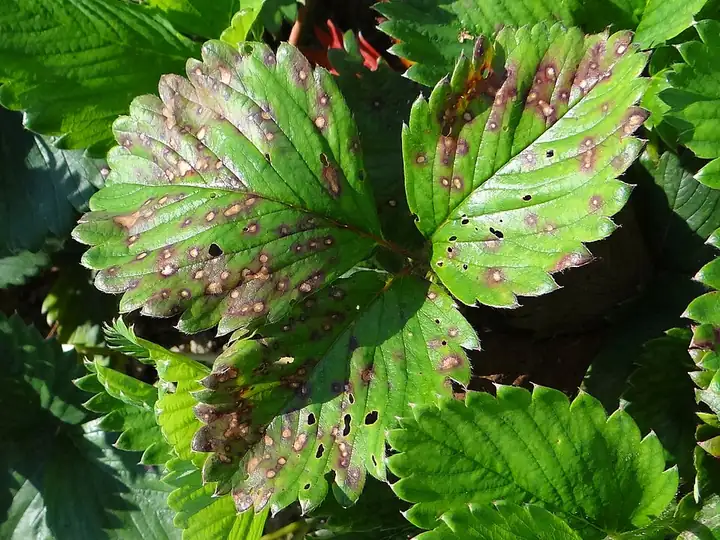
Common leaf spot of strawberry
Fungus (Mycosphaerella fragariae; asexual stage Ramularia)
| Type | Fungus |
|---|---|
| Cause | Fungus (Mycosphaerella fragariae; asexual stage Ramularia) |
| When | Through the growing season in wet weather. |
About
A very common spotting of strawberry leaves. It is usually minor and must be severe before it cuts yield.
Also called common leaf spot, strawberry leaf spot
How to recognize it
Symptoms
Small round spots, roughly 1/16 to 1/4 inch across, start reddish-purple and develop tan to gray-white centers with a purple border. Spots can run together on heavily infected leaves.
Often confused with
Leaf scorch spots stay dark purple without a pale center; leaf blight and leaf blotch lesions spread larger and faster.
Worse when
Humid weather and long leaf wetness (12 to 18 hours or more), with temperatures of about 59 to 77°F.
How it spreads
The fungus spends the winter in old leaves and debris, and spores spread by splashing rain and overhead watering.
When
Through the growing season in wet weather.
What to do, gentlest first
Prevention works best; most sprays only protect healthy leaves and can't cure infected ones. Always read and follow the product label.
Plant resistant varieties Prevent
Allstar, Earliglow and Jewell resist both leaf spot and leaf scorch, and Honeoye is tolerant.
Keep leaves dry and growth balanced Prevent
Space plants, pull weeds, use drip irrigation instead of overhead watering, and avoid heavy spring nitrogen; UMass suggests splitting nitrogen between renovation time and early fall.
Remove old leaves and debris By hand
Clear out dead and spotted leaves and plant debris where the fungus overwinters.
Plants it affects
Sources
Photo: Photo: Jerzy Opioła, CC BY-SA 4.0, via Wikimedia Commons (CC BY-SA 4.0). Photo resized for the web.

Planting dates and advice are general guidance; check with your local Cooperative Extension office for your area.