
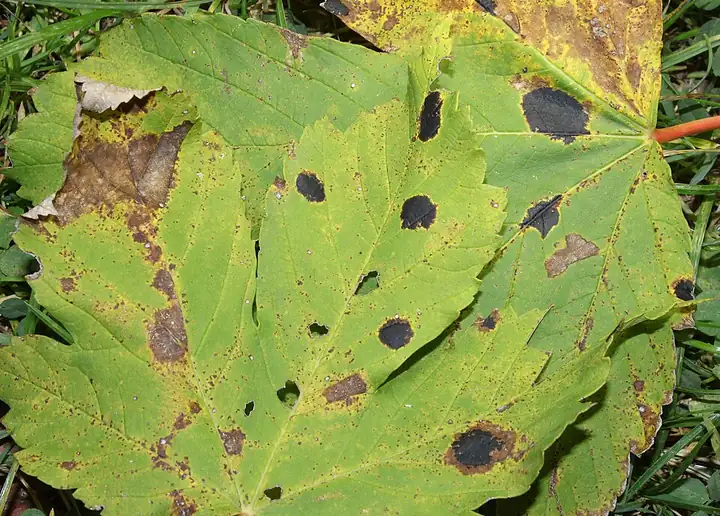
Tar spot of maple
Fungi (Rhytisma acerinum, R. americanum and R. punctatum)
| Type | Fungus |
|---|---|
| Cause | Fungi (Rhytisma acerinum, R. americanum and R. punctatum) |
About
Tar spot makes maple leaves look like someone dabbed them with tar. It looks alarming but is mostly cosmetic and does not kill trees.
Also called tar spot, Tar spot, maple tar spot, tar spot of maple, Rhytisma tar spot, giant tar spot, speckled tar spot
How to recognize it
Symptoms
Small yellowish or pale green spots show on leaves in late spring and early summer. By mid to late summer they turn into raised, shiny black spots, either clusters of small specks (common on Norway maple) or single large spots up to about three-quarters of an inch (common on silver maple). Heavily spotted leaves may drop a little early in fall.
Worse when
Moist, rainy springs, and trees in damp, sheltered spots.
How it spreads
The fungus spends the winter in the black spots on fallen leaves; in spring it releases spores that wind and splashing rain carry up to the new leaves.
When
Infects new leaves in spring; black spots show from mid to late summer into fall.
Where
Common in the Northeast and Midwest; giant tar spot is frequent on Norway maples in the Northeast (UConn).
What to do, gentlest first
Prevention works best; most sprays only protect healthy leaves and can't cure infected ones. Always read and follow the product label.
Accept it Prevent
Tar spot rarely harms a tree's health, so most years no treatment is needed.
Rake and remove fallen leaves By hand
Rake up spotted leaves in fall (or early spring) and bag, bury or burn them where allowed. Hot compost works only if the pile reaches about 140°F and is turned so the outside leaves get to the center.
Raking helps less if neighbors' infected maples drop leaves nearby.
Copper (rarely worth it) Organic spray
Copper hydroxide, alone or with mancozeb, is labeled for tar spot. It takes three sprays: at bud break, when leaves are half open, and when fully open.
Extension sources say spraying is seldom if ever warranted: it is costly, hard to do on a big tree, and the disease is cosmetic. WSU's bee guide rates copper products toxic to bees. Follow the label.
Plants it affects
Sources
- hort.extension.wisc.edu
- homegarden.cahnr.uconn.edu
- yardandgarden.extension.iastate.edu
- extension.illinois.edu
- s3.wp.wsu.edu
Photo: Photo: Holger Krisp / Wikimedia Commons, CC BY 3.0 (CC BY 3.0). Photo resized for the web.

Planting dates and advice are general guidance; check with your local Cooperative Extension office for your area.