
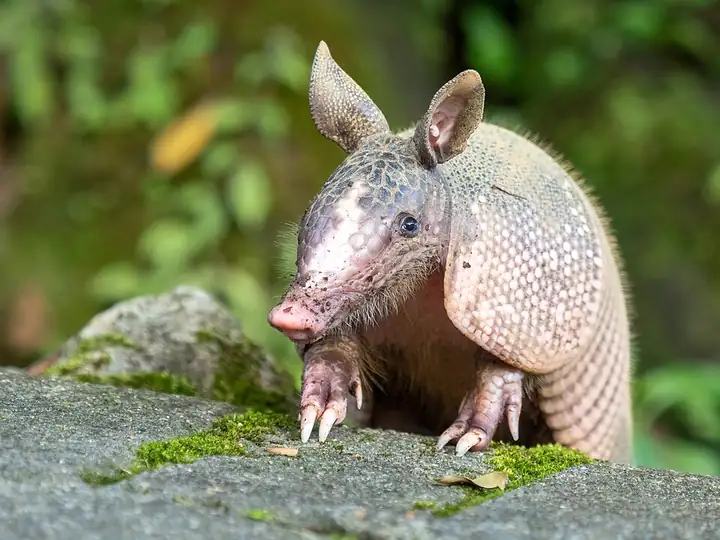
Nine-banded armadillo
Dasypus novemcinctus
| Type | Animal |
|---|---|
| When | Year-round; worst in summer. |
| Pressure by region | High pressure: Southeast, South Central |
About
The only armadillo in the United States: an 8- to 17-pound animal with a hard, banded shell, poor eyesight and a keen nose. It eats mostly insects and grubs, and it digs up lawns and uproots flowers and other plants while hunting for them.
Spotting it
Damage
Many shallow, cone-shaped holes about 1 to 3 inches deep and 3 to 5 inches wide (sometimes up to 6 inches deep), plus mulch rooted up as if by a pig and shallow-rooted annuals dug out of beds.
How to find it early
Armadillos feed mostly at night, so look for fresh holes in the morning, especially in summer in watered lawns and beds.
When
Year-round; worst in summer.
Life cycle
Armadillos breed in summer, and each female has one litter a year in late winter or early spring of four identical young that develop from a single egg. They live about 6 to 7 years, and cold weather (below about 36°F) limits how far north they can spread.
What to do, gentlest first
Start at the top. Sprays are a last step; always read and follow the product label.
Water and feed the lawn less Prevent
Cutting back on lawn watering and fertilizing makes the soil less rich in the earthworms and insects armadillos dig for.
Low, buried fence Barrier
A fence about 24 inches high with the bottom buried 18 inches and the top slanted outward at about 40 degrees keeps armadillos out (University of Florida). Oklahoma State says a fence more than 12 inches tall that fits closely to the ground stops most of them.
Live traps with wings, where legal Trap
Use a live trap about 12 by 12 by 32 inches, ideally with doors at both ends, and set boards on edge as wings to funnel armadillos in. Bait with earthworms, mealworms or overripe fruit. Armadillos are not protected in Georgia or Oklahoma. Florida does not allow you to move and release one, and Oklahoma requires permission from the owner of the land where you release it.
Armadillos can carry the bacteria that cause leprosy (Hansen's disease) and pass it to people. The risk is low, but wear gloves. Trapping and relocating wildlife is regulated by state law, and the rules differ from state to state. Check with your state wildlife agency or your county Extension office before you set a trap.
Skip repellents and poisons Repellent
Oklahoma State says repellents are not effective at keeping armadillos out. Florida has no chemical repellents registered for armadillos, and poison baits are illegal there, so don't use them.
Pressure by region
Armadillos spread from Texas through Louisiana and across the Mississippi River by 1954 (UGA). UF/IFAS says they now occur from Texas east throughout the South and occasionally in Missouri and South Carolina; they are found in uplands throughout Florida and as far north as Athens and Rome in Georgia. Cold below about 36°F limits how far north they can spread (UGA). The high ratings for the South are estimates based on that range. No source covering the West, the Northeast, Alaska or Hawaii was found, so those low ratings are estimates; armadillos are not expected there.
| Northeast | Low |
|---|---|
| Southeast | High pressure |
| South Central | High pressure |
| Midwest | Low |
| Great Plains | Low |
| Mountain West | Low |
| Southwest | Low |
| Pacific Northwest | Low |
| California | Low |
| Alaska | Low |
| Hawaii | Low |
Ratings come from extension sources where available; some are estimates, as noted above.
Sources
Photo: Photo: Rhododendrites, CC BY-SA 4.0, via Wikimedia Commons (CC BY-SA 4.0). Photo resized for the web.

Planting dates and advice are general guidance; check with your local Cooperative Extension office for your area.