
Billbugs
Bluegrass billbug (Sphenophorus parvulus), lesser billbug (S. minimus) and hunting billbug (S. venatus), plus other Sphenophorus species
| Type | Insect |
|---|---|
| When | Adults in spring; larval damage from mid-June through August. |
| Pressure by region | Moderate: Northeast, Midwest, Great Plains, Mountain West |
About
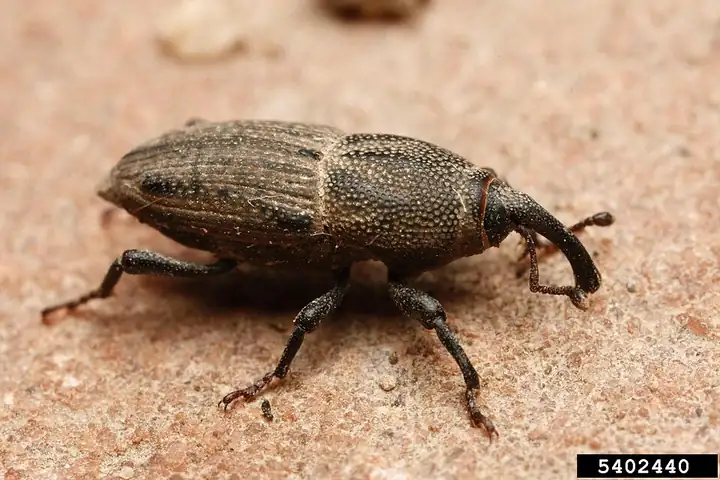
Small black or gray weevils, 1/4 to 3/8 inch long, with a long curved snout, often seen walking slowly across sidewalks and driveways on warm spring days. Their legless larvae hollow out grass stems and then eat the crowns and roots; Kentucky bluegrass is the favorite, and the hunting billbug mainly attacks zoysia (Ohio State, UC IPM).
Spotting it
Damage
Lawns thin and brown in irregular patches from about mid to late June, easily mistaken for drought or disease. Dead stems snap off at the soil line and are hollow and packed with fine, sawdust-like frass, and unlike grub-damaged turf the grass won't roll back like a carpet (Ohio State, UC IPM).
How to find it early
Try the tug test on dying patches: pull up stems and look for sawdust-like frass at the base. In spring, watch sidewalks for slow, armored weevils; from late June, dig small plugs and look for legless, cream-colored larvae with brown heads (Ohio State, UC IPM).
When
Adults in spring; larval damage from mid-June through August.
Life cycle
Adults spend winter in thatch and leaf litter and become active from late April into May; females tuck eggs into stems, and larvae feed inside the stems, then on crowns and roots, for 35 to 55 days. New adults appear from late July into September, and some years bring a partial second generation (Ohio State).
What to do, gentlest first
Start at the top. Sprays are a last step; always read and follow the product label.
Resistant grass Prevent
High-endophyte perennial ryegrass and turf-type tall fescue resist billbugs, some Kentucky bluegrass varieties hold up better than others, and mixed lawns are hit less often. Reseed dead spots; turf-type tall fescue blends well with bluegrass (Ohio State).
Water and mow to hide light damage Prevent
Water and fertilize at the rates recommended for your grass, and mow at the high end of its range; this helps lawns outgrow light to moderate damage (UC IPM, Ohio State).
Beneficial nematodes Natural enemies
Steinernema and Heterorhabditis nematodes have worked in trials. Water before applying, apply late in the day, water right after, and keep the soil moist for 10 to 14 days (Ohio State, UC IPM).
Time it to adults or young larvae Conventional spray
Billbugs are hard to kill. Spray a surface insecticide in spring when adults start walking (soil about 65 to 68°F), or use a systemic lawn product such as chlorantraniliprole while larvae are still inside the stems, usually mid-May to mid-June (Ohio State).
Treat only lawns with past damage or confirmed bugs; UC IPM suggests acting at more than 1 billbug per square foot. Pyrethroids are highly toxic to bees (PNW 591), and some billbug products are neonicotinoids, which harm pollinators, so skip them. Follow the label.
Pressure by region
Ohio State calls the bluegrass billbug Ohio's most common billbug, and billbugs cluster in neighborhoods of continuous Kentucky bluegrass. UC IPM says billbugs can attack all turfgrasses. No regional severity source was found, so ratings are estimates.
| Northeast | Moderate |
|---|---|
| Southeast | Low |
| South Central | Low |
| Midwest | Moderate |
| Great Plains | Moderate |
| Mountain West | Moderate |
| Southwest | Low |
| Pacific Northwest | Low |
| California | Low |
| Alaska | Low |
| Hawaii | Low |
Ratings come from extension sources where available; some are estimates, as noted above.
Sources
Photo: Photo: Joseph Berger, Bugwood.org / Wikimedia Commons, CC BY 3.0 US (CC BY 3.0 US). Photo resized for the web.

Planting dates and advice are general guidance; check with your local Cooperative Extension office for your area.