
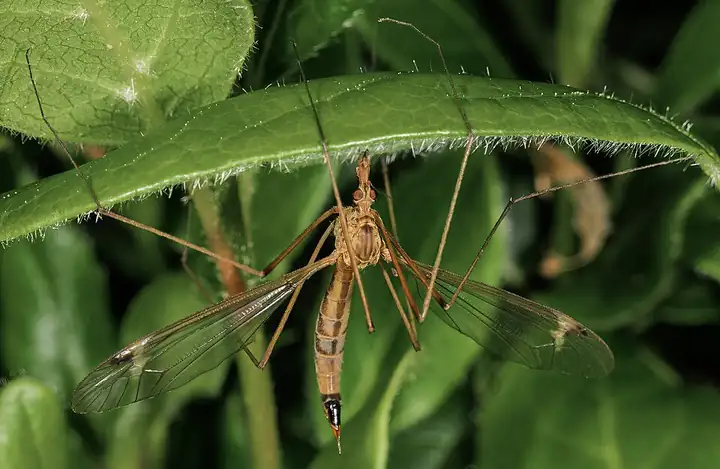
Crane flies (leatherjackets)
European crane fly (Tipula paludosa) and marsh crane fly (Tipula oleracea), both from Europe; native crane flies are harmless
| Type | Insect |
|---|---|
| Pressure by region | High pressure: Pacific Northwest |
About
Adults look like giant mosquitoes about an inch long, but they can't bite and don't eat mosquitoes. Two invasive European species have grayish, legless larvae called leatherjackets that eat lawn grass, mainly in the Pacific Northwest, northern California, western New York and Ohio (Oregon State, Ohio State, Cornell).
Spotting it
Damage
Larvae eat grass roots, crowns and blades through winter and spring, so turf thins from about February and can die out in April and May, mostly in wet, low spots. Birds, skunks and raccoons tear up the lawn to eat them (Oregon State). Cornell says they can also hurt vegetables, small fruits and seedling nurseries.
How to find it early
From November through January, cut a 1-foot square of sod about an inch deep in wet or previously damaged spots, flip it, and count the larvae. More than 25 per square foot in a well-kept lawn may call for action (Oregon State).
When
Larvae fall through spring, with damage worst from February to May; adults in late summer and fall (plus spring for the marsh crane fly).
Life cycle
The European crane fly has one generation a year: adults appear in late summer and early fall, lay eggs in moist soil in mid-September, and larvae feed from October until spring. The marsh crane fly has two generations, with adults in spring and fall (Oregon State, Ohio State).
What to do, gentlest first
Start at the top. Sprays are a last step; always read and follow the product label.
Healthy, well-drained lawn Prevent
Mow weekly at 2 to 3 inches and leave the clippings, fertilize on schedule, and improve drainage in soggy spots. Cut back watering around Labor Day, when adults look for wet soil to lay eggs (Oregon State).
Treat in winter, only above threshold Conventional spray
If winter counts still top about 25 larvae per square foot, a labeled lawn insecticide such as chlorantraniliprole applied in winter, before damage shows, works far better than a spring treatment (Oregon State).
Winter timing also lowers the risk to bees. Carbaryl and pyrethroids such as bifenthrin are highly toxic to bees (PNW 591), and imidacloprid is a neonicotinoid that harms pollinators, so skip it. Follow the label.
Pressure by region
Both species occur in Washington, Oregon and northern California, with outbreaks east of the Cascades in Bend and Spokane (Oregon State). In the East they were first found in western New York in 2004 and are now in Ohio (Cornell, Ohio State). Other ratings are estimates.
| Northeast | Low |
|---|---|
| Southeast | Low |
| South Central | Low |
| Midwest | Low |
| Great Plains | Low |
| Mountain West | Low |
| Southwest | Low |
| Pacific Northwest | High pressure |
| California | Moderate |
| Alaska | Low |
| Hawaii | Low |
Ratings come from extension sources where available; some are estimates, as noted above.
Sources
Photo: Photo: Didier Descouens / Wikimedia Commons, CC BY-SA 4.0 (CC BY-SA 4.0). Photo resized for the web.

Planting dates and advice are general guidance; check with your local Cooperative Extension office for your area.