
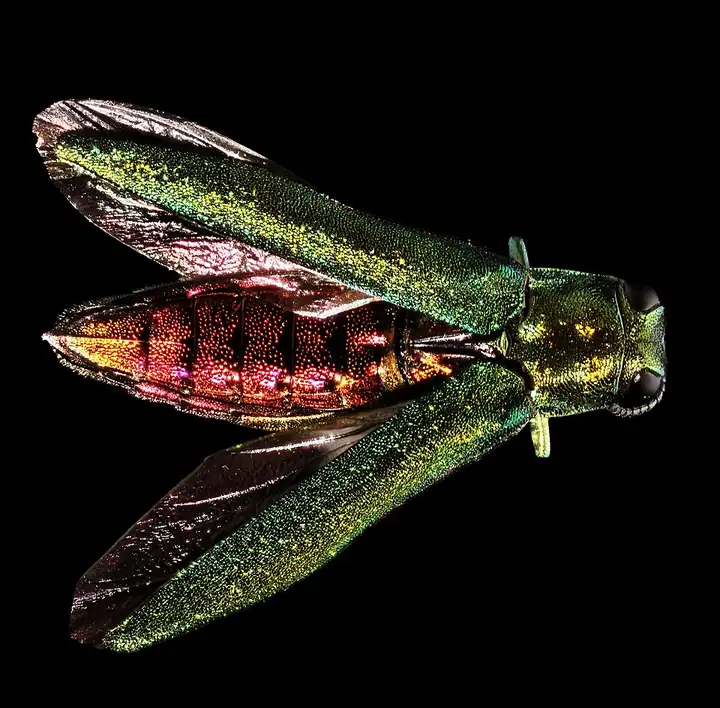
Emerald ash borer
Agrilus planipennis
| Type | Insect |
|---|---|
| Pressure by region | High pressure: Northeast, Southeast, Midwest |
About
A slim, metallic green beetle about 1/3 inch long, native to China and Korea, whose larvae tunnel under the bark of ash trees, including green, white and black ash (Penn State). Since it was first found in southeast Michigan in 2002 it has killed huge numbers of ash trees and has been found in 38 states and Washington, D.C. (USDA APHIS).
Spotting it
Damage
Larvae carve winding, S-shaped tunnels packed with sawdust-like frass just under the bark, which cuts off the flow of water and food. Leaves wilt, branches die back, the crown thins, bark can split over the tunnels and sprouts pop out on the trunk; heavily infested trees can die in about 3 years (Penn State).
How to find it early
Woodpecker damage, with jagged patches of bark flaked off, is often the first clue. Then look for small D-shaped exit holes, a thinning top and sprouts on the trunk; new infestations can stay hidden for up to 3 years (Penn State).
When
Adults fly late May through July; larvae feed under the bark from summer into fall.
Life cycle
In Pennsylvania it usually takes one year. Larvae spend winter in shallow cells in the bark, pupate in late April or May, and adults chew out through D-shaped holes from late May, with the most beetles out from mid-June to early July (Penn State).
What to do, gentlest first
Start at the top. Sprays are a last step; always read and follow the product label.
Use local firewood Prevent
Moving firewood and nursery stock is thought to be the main way it spreads. Buy firewood where you burn it, or buy certified heat-treated wood (USDA APHIS, Penn State).
Know your ash trees and plan ahead Prevent
Oregon State advises against cutting down healthy ash ahead of time. Learn the signs, decide which trees are worth protecting, and plan replacement trees of other kinds.
Remove badly declining trees By hand
Ash that have lost more than half of their canopy are unlikely to recover, even with treatment, so plan to remove them (Wisconsin, Missouri multistate bulletin).
Follow any local rules about moving or disposing of ash wood.
Parasitic wasp releases Natural enemies
USDA APHIS raises tiny stingless wasps that attack emerald ash borer and releases them in infested areas. They are not something homeowners buy, but they are part of the long-term effort.
Homeowner soil drench for small to mid-size trees Conventional spray
Start protecting valuable, still-healthy ash once the borer is within about 10 to 15 miles (multistate bulletin). Imidacloprid soil drench, applied every year in spring (mid-April to mid-May in Wisconsin), works well on trees under about 15 inches across at chest height; dinotefuran is another homeowner option (Wisconsin, multistate bulletin).
Imidacloprid and dinotefuran are highly toxic to bees (PNW 591). Do not drench where flowering plants grow under the tree; remove them or use a trunk injection instead (multistate bulletin). Follow the label.
Professional trunk injection for large trees Conventional spray
A certified arborist can inject emamectin benzoate into the trunk in mid-May to early June after the leaves are out. In studies it was the most consistently effective treatment and protected trees for at least two years, and treating usually costs much less than removing a big tree (multistate bulletin).
Emamectin benzoate is highly toxic to bees (PNW 591). Insecticides cannot save a dead or heavily infested ash. Follow the label.
Pressure by region
USDA APHIS reports it in 38 states plus D.C. In the West it was found in Boulder, Colorado, in 2013 and has since turned up in more Front Range cities and in Carbondale (Colorado State Forest Service), and it was first seen in Oregon in 2022 (Oregon State). Regional ratings are estimates.
| Northeast | High pressure |
|---|---|
| Southeast | High pressure |
| South Central | Moderate |
| Midwest | High pressure |
| Great Plains | Moderate |
| Mountain West | Low |
| Southwest | Low |
| Pacific Northwest | Low |
| California | Low |
| Alaska | Not found here |
| Hawaii | Not found here |
Ratings come from extension sources where available; some are estimates, as noted above.
Sources
- extension.psu.edu
- aphis.usda.gov
- extension.missouri.edu
- datcpservices.wisconsin.gov
- extension.oregonstate.edu
- csfs.colostate.edu
- s3.wp.wsu.edu
Photo: Photo: Benjamin Smith / Wikimedia Commons, CC BY 2.0 (CC BY 2.0). Photo resized for the web.

Planting dates and advice are general guidance; check with your local Cooperative Extension office for your area.