
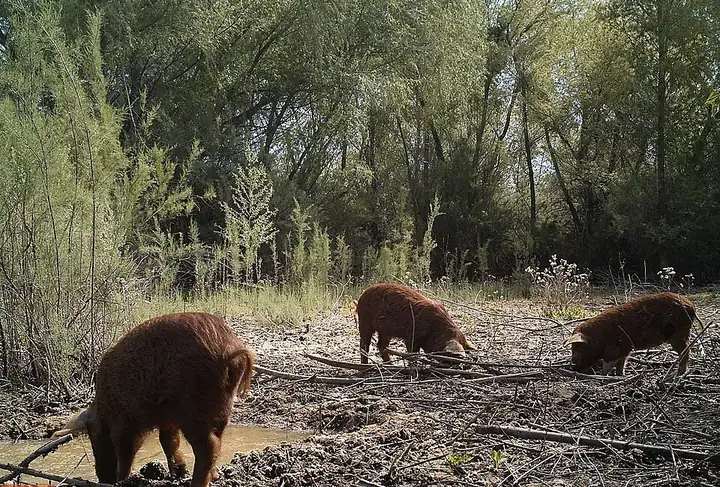
Feral hogs (wild pigs)
Sus scrofa: feral swine descended from escaped or released domestic pigs, Eurasian wild boar and their crosses
| Type | Animal |
|---|---|
| When | Year-round. |
| Pressure by region | High pressure: South Central, California, Hawaii |
About
Invasive wild pigs weighing about 75 to 250 pounds, now living in more than 30 states, with about 6 million animals nationwide. They root up lawns, gardens and crops, and their damage in the United States costs at least $3.4 billion a year.
Spotting it
Damage
Large patches of torn-up turf and overturned soil where pigs dig with their snouts, muddy wallows in wet spots in warm months, mud rubs on trees and posts, hoof tracks near water, and scat that looks like dog droppings.
How to find it early
Check in the morning for freshly rooted ground, especially near springs, ponds, creeks and woods.
When
Year-round.
Life cycle
Females usually first breed at 6 to 10 months old. A sow can have 2 litters of 4 to 12 piglets every 12 to 15 months, and sows and their young travel together in family groups called sounders.
What to do, gentlest first
Start at the top. Sprays are a last step; always read and follow the product label.
Strong fencing Barrier
Hog panel (cattle panel) fence on steel T-posts was the most effective barrier in Texas tests. Electric fence cut pig crossings by about half; a Hawaii guide suggests strands at 8, 18 and 28 inches, 12.5-gauge galvanized wire, and a charger of at least 5,000 volts.
Electric fences are not 100 percent effective. Post signs so children and visitors know the fence is live.
Get expert help; rules apply Trap
Trapping works, but handling and disposing of pigs is the hard part, so most gardeners should call USDA Wildlife Services (1-866-4-USDA-WS), their state wildlife agency or the county Extension office. Never move live pigs to a new area. Georgia requires a Department of Agriculture permit to trap and transport live hogs, moving them is illegal in Texas, and in California you need a depredation permit from the Department of Fish and Wildlife or must report a pig taken while damaging property by the next working day.
Wild pigs can carry at least 30 diseases, and UC IPM says 20 of them can spread to people. Never handle a wild pig, live or dead, with bare hands. Trapping and relocating wildlife is regulated by state law, and the rules differ from state to state. Check with your state wildlife agency or your county Extension office before you set a trap.
No repellents or poisons Repellent
UC IPM reports no effective repellents and no toxicants registered for wild pigs anywhere in the United States, and this guide does not recommend poisons.
Pressure by region
USDA says about 6 million feral swine live in more than 31 states, and 12 states have wiped them out since 2014. Texas has an estimated 2.6 million, in every county but El Paso as of 2019; California has them in 56 of its 58 counties; and in Hawaii they are a serious problem on vegetable farms. Georgia also has feral swine (UGA Extension). Other ratings are estimates, so check USDA's current map for your state. Alaska is rated absent: pigs released on Marmot Island in 1984 were gone by 1998 (University of Alaska Fairbanks). Report pigs in a new area to USDA Wildlife Services at 1-866-4-USDA-WS, or to your state department of agriculture or wildlife agency.
| Northeast | Low |
|---|---|
| Southeast | Moderate |
| South Central | High pressure |
| Midwest | Low |
| Great Plains | Low |
| Mountain West | Low |
| Southwest | Low |
| Pacific Northwest | Low |
| California | High pressure |
| Alaska | Not found here |
| Hawaii | High pressure |
Ratings come from extension sources where available; some are estimates, as noted above.
Sources
- aphis.usda.gov
- aphis.usda.gov
- ipm.ucanr.edu
- tpwd.texas.gov
- nri.tamu.edu
- site.extension.uga.edu
- wildlife.ca.gov
- wildlife.ca.gov
- gms.ctahr.hawaii.edu
- uaf.edu
Photo: Photo: U.S. Department of Agriculture, Public domain (USDA), via Wikimedia Commons. Photo resized for the web.

Planting dates and advice are general guidance; check with your local Cooperative Extension office for your area.