
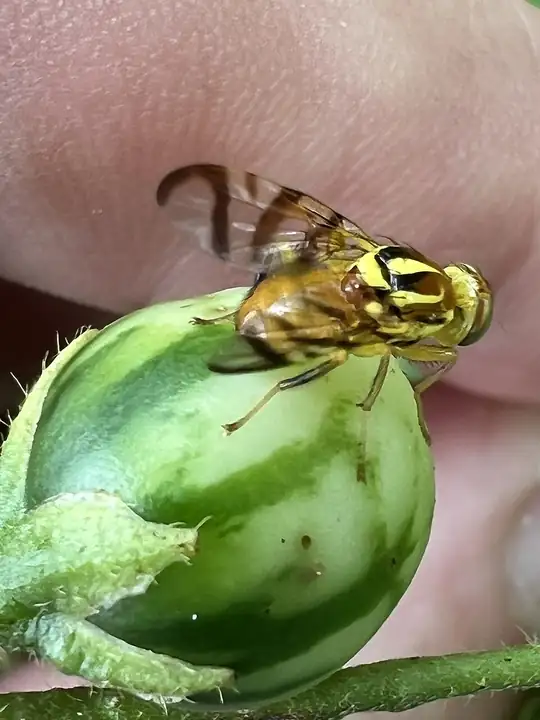
Pepper maggot
Zonosemata electa
| Type | Insect |
|---|---|
| When | Mid to late summer. |
| Pressure by region | Moderate: Northeast, Southeast |
About
The larva of a bright yellow fly with green eyes and brown bands on its wings. A single maggot can ruin a whole pepper, and cherry and bell peppers are its favorites.
Spotting it
Damage
Females leave tiny puncture marks in young fruit that become shallow dimples as the pepper grows. Infested peppers turn red early, soften and rot from the inside.
How to find it early
In midsummer, check young peppers (about half an inch to an inch across) for pinprick egg punctures, and cut open any that ripen or soften too early.
When
Mid to late summer.
Life cycle
There is one generation a year. Pupae spend the winter 2 to 4 inches deep in the soil, and flies come out from about June to August and lay eggs under the skin of young peppers.
What to do, gentlest first
Start at the top. Sprays are a last step; always read and follow the product label.
Clean up and remove wild hosts Prevent
Pick up and destroy fallen or rotting peppers, and pull horsenettle, the fly's original wild host, from around the garden.
Grow less-favored types Prevent
The Connecticut Agricultural Experiment Station reports that cayenne and jalapeño types show resistance.
Netting Barrier
Cover pepper plants with netting while flies are laying eggs to keep them off the fruit.
Trap plants and baited traps Trap
Plant a few hot cherry peppers around the edge as indicator or trap plants, and use ammonia-baited traps to tell when flies are active.
Time sprays to the flies Conventional spray
NC State says insecticides are the only reliable control on farms. Spray only after flies show up on traps, and repeat weekly while they are active (Virginia Tech).
Many insecticides are toxic to bees. Keep sprays off open flowers and follow the label and pre-harvest interval.
Plants it goes after
Pressure by region
It lives in the eastern U.S., from Massachusetts to Florida and west to Indiana, Oklahoma and Texas (NC State). No regional severity source was found, so the moderate and low ratings are estimates; regions west of that range are rated low, not absent.
| Northeast | Moderate |
|---|---|
| Southeast | Moderate |
| South Central | Low |
| Midwest | Low |
| Great Plains | Low |
| Mountain West | Low |
| Southwest | Low |
| Pacific Northwest | Low |
| California | Low |
| Alaska | Low |
| Hawaii | Low |
Ratings come from extension sources where available; some are estimates, as noted above.
Sources
Photo: Photo: Mark Richman, CC BY 4.0, via Wikimedia Commons (CC BY 4.0). Photo resized for the web.

Planting dates and advice are general guidance; check with your local Cooperative Extension office for your area.