
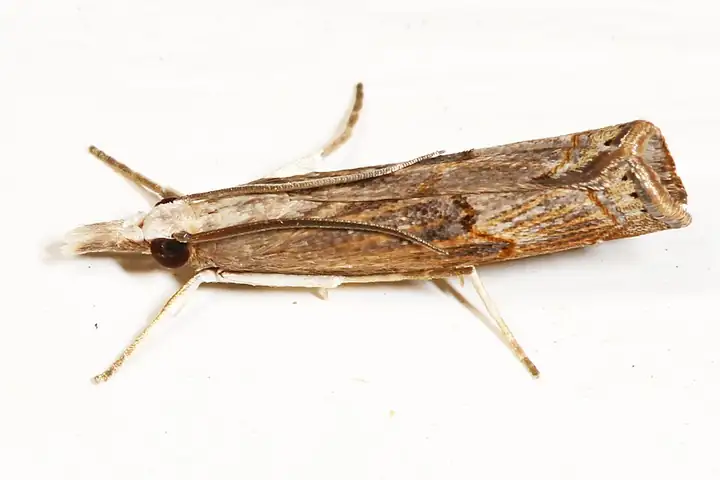
Sod webworms (lawn moths)
Several lawn moth species (Crambus, Parapediasia, Pediasia and related genera) in cool-season lawns; tropical sod webworm (Herpetogramma phaeopteralis) in southern warm-season lawns
| Type | Insect |
|---|---|
| Pressure by region | Moderate: Northeast, Southeast, South Central, California, Hawaii |
About
Caterpillars of small, snouted, tan moths that flutter in zigzags low over the lawn at dusk. The larvae hide by day in silk-lined tunnels in the thatch and come out at night to chew grass blades (Penn State, UMN).
Spotting it
Damage
Small, ragged brown patches, from quarter-size to baseball-size, where blades are clipped off near the crown; they grow and merge in hot, dry weather (Penn State, UMN). Look for green droppings in the thatch and pencil-size holes where birds have probed. Dog urine spots, by contrast, have a dark green ring and no clipped grass (Penn State).
How to find it early
Mix 2 tablespoons of dish soap in 2 gallons of water and sprinkle it over a square yard at the edge of damage; larvae wriggle to the surface. Penn State says 10 to 15 larvae per square yard may call for treatment, while UMN would tolerate up to 12 per square foot. Dew-covered webs at dawn are another sign (Penn State, UMN).
When
Early summer through fall; worst in July and August in the North and in fall in Florida.
Life cycle
Larvae spend winter in their silk tunnels, finish feeding in spring and pupate; moths lay eggs in early summer, and a second generation follows in late summer, two a year in Minnesota (Penn State, UMN). The tropical sod webworm has three or four generations a year in South Florida and is worst in fall (UF/IFAS).
What to do, gentlest first
Start at the top. Sprays are a last step; always read and follow the product label.
Tougher grass and good care Prevent
Endophyte-enhanced tall fescue, fine fescue and perennial ryegrass resist webworms (Penn State, UC IPM). Mow above 2 1/2 inches, don't overfeed (too much fertilizer is a leading cause of tropical sod webworm outbreaks), and keep thatch down (UC IPM, UF/IFAS).
Nematodes or Bt Natural enemies
Water in Steinernema carpocapsae nematodes, or use a Bt (Bacillus thuringiensis kurstaki) product labeled for sod webworms while the larvae are young (UC IPM, Penn State).
Bt works poorly on big larvae and breaks down in sunlight; don't water for 2 days after a Bt treatment (UC IPM). Nematodes need warm, moist soil and a fresh product, so check the expiration date and water them in (Penn State, UC IPM).
Spinosad or azadirachtin Organic spray
Spinosad and azadirachtin are among the lower-impact choices on UC IPM's list. Apply in late afternoon or early evening, when larvae are active (Penn State).
Spinosad is toxic to bees (UC IPM), so keep it off blooming clover and weeds. Follow the label.
Spot-treat only at threshold Conventional spray
If counts are high, spot-treat the patches with a labeled lawn insecticide such as chlorantraniliprole. Water the lawn before treating, then hold off mowing and watering for at least a day (UC IPM, UMN).
Carbaryl and pyrethroids such as bifenthrin are highly toxic to bees (PNW 591), and carbaryl needs a permit in California (UC IPM). Switch product types if you must treat again, to slow resistance (UC IPM). Follow the label.
Pressure by region
UMN says larval damage is uncommon in Minnesota even though the moths are common. The tropical sod webworm is recorded in Florida, Georgia, Alabama, Mississippi, Louisiana, Texas and Hawaii (UF/IFAS), and California has its own lawn moths (UC IPM). Ratings are estimates.
| Northeast | Moderate |
|---|---|
| Southeast | Moderate |
| South Central | Moderate |
| Midwest | Low |
| Great Plains | Low |
| Mountain West | Low |
| Southwest | Low |
| Pacific Northwest | Low |
| California | Moderate |
| Alaska | Low |
| Hawaii | Moderate |
Ratings come from extension sources where available; some are estimates, as noted above.
Sources
Photo: Photo: Judy Gallagher / Wikimedia Commons, CC BY 2.0 (CC BY 2.0). Photo resized for the web.

Planting dates and advice are general guidance; check with your local Cooperative Extension office for your area.