
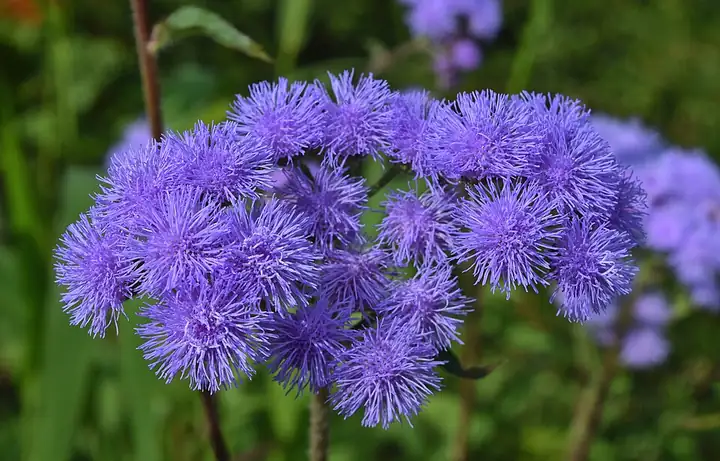
Ageratum (floss flower)
Ageratum houstonianum · Aster family (Asteraceae)
| Hardiness zones | 2 to 11 |
|---|---|
| Sun | full sun to part shade |
| Water | moderate |
| Life cycle | annual |
| Frost | Tender: killed by frost |
| Spacing | 6 to 12 inches |
| Days to harvest | 84 to 105 days |
About Ageratum (floss flower)
Ageratum, or floss flower, is a neat, mounding annual from Mexico and Central America with fuzzy, powder-puff flower clusters. It's one of the few annuals with truly blue flowers, and it also comes in lavender, pink and white. Short types edge beds and pots, taller ones make good cut flowers, and butterflies visit it all season. The species reseeds freely, and UF/IFAS lists it as a landscape weed, though not a problem in Florida's natural areas.
Grown as a summer annual in every zone (NC State lists 2-11); frost kills it.
When to plant
Timing is counted from your average last spring frost (and first fall frost). Sow & Tell works out the actual dates for your ZIP code.
- Start seeds indoors: 8 to 10 weeks before the last frost
- Set out plants: up to 2 weeks after the last frost
Days to harvest count from sowing: Wisconsin gives 12-15 weeks to bloom for the tall cultivar 'Blue Horizon'. Start seed indoors 8-10 weeks before the last frost; press it onto the surface without covering, since it needs light to sprout, about 7-21 days at 70-75 F (Wisconsin, Iowa State). Harden off and plant out after frost, 6-12 inches apart (Wisconsin, NC State).
Soil
Rich, moist, well-drained soil with plenty of organic matter; it handles short dry spells (NC State, Wisconsin).
Give it rich, moist, well-drained soil with organic matter (NC State); no source we found gives a feeding schedule, so follow a soil test.
Feeding
Spider mites build up in hot, dry weather, so water during dry spells (Wisconsin).
Harvest
Blooms from late spring until frost (May to October). Old flower heads often turn brown and hang on, so deadhead to keep plants tidy and blooming; tall types can be cut for bouquets or pressed (Wisconsin, NC State, Missouri).
Varieties (17)
| Variety | Type | Days | Notes |
|---|---|---|---|
| Artist series | Bedding | Early, compact, upright mounds 8-10 in tall; Basso Blue, Rose and White. | |
| Blue Mink | Bedding | Powder-blue flowers on 12-14 in plants. | |
| Summer Snow | Bedding | Fluffy white flowers. | |
| Aloha series | Dwarf bedding | 6-8 in tall and 8-12 in wide, in blue and white. | |
| Blue Blazer | Dwarf bedding | More uniform, vigorous and earlier than older open-pollinated types. | |
| Blue Danube | Dwarf bedding | Uniform, early, mid-blue flowers on 6-8 in plants; excellent Phytophthora resistance. | |
| Hawaii series | Dwarf bedding | Under 8 in, in soft pink, royal blue and white; blooms earlier and longer than many. | |
| Monarch Magic | Spreading | Spreading plants 6-12 in tall and 8-16 in wide; very attractive to butterflies. | |
| Blue Horizon | Tall cut-flower | 84 to 105 days | Vigorous triploid hybrid with purplish-blue clusters about 3 in wide on 30 in stems; excellent Phytophthora resistance. |
| Red Flint | Tall cut-flower | Upright, 24 in, with reddish-purple flowers; good cut or dried. | |
| Timeless Mix | Tall cut-flower | 24-30 in, with long-lasting blue, pink, red-purple and white flowers. | |
| White Bouquet | Tall cut-flower | 18-24 in, with snow-white flowers for cutting. | |
| Leilani Blue | |||
| Neptune Blue | |||
| Redtop | Raspberry-red to magenta flowers. | ||
| Summer Stars | |||
| True Blue |
Pests to watch for
Aphids, Whiteflies, Twospotted spider mite
Diseases and problems
Powdery mildew, Phytophthora root rot
In the kitchen
Safety: Not an edible flower. UF/IFAS lists ageratum as toxic to grazing animals, and in a 2022 study goats fed large amounts over several weeks developed liver and kidney damage (Bhatta and others).
Pets: Not listed by the ASPCA (no entry on its toxic plant lists for dogs or cats); UF/IFAS notes it is toxic to grazing animals, so keep pets and livestock from eating it.
Sources
- plants.ces.ncsu.edu
- hort.extension.wisc.edu
- extension.okstate.edu
- yardandgarden.extension.iastate.edu
- mrec.ifas.ufl.edu
- assessment.ifas.ufl.edu
- nepjol.info
- extension.rutgers.edu
- aspca.org
- aspca.org
Photo: Photo: The Cosmonaut / Wikimedia Commons, CC BY-SA 2.5 CA (CC BY-SA 2.5 CA). Photo resized for the web.

Planting dates and advice are general guidance; check with your local Cooperative Extension office for your area.