
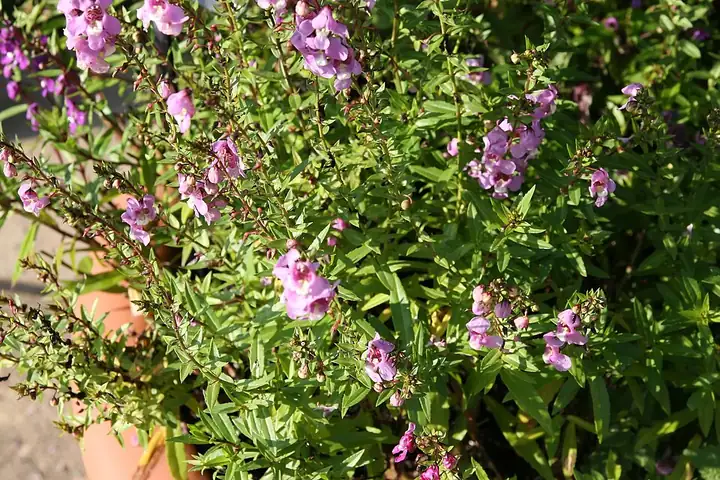
Angelonia (summer snapdragon)
Angelonia angustifolia · Plantain family (Plantaginaceae)
| Hardiness zones | 9 to 11 |
|---|---|
| Sun | full sun |
| Water | low |
| Life cycle | tender perennial (grown as an annual) |
| Frost | Tender: killed by frost |
| Spacing | 8 to 12 inches |
| Days to harvest | 91 to 98 days |
About Angelonia (summer snapdragon)
Angelonia is a heat-loving summer annual with spikes of small, snapdragon-like flowers in purple, blue, pink and white. Unlike true snapdragons it shrugs off hot, humid summers, needs no deadheading, takes dry spells once rooted in, and deer tend to leave it alone (Clemson). The softly scented stems also make long-lasting cut flowers; some people say the leaves smell like grape soda (UF/IFAS).
Grown as a summer annual in most zones; it is hardy only to about zone 9 (NC State, Clemson).
When to plant
Timing is counted from your average last spring frost (and first fall frost). Sow & Tell works out the actual dates for your ZIP code.
- Start seeds indoors: 6 to 8 weeks before the last frost
Days to bloom count from sowing: seed-grown plants take about 13-14 weeks to flower (Clemson). Sow seed 6-8 weeks before the last frost on the surface, since it needs light; it sprouts in 7-14 days (Clemson, UNL). Wait for warm soil before planting out, because it grows very slowly in cool soil (UNL); space 8-12 inches apart so plants hold each other up (Clemson, NC State). For winter, bring pots indoors to the sunniest, warmest spot, or dig root divisions in late summer to keep indoors until spring (Clemson).
Soil
Moist, fertile, well-drained soil; organic matter and mulch help it ride out drought, and it sulks in heavy, compacted clay (NC State, UF/IFAS, Mississippi State).
Work organic matter into well-drained soil; avoid compacted clay, or grow it in containers (UF/IFAS, Mississippi State).
Feeding
- Through summer, about monthly to every 2 months: light feeding of a fertilizer such as 10-5-10, or slow-release landscape fertilizer. UF/IFAS suggests a light monthly feeding; Clemson suggests slow-release fertilizer every 2 months, with liquid feeding only as needed.
Overfeeding gives more leaves and fewer flowers (UF/IFAS). Water well until established, then let the soil dry briefly between waterings (Clemson, UNL).
Harvest
Blooms from early summer until frost. No deadheading is needed (UNL); if plants slow down in midsummer, shear them back by about half and they rebloom in 2-3 weeks (Clemson).
Varieties (15)
| Variety | Type | Days | Notes |
|---|---|---|---|
| Alba | Angelonia (A. angustifolia) | White flowers on upright stems. | |
| Alonia series | Angelonia (A. angustifolia) | ||
| Angel Wing series | Angelonia (A. angustifolia) | ||
| AngelDance series | Angelonia (A. angustifolia) | Taller and more vigorous, 14-18 in, with fuchsia or violet bicolor flowers. | |
| Angelface series | Angelonia (A. angustifolia) | 18-30 in tall, sold in standard, super and cascading forms; 'Angelface Blue' did well in Florida field tests. | |
| AngelMist series | Angelonia (A. angustifolia) | Includes low, spreading types 4-10 in tall for groundcover and hanging baskets; 'Spreading Dark Purple' blooms late spring to frost. | |
| Archangel series | Angelonia (A. angustifolia) | 12-14 in tall; stands extreme heat and humidity; 'Archangel Blue' and 'Archangel Pink' resist Phytophthora very well. | |
| Blue Pacifica | Angelonia (A. angustifolia) | White-and-blue flowers. | |
| Carita series | Angelonia (A. angustifolia) | Patented series; 'Carita Raspberry' did well in Athens, Georgia trials. | |
| Hilo Princess | Angelonia (A. angustifolia) | ||
| Night Sky | Angelonia (A. angustifolia) | ||
| Pandiana | Angelonia (A. angustifolia) | Pink flowers over silvery leaves. | |
| Serena series | Angelonia (A. angustifolia) | Seed-grown, tough and water-wise; 10-20 in tall in blue, pink, violet and white. | |
| Serenita Lavender Pink | Angelonia (A. angustifolia) | Compact with lavender-pink flowers. | |
| Serenita series | Angelonia (A. angustifolia) | A more compact, dwarf version of Serena with deeper colors; heat and drought tolerant. |
Pests to watch for
Aphids
Diseases and problems
Powdery mildew, Phytophthora root and stem rot
In the kitchen
Pets: Not listed by the ASPCA (no entry for angelonia).
Sources
- plants.ces.ncsu.edu
- hgic.clemson.edu
- hgic.clemson.edu
- lancaster.unl.edu
- gardeningsolutions.ifas.ufl.edu
- blogs.ifas.ufl.edu
- extension.msstate.edu
- apps.lsuagcenter.com
- aspca.org
Photo: Photo: David J. Stang / Wikimedia Commons, CC BY-SA 4.0 (CC BY-SA 4.0). Photo resized for the web.

Planting dates and advice are general guidance; check with your local Cooperative Extension office for your area.