
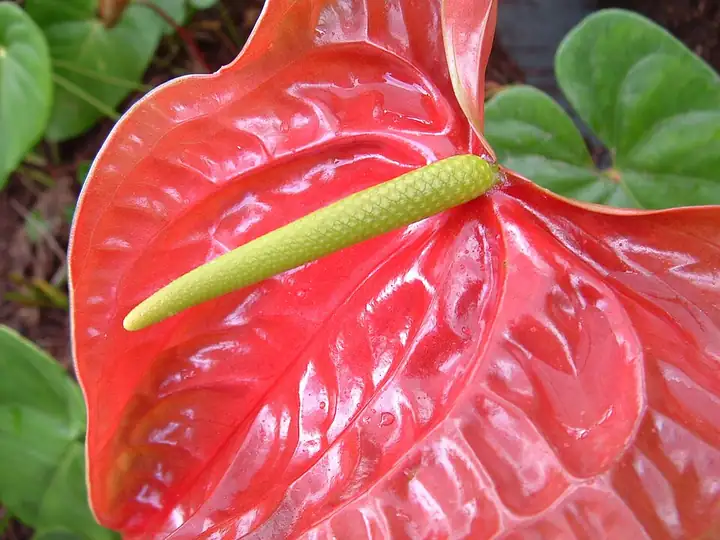
Anthurium (flamingo flower)
Anthurium andraeanum hybrids (also A. scherzerianum) · Arum family (Araceae)
| Hardiness zones | 11 to 12 |
|---|---|
| Sun | shade |
| Water | moderate |
| Life cycle | perennial |
| Frost | Tender: killed by frost |
About Anthurium (flamingo flower)
Anthurium is a slow-growing epiphyte from the rainforests of Colombia and Ecuador with glossy heart-shaped leaves and a waxy red, pink, orange or white 'flower' that is really a spathe wrapped around a yellow spadix (NC State). Each spathe lasts about six weeks on the plant and a month in a vase, and a happy plant blooms several times a year in bright indirect light and humid air (UF/IFAS, NC State). Like its aroid cousins it is full of calcium oxalate crystals, so it goes up high, away from pets and toddlers.
Hardy outdoors only in zones 11-12 (NC State); it is grown indoors everywhere and can summer outdoors in deep shade once nights stay above about 65 F, its preferred minimum (NC State); in South Florida it grows in shaded beds year-round (UF/IFAS).
When to plant
Timing is counted from your average last spring frost (and first fall frost). Sow & Tell works out the actual dates for your ZIP code.
Usually bought as a blooming nursery plant; new plants come from division or stem cuttings (NC State).
Growing it indoors
- Light: Bright but indirect light gives the most flowers; direct sun scorches the leaves, and in a dim corner it lives but stops blooming (NC State, Clemson).
- Water: Water thoroughly when the top inch of mix feels dry, let it drain, and never leave it standing in water; overwatering yellows the leaves and rots the roots, so a coarse, chunky mix matters more than any schedule (NC State, Clemson). Water a little less in winter.
- Humidity: NC State gives 60-80 percent as its preference, so set the pot on a tray of moist gravel or group it with other plants, and expect brown leaf edges in dry heated rooms (UF/IFAS).
- Temperature: Happiest at 65-80 F; keep it away from cold drafts, cold glass and sudden temperature swings (NC State).
- Feeding: NC State suggests a dilute liquid fertilizer weekly through the growing season, while Clemson HGIC and Iowa State say it needs very little, a light feeding once or twice in spring and summer; none in winter.
- Repotting: Every 2-3 years in spring, or when roots fill the pot, into a pot one size larger with fresh coarse mix (NC State, Clemson).
Soil
A coarse, fast-draining mix of peat, pine bark and perlite, or half cactus mix and half orchid mix, in a pot with a drainage hole (Clemson, NC State).
Pot in a coarse, fast-draining mix of peat, pine bark and perlite, or half cactus mix and half orchid mix (Clemson, NC State).
Feeding
- Spring and summer, while it is growing and flowering: balanced liquid houseplant fertilizer, diluted. NC State feeds a dilute liquid fertilizer weekly; Clemson and Iowa State say once or twice a season is plenty, and Clemson's author never fed a plant that still bloomed several times a year. Water first.
- Fall and winter: none. Skip feeding while growth slows (Iowa State, MU Extension).
A wet pot does more harm than a lean one; yellow leaves are usually water, not food (NC State).
Harvest
Blooms several times a year in good light, and each spathe lasts about 6 weeks on the plant (UF/IFAS, NC State); cut faded ones off at the base with gloves on.
Varieties (8)
NC State names 6 cultivars and UF/IFAS 2 Florida-bred ones.
| Variety | Type | Days | Notes |
|---|---|---|---|
| Baron | Bicolor spathe | Pink center shading to green edges. | |
| Midori | Green spathe | Green spathe. | |
| Orange Hot | Orange spathe | A compact Florida foliage-industry release with orange spathes. | |
| Cheers | Pink spathe | Pink spathe. | |
| Florida | Red spathe | Bright red spathe with a spadix that matures to yellow. | |
| Red Hot | Red spathe | A compact Florida foliage-industry release with red spathes. | |
| Rosee Choco | Red spathe | Deep red, almost chocolate-red spathe. | |
| Acropolis | White spathe | Pure white spathe. |
Pests to watch for
Aphids, Twospotted spider mite, Mealybugs, Scale insects
Diseases and problems
Root and crown rot, Leaf spot
In the kitchen
Safety: Every part contains calcium oxalate crystals (NC State, low severity): chewing it causes drooling, mouth pain and swelling of the lips and tongue, trouble swallowing and vomiting, and the sap stings skin and eyes. Wear gloves to cut it and keep it out of reach of small children.
Pets: Toxic to dogs, cats and horses (ASPCA, listed as flamingo flower, Anthurium scherzeranum): insoluble calcium oxalates cause oral irritation, burning and swelling of the mouth, tongue and lips, heavy drooling, trouble swallowing and vomiting (not reported in horses).
Sources
- plants.ces.ncsu.edu
- hgic.clemson.edu
- gardeningsolutions.ifas.ufl.edu
- yardandgarden.extension.iastate.edu
- aspca.org
- extension.missouri.edu
Photo: Photo: ImagePerson, CC BY 4.0, via Wikimedia Commons (CC BY 4.0). Photo resized for the web.

Planting dates and advice are general guidance; check with your local Cooperative Extension office for your area.