
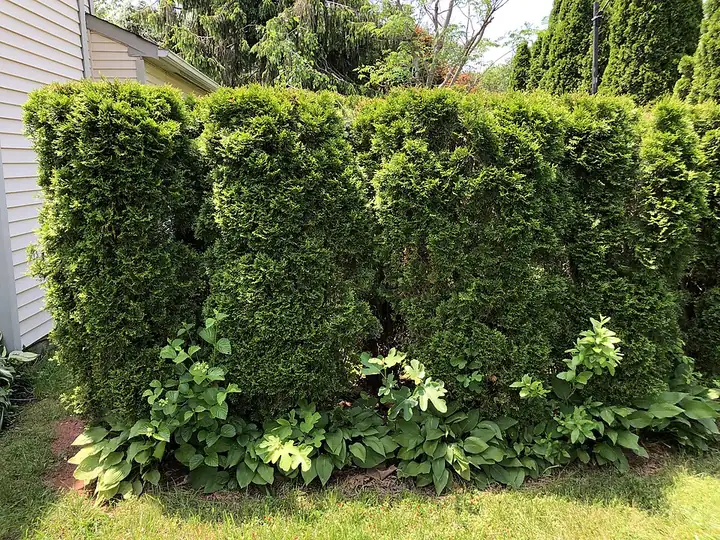
Arborvitae
Thuja occidentalis (American or eastern arborvitae) and the hybrid 'Green Giant' (T. standishii x T. plicata) · Cypress family (Cupressaceae)
| Hardiness zones | 3 to 8 |
|---|---|
| Sun | full sun to part shade |
| Water | moderate |
| Life cycle | perennial |
| Frost | Hardy: takes frost |
About Arborvitae
Arborvitae are evergreen conifers with flat sprays of scale-like leaves, planted for hedges, screens and windbreaks. American arborvitae is native to eastern Canada and the northeastern and north-central US; narrow cultivars like 'Emerald Green' stay 10-15 ft tall, while the hybrid 'Green Giant' grows fast to 40-60 ft (Morton Arboretum, NC State). Deer browse American arborvitae heavily.
American arborvitae is hardy in zones 3-7 and 'Green Giant' in 5-8 (NC State). Dry, windy, exposed sites cause yellow-brown winter burn.
When to plant
Timing is counted from your average last spring frost (and first fall frost). Sow & Tell works out the actual dates for your ZIP code.
Water new plants deeply and often until the roots spread (UMN). Give each plant room for its mature width; heavy snow and ice can bend or break upright stems (NC State).
Soil
Moist, well-drained loam, neutral to alkaline; it dislikes dry, windy sites, and full shade makes the foliage thin out (NC State, Morton Arboretum).
Test the soil before planting; mature shrubs in decent soil need little or no fertilizer (Clemson).
Feeding
- Spring to early summer after new growth starts, only if a soil test shows a need: slow-release complete fertilizer in a 3:1:2 ratio, or what the soil test calls for. Spread evenly from the trunk out to the drip line and water it in; a typical soil-test rate for shrubs is about 2 lb of 12-6-6 per 100 sq ft (Clemson). Follow a soil test.
Water is what new shrubs need most: daily for the first 2 weeks, every 2-3 days through week 12, then weekly until the roots spread (at least two growing seasons), using about a quarter to a third of the nursery pot's volume each time (UMN). Give new arborvitae extra water during establishment and mulch the roots (Morton Arboretum); dry, windy sites cause winter burn (NC State).
Varieties (15)
| Variety | Type | Days | Notes |
|---|---|---|---|
| Brandon | American arborvitae | Narrow, 12-15 ft tall; foliage resists winter burn. | |
| Fire Chief ('Congabe') | American arborvitae | Globe about 4 ft with red-tipped foliage. | |
| Golden Globe | American arborvitae | Compact ball with yellow-green foliage. | |
| Hetz' Midget | American arborvitae | Dwarf globe 3-4 ft. | |
| Hetz' Wintergreen | American arborvitae | Narrow column 20-30 ft tall with a central leader. | |
| Holmstrup | American arborvitae | Upright, 6-8 ft tall and 2-3 ft wide; keeps green winter color; deer resistant per Morton. | |
| Little Gem | American arborvitae | Dwarf, flattened globe about 3 ft tall. | |
| Nigra | American arborvitae | Narrow pyramid 25-30 ft tall; dark green winter foliage. | |
| North Pole ('Art Boe') | American arborvitae | Narrow, upright, 12-15 ft tall and 3-5 ft wide. | |
| Pyramidalis | American arborvitae | 20-30 ft tall; needs moist soil and wind shelter. | |
| Rheingold | American arborvitae | Golden-yellow summer foliage turning coppery in winter. | |
| Techny | American arborvitae | Broad pyramid 10-15 ft tall and 6-10 ft wide; dark green in winter; extremely cold hardy. | |
| Woodwardii | American arborvitae | Rounded, 3-6 ft; tolerates light shade and wet sites. | |
| Emerald Green ('Smaragd') | American arborvitae (T. occidentalis) | Narrow pyramid 10-15 ft tall and 3-4 ft wide; keeps green winter color; tolerates heat, cold and wet sites. | |
| Green Giant | Hybrid (T. standishii x T. plicata) | Fast, 3-4 ft a year in good conditions, to 40-60 ft tall and 12-18 ft wide; deer resistant; a common substitute for Leyland cypress. |
Pests to watch for
Bagworm, Arborvitae leafminer, Twospotted spider mite, Scale insects, Mealybugs, Deer, Spruce spider mite
Diseases and problems
Canker, Root rot, Winter injury, Drought stress, Dog urine damage, Normal needle drop
In the kitchen
Safety: NC State gives no poison rating for American arborvitae; it does list 'Green Giant' as a problem for horses.
Pets: Not on the ASPCA toxic plant lists. NC State flags 'Green Giant' as a problem for horses.
Sources
- plants.ces.ncsu.edu
- plants.ces.ncsu.edu
- mortonarb.org
- extension.umn.edu
- aspca.org
- aspca.org
- extension.rutgers.edu
- hgic.clemson.edu
Photo: Photo: Famartin / Wikimedia Commons, CC BY-SA 4.0 (CC BY-SA 4.0). Photo resized for the web.

Planting dates and advice are general guidance; check with your local Cooperative Extension office for your area.