
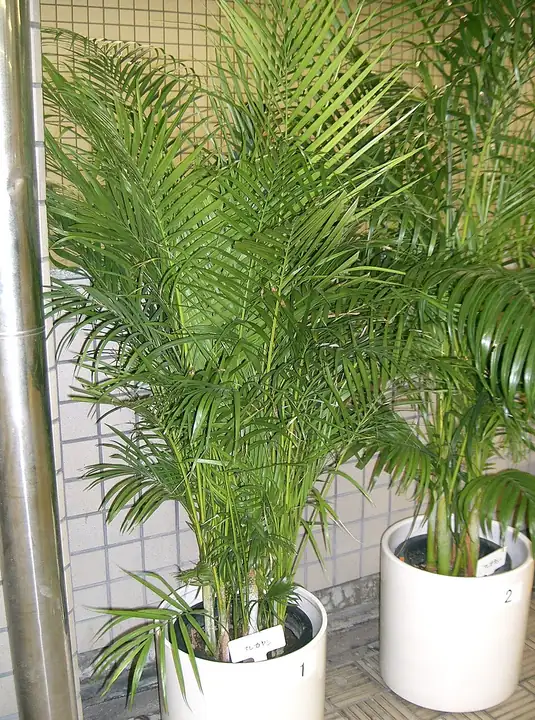
Areca palm
Dypsis lutescens (also sold as Chrysalidocarpus lutescens; butterfly palm, golden cane palm) · Palm family (Arecaceae)
| Hardiness zones | 10 to 11 |
|---|---|
| Sun | part shade |
| Water | moderate |
| Life cycle | perennial |
| Frost | Tender: killed by frost |
About Areca palm
The areca palm is a clustering palm from Madagascar with yellow-green, bamboo-like ringed canes and feathery arching fronds of 40-60 leaflet pairs (NC State). Indoors it makes a soft, full screen 6-7 ft tall, growing 6-10 in a year, and it is one of the few popular palms the ASPCA lists as safe for cats and dogs (Clemson, ASPCA). It needs bright indirect light and humid air, and dry rooms invite its one serious enemy, spider mites.
Hardy outdoors only in zones 10-11 (NC State); it is grown indoors everywhere and can summer outdoors in part shade once nights stay above about 60 F.
When to plant
Timing is counted from your average last spring frost (and first fall frost). Sow & Tell works out the actual dates for your ZIP code.
Almost always bought as a nursery plant grown from seed; a big clump can be divided (NC State, Clemson).
Growing it indoors
- Light: Bright indirect light near an east, west or south window suits it; outdoors it prefers part shade (Clemson, NC State), and MU Extension's rule for palms is no direct sun indoors.
- Water: Keep the mix moist but never soggy during the growing season: water thoroughly when the surface dries, let the pot drain and empty the saucer (Clemson, NC State). Never let it dry out completely or sit in water, and water a little less in winter when growth slows.
- Humidity: It prefers high humidity; below 50 percent, set the pot on a tray of wet gravel, run a humidifier or mist weekly, since dry air browns the leaf tips and invites spider mites (Clemson, NC State).
- Temperature: Ideal is 65-70 F nights and 75-85 F days; palms need to stay above 45 F to avoid chilling injury, which shows as reddish-brown dead patches, so keep it away from drafts and cold glass (Clemson).
- Feeding: Feed a slow-release palm fertilizer with micronutrients, such as 12-4-12 or 8-2-12, only two or three times a year in spring and summer; too much fertilizer harms palms and browns the leaf tips (Clemson).
- Repotting: Repot every two to three years in spring or early summer, only when the roots fill the pot, handling the brittle roots gently and moving up one pot size (Clemson, NC State).
Soil
A porous, well-drained potting mix high in organic matter that holds moisture without staying soggy (NC State, Clemson).
Pot in a porous, well-drained potting mix with plenty of organic matter in a container with a drainage hole (Clemson, NC State).
Feeding
- Spring and summer, while new fronds are coming: slow-release palm fertilizer with micronutrients, such as 12-4-12 or 8-2-12. Clemson applies it only two or three times a year during spring and summer growth, at the label rate, watering first.
- Fall and winter: none. Skip feeding while growth has slowed (Clemson, MU Extension).
Overfeeding is the usual mistake with palms and shows up as brown leaf tips; never use leaf-shine products on the fronds (Clemson).
Pests to watch for
Twospotted spider mite, Scale insects, Mealybugs, Whiteflies
Diseases and problems
Root and crown rot
In the kitchen
Safety: The leaves and canes are not a poisoning risk, but the growing tip (heart of palm) contains cyanogenic glycosides that can cause nausea and vomiting, so don't eat it (NC State, low severity). It does not irritate skin.
Pets: Non-toxic to dogs, cats and horses (ASPCA).
Sources
Photo: Photo: KENPEI, CC BY-SA 3.0, via Wikimedia Commons (CC BY-SA 3.0). Photo resized for the web.

Planting dates and advice are general guidance; check with your local Cooperative Extension office for your area.