
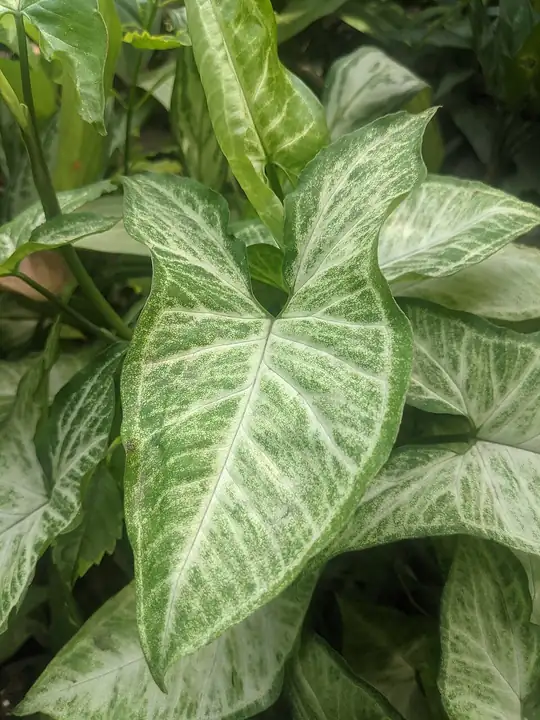
Arrowhead vine (syngonium)
Syngonium podophyllum (sold as nephthytis) · Arum family (Araceae)
| Hardiness zones | 10 to 12 |
|---|---|
| Sun | part shade |
| Water | moderate |
| Life cycle | perennial |
| Frost | Tender: killed by frost |
About Arrowhead vine (syngonium)
Arrowhead vine is a tropical climber from Mexico to South America whose young leaves are arrow- or heart-shaped, often marked with silver, cream or pink, and change with age into big leaves split into 5-11 fingers (NC State). Young plants stay bushy, then send out climbing stems; cut those off to keep it compact, or give it a pole to climb (NC State, Illinois Extension). Outdoors in central and south Florida it escapes into woods and is listed as a Category I invasive, so keep it in a pot there (UF/IFAS, FLEPPC).
Hardy outdoors only in zones 10-12 (NC State), and invasive in Florida; it is grown indoors everywhere and can summer outdoors in shade in its pot once nights stay above about 65 F (MU Extension).
When to plant
Timing is counted from your average last spring frost (and first fall frost). Sow & Tell works out the actual dates for your ZIP code.
Usually bought as a nursery plant or started from a stem cutting; division and layering also work (NC State, Illinois Extension).
Growing it indoors
- Light: Bright indirect light is best (Illinois Extension); it takes dappled light or part shade, but direct hot sun burns or bleaches the leaves (NC State).
- Water: Keep the mix barely moist, watering again when the top of it starts to dry (Illinois Extension; MU Extension lists it as evenly moist). Water until it drains, empty the saucer after an hour, and give a little less in winter when growth slows (MU Extension).
- Humidity: NC State says it thrives in high humidity while Illinois Extension says it copes with drier air; a pebble tray in winter does no harm (MU Extension).
- Temperature: It likes warm rooms; MU Extension gives 65 F as its night temperature, so keep it off cold winter glass and out of drafts.
- Feeding: Feed a complete houseplant fertilizer at label strength about once a month while it is putting out new leaves, and skip feeding in winter when growth stops (MU Extension).
- Repotting: Repot every few years, when roots fill the pot; NC State says you can trim the roots then to keep the plant a manageable size.
Soil
A regular well-drained houseplant potting mix kept lightly moist (Illinois Extension, NC State).
Pot in a regular well-drained houseplant mix in a pot with a drainage hole, with a pole or totem if you want it to climb (Illinois Extension, NC State).
Feeding
- Spring through summer, while new leaves are coming: complete houseplant fertilizer. About once a month at the strength on the label, watering first (MU Extension).
- Winter: none. Skip feeding while no new growth shows (MU Extension).
Don't feed a newly bought plant for its first few weeks, and don't overfeed, which burns roots (MU Extension).
Varieties (4)
NC State Extension names 4 cultivars.
| Variety | Type | Days | Notes |
|---|---|---|---|
| Painted Arrow | Cream variegated | Creamy green leaves splattered with light green. | |
| Milk Confetti | Pink and white | Leaves in shades of pink, white and mint green. | |
| Bold Allusion | Pink-veined | Creamy green leaves with pink veins; slow growing. | |
| Three Kings | White variegated | Each leaf is different, marked with deep green, light green and white. |
Pests to watch for
Aphids, Mealybugs, Twospotted spider mite, Thrips
Diseases and problems
Bacterial leaf spot, Soft rot
In the kitchen
Safety: Medium-severity poison (NC State): every part holds needle-like calcium oxalate crystals, so chewing it causes pain and swelling of the mouth, tongue and lips, drooling and trouble swallowing, and the sap can give a skin rash. Wear gloves when pruning and keep it away from small children.
Pets: Toxic to dogs, cats and horses (ASPCA, listed as arrow-head vine and nephthytis): insoluble calcium oxalates cause mouth pain and swelling, heavy drooling, trouble swallowing and vomiting (no vomiting in horses).
Sources
- plants.ces.ncsu.edu
- extension.illinois.edu
- extension.missouri.edu
- aspca.org
- gardeningsolutions.ifas.ufl.edu
- assessment.ifas.ufl.edu
- plant-directory.ifas.ufl.edu
Photo: Photo: Stephanie cheks, CC BY-SA 4.0, via Wikimedia Commons (CC BY-SA 4.0). Photo resized for the web.

Planting dates and advice are general guidance; check with your local Cooperative Extension office for your area.