
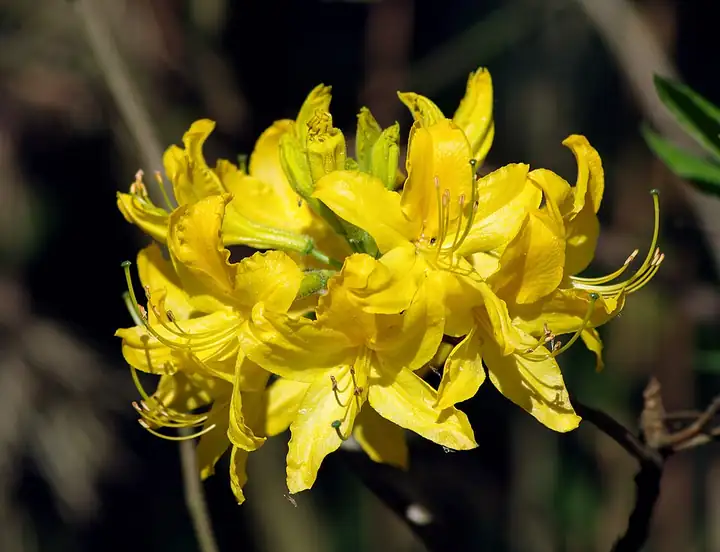
Azalea
Rhododendron species and hybrids (evergreen azaleas and deciduous native azaleas) · Heath family (Ericaceae)
| Hardiness zones | 3 to 9 |
|---|---|
| Sun | part shade |
| Water | moderate |
| Life cycle | perennial |
| Frost | Hardy: takes frost |
| Soil pH | 4.5–6.0 |
About Azalea
Azaleas are acid-loving shrubs in the rhododendron genus that cover themselves in funnel-shaped flowers in spring. Evergreen azaleas (Southern Indica, Kurume, Satsuki, Glenn Dale and the reblooming Encore series) are Southern favorites, while deciduous native azaleas such as flame, Florida, pinxterbloom and plumleaf azalea feed hummingbirds, butterflies and bees. All parts are poisonous.
NC State lists azaleas and rhododendrons for zones 4-8; Florida and plumleaf azaleas grow to zone 9, and the University of Minnesota's Northern Lights azaleas have flower buds hardy to about -30 to -45 F.
When to plant
Timing is counted from your average last spring frost (and first fall frost). Sow & Tell works out the actual dates for your ZIP code.
Filtered shade, like under pines, suits them best; too much sun invites lace bugs (Clemson). Water new plants deeply, 6-8 inches down, in dry spells, and keep 2-3 inches of pine straw or bark mulch a couple of inches from the stems (Clemson).
Soil
Acid, well-drained soil rich in organic matter; roots are shallow and rot in wet ground, and high pH causes yellow leaves with green veins (Clemson). Native azaleas dislike dense clay (NC State).
Plant in acid (pH 4.5-6.0), well-drained soil rich in organic matter; set plants high rather than deep, since the shallow roots rot in wet soil (Clemson).
Feeding
- Late spring to early summer, after new growth appears: acid-forming azalea fertilizer with about a 2-1-1 ratio (for example 10-5-4), slow-release. Clemson: about 1 lb of actual nitrogen per 1,000 sq ft (up to 2 lb with slow-release products), spread over the root zone and watered in; follow a soil test.
Never fertilize in late fall; it delays dormancy and invites cold injury (Clemson). Yellow leaves with green veins usually mean the pH is too high.
Harvest
Azaleas bloom from early spring to midsummer depending on the kind; plumleaf azalea blooms in late summer and Encore azaleas bloom in spring and again in fall. Prune just after flowering in spring so you don't cut off next year's buds (Clemson, NC State).
Varieties (22)
| Variety | Type | Days | Notes |
|---|---|---|---|
| Apricot Surprise | Deciduous hybrid (Univ. of Minnesota) | Light orange, fragrant; 3-4 ft. | |
| Candy Lights | Deciduous hybrid (Univ. of Minnesota) | Light pink, fragrant; 5-6 ft. | |
| Electric Lights Red | Deciduous hybrid (Univ. of Minnesota) | Fiery red; about 4 ft; buds hardy to about -30 F. | |
| Golden Lights | Deciduous hybrid (Univ. of Minnesota) | Golden, fragrant; 4-6 ft. | |
| Lemon Lights | Deciduous hybrid (Univ. of Minnesota) | Lemon yellow; 4-5 ft. | |
| Lilac Lights | Deciduous hybrid (Univ. of Minnesota) | Pinkish purple; 3.5-5 ft. | |
| Mandarin Lights | Deciduous hybrid (Univ. of Minnesota) | Orange; 5-6.5 ft. | |
| Northern Hi-Lights | Deciduous hybrid (Univ. of Minnesota) | Creamy white; 5-6 ft. | |
| Northern Lights | Deciduous hybrid (Univ. of Minnesota) | Pink, fragrant; 4-7 ft. | |
| Orchid Lights | Deciduous hybrid (Univ. of Minnesota) | Orchid; compact, 2-3 ft. | |
| Rosy Lights | Deciduous hybrid (Univ. of Minnesota) | Deep rosy pink; 4-5 ft; flower buds hardy to about -45 F. | |
| Spicy Lights | Deciduous hybrid (Univ. of Minnesota) | Salmon pink; 5-6.5 ft. | |
| White Lights | Deciduous hybrid (Univ. of Minnesota) | White; 5-6 ft. | |
| Glenn Dale hybrids | Evergreen azalea group | ||
| Kurume hybrids | Evergreen azalea group | ||
| Satsuki hybrids | Evergreen azalea group | ||
| Chattooga | Flame azalea (R. calendulaceum), native | ||
| Don's Variegated | Florida azalea (R. austrinum), native | Variegated leaves. | |
| Firecracker | Florida azalea (R. austrinum), native | ||
| Lisa's Gold | Florida azalea (R. austrinum), native | ||
| Encore series | Reblooming evergreen azalea | Blooms twice a year. | |
| Formosa | Southern Indica evergreen azalea |
Pests to watch for
Twospotted spider mite, Aphids, Mealybugs, Scale insects, Thrips, Whiteflies, Sawflies (garden sawflies), Lace bugs (azalea and chrysanthemum lace bugs), Four-lined plant bug, Granulate ambrosia beetle, Foliar nematodes
Diseases and problems
Petal blight, Leaf gall, Phytophthora root rot, Leaf spot, Dieback, Iron chlorosis, Leaf scorch, Black walnut toxicity, Soil pH problems
In the kitchen
Safety: All parts, including the nectar, contain grayanotoxins; NC State rates the risk from small amounts as low, but don't eat any part.
Pets: Toxic to dogs, cats and horses (ASPCA): grayanotoxin can cause vomiting (not in horses), diarrhea, weakness and heart failure.
Sources
- hgic.clemson.edu
- plants.ces.ncsu.edu
- plants.ces.ncsu.edu
- plants.ces.ncsu.edu
- plants.ces.ncsu.edu
- plants.ces.ncsu.edu
- mnhardy.umn.edu
- aspca.org
Photo: Photo: Chrumps, CC BY 3.0, via Wikimedia Commons (CC BY 3.0). Photo resized for the web.

Planting dates and advice are general guidance; check with your local Cooperative Extension office for your area.