
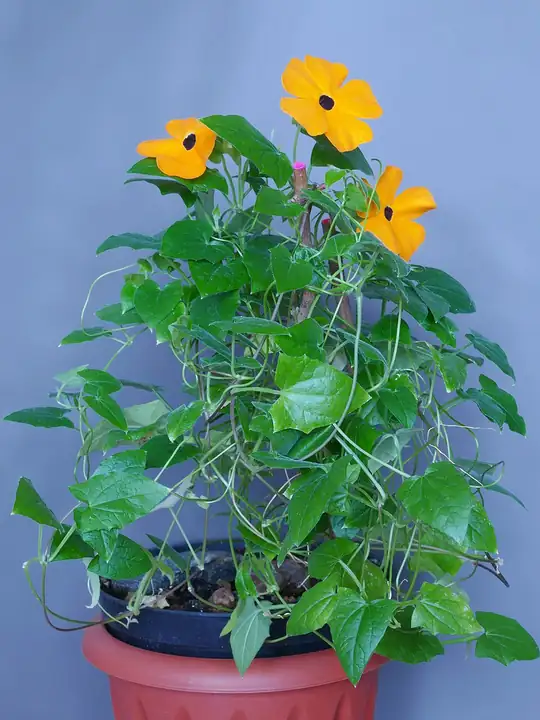
Black-eyed Susan vine
Thunbergia alata · Acanthus family (Acanthaceae)
| Hardiness zones | 9 to 11 |
|---|---|
| Sun | full sun to part shade |
| Water | moderate |
| Life cycle | tender perennial (grown as an annual) |
| Frost | Tender: killed by frost |
| Spacing | 14 to 16 inches |
| Soil temperature to plant | at least 60°F |
About Black-eyed Susan vine
Black-eyed Susan vine is a tender twining vine from tropical East and southern Africa with flat, five-petaled flowers, usually bright orange or yellow with a dark eye, plus white, apricot and pink kinds. It suits trellises, mailboxes, window boxes and hanging baskets, and butterflies, bees and hummingbirds visit it (NC State, Wisconsin). Despite the name it isn't related to the black-eyed Susan daisy (Rudbeckia); it reseeds and has gone wild in frost-free places such as Hawaii.
Hardy only in about zones 9-11 (Wisconsin, NC State); grown as a summer annual elsewhere. Rated high risk for invasiveness in Hawaii (advisory), and it can turn weedy wherever there's no frost.
When to plant
Timing is counted from your average last spring frost (and first fall frost). Sow & Tell works out the actual dates for your ZIP code.
- Start seeds indoors: 6 to 8 weeks before the last frost
- Set out plants: up to 2 weeks after the last frost
- Sow seeds outdoors: up to 2 weeks after the last frost
Soak seed overnight and start indoors 6-8 weeks before the last frost; seeds sprout in 10-21 days. Set plants 14-16 inches apart by a support after frost, once nights stay above 50 F, or sow outdoors when the soil reaches 60 F (transplants do better in short northern summers) (Wisconsin, Iowa State). No sourced count from sowing to bloom. To keep one over winter, bring a potted plant into a sunny, warm room with nights above 60 F (Wisconsin).
Soil
Rich, moist, well-drained soil high in organic matter; it wilts fast when dry (NC State, Arkansas Extension).
Rich, moist, well-drained soil high in organic matter (NC State, Wisconsin).
Feeding
- Container plants, once flowering starts: balanced fertilizer for flowering plants. Feed every 2-3 weeks while in bloom (Wisconsin); follow the label.
Don't let it dry out: it wilts quickly, and spider mites get worse on dry, stressed plants in midsummer (Arkansas Extension).
Harvest
Blooms from June or midsummer until frost, often best in late summer when nights cool (Clemson, Wisconsin, Iowa State). Trim overly long shoots to keep it tidy and push more blooms (Arkansas Extension).
Varieties (15)
| Variety | Type | Days | Notes |
|---|---|---|---|
| A-Peel series | Thunbergia alata | Vigorous, large-flowered vines 5-8 ft; includes Lemon, Orange, Coconut and Tangerine Slice, with rusty orange, yellow-edged, dark-eyed flowers. | |
| African Sunset | Thunbergia alata | Seed mix with apricot, buff, cream and brick-red flowers with dark eyes; vines to about 5 ft. | |
| Amber Eyes | Thunbergia alata | Large amber-yellow flowers with big dark eyes; vines to about 5 ft. | |
| Angel Wings | Thunbergia alata | White flowers with a light scent. | |
| Blushing Susie | Thunbergia alata | Mix of apricot and rose flowers with dark centers. | |
| Bright Eyes | Thunbergia alata | All-white flowers. | |
| Pure White | Thunbergia alata | Pure white flowers. | |
| Raspberry Smoothie | Thunbergia alata | Pale lilac-pink flowers over gray-green leaves. | |
| Spanish Eyes | Thunbergia alata | Muted apricot, terra cotta, salmon, rose and ivory flowers with dark centers. | |
| Superstar Orange | Thunbergia alata | Extra-large bright orange flowers. | |
| Susie Mix | Thunbergia alata | Orange, yellow and white flowers, with or without dark eyes; vines to about 7 ft. | |
| Arizona Glow | Thunbergia alata, Sunny series | Red-orange flowers with dark eyes on vigorous 6-8 ft vines. | |
| Lemon Star | Thunbergia alata, Sunny series | Bright yellow flowers; vines 6-8 ft. | |
| Orange Wonder | Thunbergia alata, Sunny series | Vivid orange flowers with dark eyes; vines 6-8 ft. | |
| Rose Sensation | Thunbergia alata, Sunny series | Rose flowers with dark eyes; vines 6-8 ft. |
Pests to watch for
Twospotted spider mite, Whiteflies, Scale insects
In the kitchen
Pets: Not listed by the ASPCA.
Sources
- plants.ces.ncsu.edu
- hort.extension.wisc.edu
- uaex.uada.edu
- yardandgarden.extension.iastate.edu
- hgic.clemson.edu
- planttalk.colostate.edu
- homegarden-cahnr.media.uconn.edu
- plantpono.org
- aspca.org
- aspca.org
Photo: Photo: Bff / Wikimedia Commons, CC BY-SA 4.0 (CC BY-SA 4.0). Photo resized for the web.

Planting dates and advice are general guidance; check with your local Cooperative Extension office for your area.