
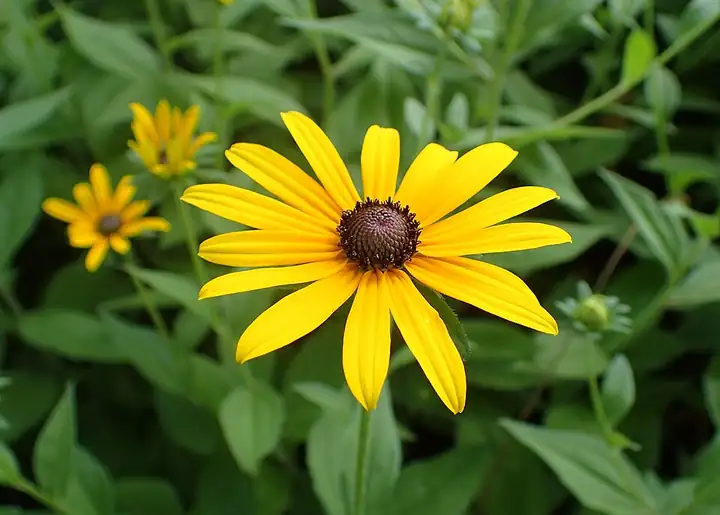
Black-eyed Susan
Rudbeckia hirta · Daisy family (Asteraceae)
| Hardiness zones | 3 to 8 |
|---|---|
| Sun | full sun to part shade |
| Water | low |
| Life cycle | perennial |
| Frost | Hardy: takes frost |
| Spacing | 12 to 36 inches |
About Black-eyed Susan
Black-eyed Susan is a tough native wildflower with golden petals around a dark center cone. It is short-lived but reseeds freely, handles heat and drought, and feeds bees, butterflies and seed-eating birds.
NC State lists zones 3-8. It is a biennial or short-lived perennial that is often treated as an annual (NC State; Clemson).
When to plant
Timing is counted from your average last spring frost (and first fall frost). Sow & Tell works out the actual dates for your ZIP code.
- Set out plants: up to 2 weeks after the last frost
Plant in spring after the final frost; perennial Rudbeckia is best planted in early fall, though mid-April works too (Clemson). It grows easily from seed and often self-sows.
Soil
Evenly moist, well-drained soil, but drought and heat tolerant once established and adaptable to average soils.
Plant in evenly moist, well-drained soil; it adapts to average soil. Follow a soil test.
Feeding
- early to mid-April, when new leaves start to come up: slow-release fertilizer such as 12-6-6. Without a soil test, scatter about 1 lb per 100 sq ft around the plants and water it in.
- September: slow-release fertilizer such as 12-6-6. Give a lighter second feeding of about 1/2 lb per 100 sq ft.
Moderate fertility gives the best flowers; do not plant at the edge of a lawn, where lawn fertilizer adds too much nitrogen.
Harvest
Blooms from late spring into early fall (Clemson). Leave seed heads standing for goldfinches (NC State).
Varieties (12)
Covers Rudbeckia broadly. Descriptions come mainly from NC State's plant pages, which are brief for most R. hirta cultivars. Chicago Botanic Garden's Rudbeckia evaluation could not be read (scanned PDF). Zones for R. hirta cultivars use NC State's species range.
| Variety | Type | Days | Notes |
|---|---|---|---|
| Black-eyed Susan (species) | Black-eyed Susan (R. hirta) | Widespread native wildflower. NC State notes a common roadside form (var. pulcherrima) and a rare sandhills form (var. angustifolia). | |
| Cherry Brandy | Black-eyed Susan (R. hirta) | Cherry-red flowers. | |
| Denver Daisy | Black-eyed Susan (R. hirta) | Yellow petals with a big mahogany-red eye. Placed 2nd in NC State's 2019 annual color trials. | |
| Indian Summer | Black-eyed Susan (R. hirta) | Very large yellow flowers, 6-9 inches across. | |
| Goldsturm | Orange coneflower (R. fulgida var. sullivantii) | Clumping perennial, 18-24 inches, with 3-4 inch golden flowers and dark centers from June to October. Can get leaf spots or powdery mildew in humid, crowded Southern plantings. | |
| Early Bird Gold | Orange coneflower (R. fulgida) | An orange coneflower selection listed by NC State. | |
| Little Goldstar | Orange coneflower (R. fulgida) | Compact orange coneflower with fair resistance to southern blight. | |
| Viette's Little Suzy | Orange coneflower (R. fulgida) | Dwarf, 10-15 inches tall. | |
| Cutleaf coneflower | R. laciniata | Tall plant with drooping yellow petals around greenish centers, late summer into fall. Likes moist soil. | |
| Giant coneflower | R. maxima | Silvery blue-green, cabbage-like leaves and 5-7 ft stalks of drooping yellow flowers with tall dark cones. Seed heads feed goldfinches. | |
| Brown-eyed Susan | R. triloba | Many small 2-3 inch yellow flowers with dark centers, July to October, on 3-5 ft plants. Biennial or short-lived perennial that reseeds freely. | |
| Henry Eilers | Sweet coneflower (R. subtomentosa) | Quilled, tube-shaped yellow petals; 3-5 ft. The species is drought-tolerant and deer-resistant, and its flowers smell faintly of anise. |
Pests to watch for
Aphids, Japanese beetle, Twospotted spider mite, Slugs, Brown garden snail
Diseases and problems
Powdery mildew, Downy mildew, Rust
In the kitchen
Pets: Not listed as toxic by the ASPCA
Sources
Photo: Photo: Krzysztof Ziarnek, Kenraiz, CC BY-SA 4.0, via Wikimedia Commons (CC BY-SA 4.0). Photo resized for the web.

Planting dates and advice are general guidance; check with your local Cooperative Extension office for your area.