
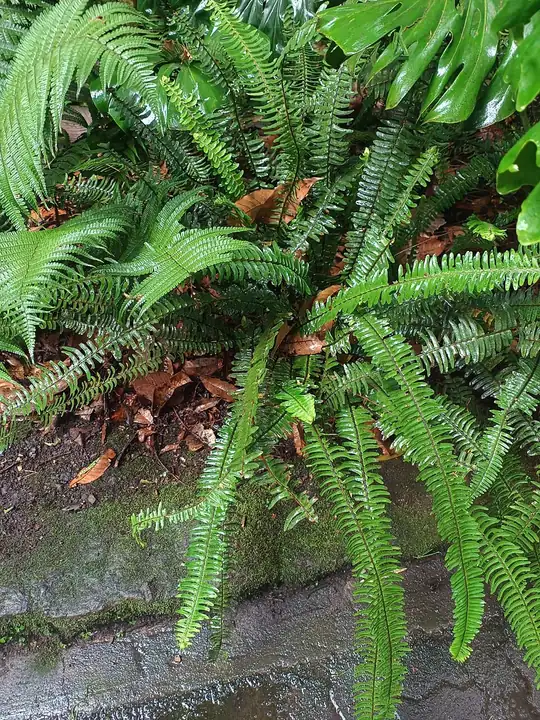
Boston fern
Nephrolepis exaltata 'Bostoniensis' and other cultivars (sword fern) · Polypody family (Polypodiaceae, as NC State files it; the ASPCA files sword ferns under Dryopteridaceae)
| Hardiness zones | 10 to 13 |
|---|---|
| Sun | shade |
| Water | high |
| Life cycle | perennial |
| Frost | Tender: killed by frost |
About Boston fern
The Boston fern is a sword fern from tropical and subtropical America whose long, arching, finely cut fronds cascade 2-3 ft on all sides, which has made it the classic porch and parlor fern for over a century (NC State, Clemson). It is a cool-room plant that wants bright filtered light, barely moist soil and humid air, and it sheds brown leaflets everywhere when the air is dry. The ASPCA lists it as safe for pets. NC State notes it is often confused with the tuberous sword fern, N. cordifolia, a weedy relative.
Hardy outdoors only in zones 10-13 (NC State); it is grown indoors or as a summer porch plant everywhere and can summer outdoors in shade once nights stay above about 55 F, coming back in before fall nights cool.
When to plant
Timing is counted from your average last spring frost (and first fall frost). Sow & Tell works out the actual dates for your ZIP code.
Usually bought as a nursery plant or started by dividing a crowded clump in early spring; the species reproduces by spores and spreads by slender runners (Clemson, NC State).
Growing it indoors
- Light: Bright filtered light from an east or north window suits it; direct sun through a south or west window scorches the fronds, and it tolerates fairly heavy shade (Clemson, NC State).
- Water: Keep the mix barely moist at all times, never bone dry and never standing in water, which rots the roots (Clemson, NC State); water less in winter when growth stops. MU Extension's table says evenly moist for ferns.
- Humidity: It needs high humidity and browns and sheds leaflets in dry winter rooms; set it on a tray of wet pebbles, double-pot it in moist sphagnum, mist it, or keep it in a bright bathroom or kitchen (Clemson, NC State).
- Temperature: Clemson gives 68-72 F days and 50-55 F nights, cooler than most houseplants; NC State says 60-70 F, and MU Extension's rule for ferns is nights around 55 F away from heat vents and radiators.
- Feeding: Feed a liquid houseplant fertilizer at half the label rate about once a month from April through September, none in winter and none for six months after buying or repotting; too much fertilizer scorches the fronds (Clemson).
- Repotting: Repot an overcrowded plant in early spring into a fast-draining peaty mix one size up, dividing it at the same time if you like (Clemson).
Soil
A fast-draining, peaty mix such as equal parts houseplant potting mix and peat moss or leaf mold (Clemson).
Pot in a fast-draining peaty mix, such as equal parts houseplant potting mix and peat moss or leaf mold, in a container with a drainage hole (Clemson).
Feeding
- April through September, while new fronds are unrolling: liquid houseplant fertilizer at half the label rate. Clemson feeds about once a month, watering first; too much fertilizer scorches the fronds.
- Winter: none. Skip feeding and water a little less while growth has stopped (Clemson, NC State).
Heavy feeding scorches fern fronds; half strength, monthly, in the growing season is plenty (Clemson).
Varieties (14)
NC State and Clemson Extension name 15 cultivars; traits are given only where a page describes them.
| Variety | Type | Days | Notes |
|---|---|---|---|
| Childsii | Compact | 10-12 in tall with overlapping, curling leaflets. | |
| Compacta | Compact | Fronds 15-18 in long. | |
| Bostoniensis | Full size | The original Boston fern: arching fronds up to 3 ft long cascading on all sides. | |
| Verona | Lacy | Lacy, drooping fronds. | |
| Fluffy Duffy | Ruffled | Very fringed and compact. | |
| Fluffy Ruffles | Ruffled | Stiff, upright, densely leafed fronds. | |
| Dallas | Listed by NC State Extension without a description. | ||
| Florida Ruffle | Listed by NC State Extension without a description. | ||
| Golden Boston | Listed by NC State Extension without a description. | ||
| Rita's Gold | Listed by NC State Extension without a description. | ||
| Ruffles | Listed by NC State Extension without a description. | ||
| Suzi Wong | Listed by NC State Extension without a description. | ||
| Tiger Stripe | Listed by NC State Extension without a description. | ||
| Whitmanii | Listed by NC State Extension without a description. |
Pests to watch for
Twospotted spider mite, Scale insects, Mealybugs
Diseases and problems
Root and crown rot
In the kitchen
Safety: Not listed as poisonous to people by NC State or Clemson, and non-toxic to pets per the ASPCA; the rows of dark spore dots under the fronds are normal, not insects or disease (NC State).
Pets: Non-toxic to dogs and cats (ASPCA, listed as Nephrolepis exaltata bostoniensis); NC State also tags it non-toxic for horses.
Sources
Photo: Photo: Nathaly 1106, CC0, via Wikimedia Commons (CC0). Photo resized for the web.

Planting dates and advice are general guidance; check with your local Cooperative Extension office for your area.