
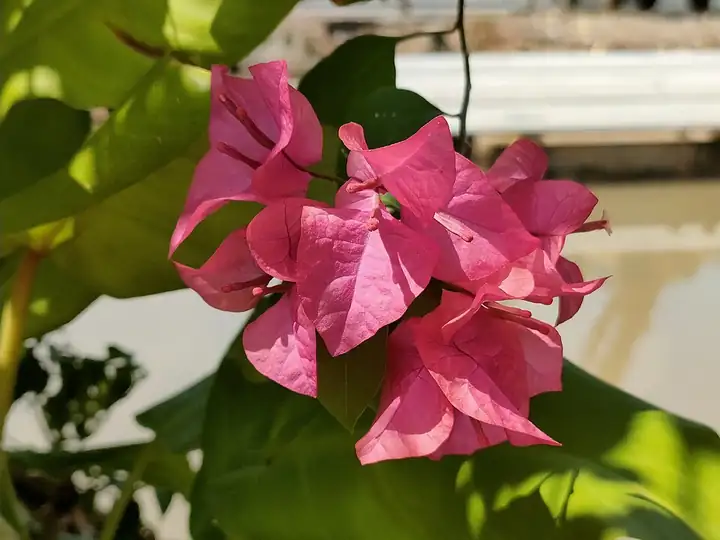
Bougainvillea
Bougainvillea glabra, B. spectabilis and hybrids · Four-o'clock family (Nyctaginaceae)
| Hardiness zones | 9 to 10 |
|---|---|
| Sun | full sun |
| Water | low |
| Life cycle | tender perennial (grown as an annual) |
| Frost | Tender: killed by frost |
| Soil pH | 5.5–6.0 |
About Bougainvillea
Bougainvillea is a thorny, scrambling tropical vine or shrub grown for its papery, brightly colored bracts; the true flowers are tiny and white, tucked inside (NC State; UF/IFAS). In frost-free areas it covers fences, walls and arbors and takes heat, drought and salt spray in stride. Elsewhere it's a sun-loving patio, hanging-basket or house plant that can spend winter indoors.
Hardy outdoors only in about zones 9b-10 and other frost-free spots (UF/IFAS, NC State); cold causes dieback and leaf drop. Everywhere else, grow it in a pot and bring it in for winter.
When to plant
Timing is counted from your average last spring frost (and first fall frost). Sow & Tell works out the actual dates for your ZIP code.
Plant or set out pots in full sun after frost danger has passed; without some direct sun it won't bloom (UF/IFAS). In pots use a fast-draining mix that isn't heavy on peat, since the fine roots rot easily (UF/IFAS ENH 874). To overwinter, bring it in before nights regularly drop below 45 F: cut back small potted plants and keep them in a sunny window, or let big pots go dormant in a cool place that doesn't freeze, never letting the roots dry out completely or stay wet (MU Extension). Days to first bloom aren't documented; nursery plants are usually sold in color.
Soil
Fast-draining sandy or loamy soil that's slightly acidic; keep it on the dry side, and expect yellow leaves from missing micronutrients in alkaline soil (UF/IFAS, NC State).
Use a fast-draining, slightly acidic soil or mix (about pH 5.5-6.0) and avoid peat-heavy mixes that stay wet (UF/IFAS ENH 874).
Feeding
- During active growth in spring and summer: balanced fertilizer, used sparingly. Feed lightly; too much fertilizer, especially nitrogen, gives leaves instead of colorful bracts (UF/IFAS). Follow the label.
- Only if new leaves turn pale or yellow between the veins: Epsom salts (magnesium sulfate) or a micronutrient spray labeled for palms or citrus. UF/IFAS lists 1-2 tsp Epsom salts per gallon as a drench or leaf spray for magnesium shortage; follow the label, since micronutrient sprays can stain concrete and stone.
Overwatering, too much shade, too much fertilizer and heavy late-summer pruning all cut down on blooms (UF/IFAS).
Harvest
Color comes in flushes on new growth through much of the year where it's frost-free, heaviest in winter's short days in Florida; a sunny potted plant can stay colorful for up to about eight weeks (UF/IFAS). Prune after a flush in late winter or early spring (or at the start of the rainy season), not in late summer or early fall, and let the soil get a bit dry between waterings to bring on more bracts (UF/IFAS).
Varieties (19)
| Variety | Type | Days | Notes |
|---|---|---|---|
| Dr. David Barry | Containers and baskets | Large lavender bracts. | |
| Juanita Hatten | Containers and baskets | Red bracts and variegated leaves; branches freely. | |
| Summer Snow | Containers and baskets | Large white bracts; suits hanging baskets. | |
| Helen Johnson | Dwarf (containers and baskets) | Dwarf, bushy and compact with red bracts; good in hanging baskets. | |
| Barbara Karst | Landscape | Bright red bracts in almost constant bloom. | |
| California Gold | Landscape | Gold to yellow bracts on a vining plant. | |
| Miami Pink | Landscape | Dark pink bracts; does best planted in the landscape. | |
| Mrs. Butt | Landscape | Red bracts aging toward peach; blooms repeatedly. | |
| Royal Purple | Landscape | Dark purple bracts; does well in humid areas. | |
| Tropical Bouquet | Landscape | Compact, bushy plant with bracts that open orange and turn pink. | |
| Pink Pixie | Miniature (containers and baskets) | A true miniature with small pink bracts. | |
| Surprise | Novelty | Pink bracts; may throw branches with white bracts. | |
| Torch Glow | Novelty | Colorful bracts only at the tips of the stems. | |
| Double Pink | Novelty (double bracts) | Pink, double bracts. | |
| Double Red | Novelty (double bracts) | Red, double bracts. | |
| Sweet Dream | Novelty (gold leaves) | Gold leaves and pale lavender bracts; thornless. | |
| Golden Summer | Novelty (variegated leaves) | White bracts with gold-variegated leaves. | |
| Raspberry Ice | Novelty (variegated leaves) | Red bracts and variegated leaves; slow-growing. | |
| Vicky | Novelty (variegated leaves) | Pink bracts over leaves with creamy yellow centers. |
Pests to watch for
Aphids
Diseases and problems
Root rot, Iron chlorosis, Magnesium deficiency
In the kitchen
Safety: Grown as an ornamental only. The long, sharp thorns can cut skin, so wear heavy gloves and long sleeves when pruning (UF/IFAS); we found no extension toxicity listing for it.
Pets: Not listed by the ASPCA (no bougainvillea entry); the sharp thorns are the main hazard.
Sources
- plants.ces.ncsu.edu
- gardeningsolutions.ifas.ufl.edu
- journals.flvc.org
- blogs.ifas.ufl.edu
- blogs.ifas.ufl.edu
- extension.missouri.edu
- aspca.org
Photo: Photo: Vitaium / Wikimedia Commons, CC BY-SA 4.0 (CC BY-SA 4.0). Photo resized for the web.

Planting dates and advice are general guidance; check with your local Cooperative Extension office for your area.