
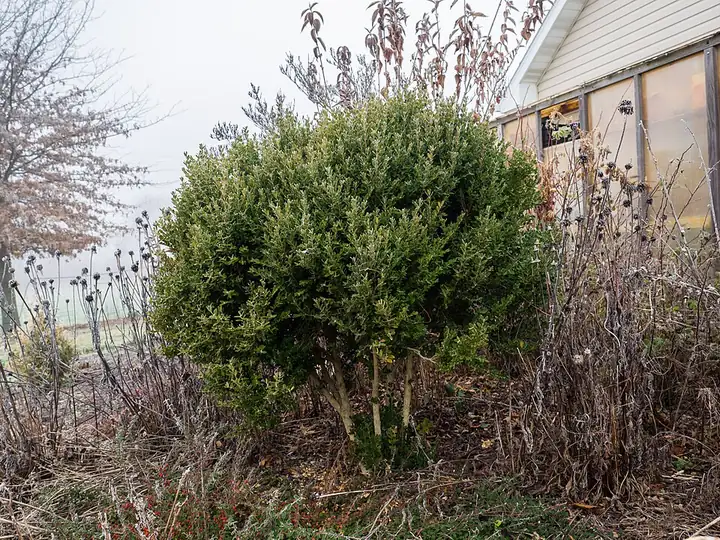
Boxwood
Buxus sempervirens (common or 'American' boxwood), B. microphylla (littleleaf and Japanese boxwood), B. sinica var. insularis (Korean boxwood) and hybrids · Boxwood family (Buxaceae)
| Hardiness zones | 4 to 9 |
|---|---|
| Sun | full sun to part shade |
| Water | moderate |
| Life cycle | perennial |
| Frost | Hardy: takes frost |
| Soil pH | 6.8–7.5 |
About Boxwood
Boxwoods are slow-growing evergreen shrubs with small, glossy leaves, grown for hedges, edging, foundation plantings and topiary. Common boxwood is not native to America: it comes from Europe, western Asia and North Africa, while littleleaf and Korean boxwoods come from East Asia. Boxwood blight reached the US around 2011; Clemson notes that littleleaf, Korean and many newer hybrid boxwoods resist it far better than common boxwood.
Korean boxwood is the most cold hardy (zones 4-9); common boxwood suits zones 5-8 and littleleaf zones 6-9 (Clemson, NC State). Wind and winter sun can bronze or dry out the leaves.
When to plant
Timing is counted from your average last spring frost (and first fall frost). Sow & Tell works out the actual dates for your ZIP code.
Plant container shrubs with the top eighth of the root ball above the soil; planting too deep weakens or kills boxwood (Clemson). Test the soil first, and keep boxwood away from acid-loving azaleas, camellias and gardenias.
Soil
Well-drained soil is a must, so never plant near downspouts or in wet spots. Roots stay in the top 15 inches, so keep 2-3 inches of mulch over them (Clemson).
Test the soil; boxwood likes pH 6.8-7.5 and sharp drainage, so pick a spot away from downspouts and acid-loving shrubs (Clemson).
Feeding
- Early spring only, and only when a soil test shows a need (not every year): complete fertilizer as the soil test recommends. Broadcast it around the plant past the drip line, on top of the mulch, so it doesn't burn bare roots; never feed in summer or fall (Clemson).
Water is what new shrubs need most: daily for the first 2 weeks, every 2-3 days through week 12, then weekly until the roots spread (at least two growing seasons), using about a quarter to a third of the nursery pot's volume each time (UMN). Overfeeding browns leaves and can kill branches. Established boxwood needs a thorough weekly watering when rain is under 1 inch a week, plus a deep soak before hard cold (Clemson).
Varieties (16)
| Variety | Type | Days | Notes |
|---|---|---|---|
| Dee Runk | Common boxwood (B. sempervirens) | Narrow cone, 8-10 ft tall and 2-3 ft wide. | |
| Suffruticosa (English boxwood) | Common boxwood (B. sempervirens) | Slow dwarf for low formal hedges; strong scent; very susceptible to blight, mites and psyllids and the least tolerant of leafminer. | |
| Vardar Valley | Common boxwood (B. sempervirens) | Bluish leaves, about 2-3 ft tall; resistant to leafminer. | |
| Heritage ('HER2010B02') | Hybrid (BetterBoxwood series) | Dark green, 3-4 ft tall and 2-3 ft wide; bred for blight resistance. | |
| Renaissance ('HER2009B01') | Hybrid (BetterBoxwood series) | Light green, about 3 ft tall and 4-5 ft wide; bred for blight resistance. | |
| NewGen Freedom ('SB 300') | Hybrid (NewGen series) | Fast, uniform, about 3.5 ft tall and wide; bred for leafminer and blight resistance. | |
| NewGen Independence ('SB108') | Hybrid (NewGen series) | Deep green, about 3 ft tall and wide; for edging and foundation beds; bred for leafminer and blight resistance. | |
| Green Gem | Hybrid (Sheridan Nursery cross) | Small globe about 2 ft tall and wide for containers and edging. | |
| Green Mound | Hybrid (Sheridan Nursery cross) | Rounded, 2-3 ft tall and wide. | |
| Green Mountain | Hybrid (Sheridan Nursery cross) | Naturally cone-shaped; good for topiary or a 5 ft tall, 3 ft wide hedge; moderately blight resistant. | |
| Green Velvet | Hybrid (Sheridan Nursery cross) | About 3 ft tall and 4 ft wide; darkest foliage of the Sheridan crosses and rarely bronzes in winter; moderately blight resistant. | |
| Green Beauty | Japanese boxwood (B. microphylla var. japonica) | Rounded, 3-5 ft tall and slightly wider. | |
| Winter Gem | Japanese boxwood (B. microphylla var. japonica) | About 4 ft tall and wide, fast growing, with bright lime-green spring growth; prunes well. | |
| Wintergreen | Korean boxwood (B. sinica var. insularis) | Fast-growing hedging boxwood kept at about 4 ft; less likely to bronze in winter and highly blight resistant (Clemson); NC State also lists it under littleleaf boxwood with good pest resistance. | |
| Baby Gem ('Gregem') | Littleleaf boxwood (B. microphylla) | Very small, dense leaves; usually kept at 2-3 ft as a low hedge or edging. | |
| Little Missy | Littleleaf boxwood (B. microphylla) | Rounded, about 2 ft tall and wide, needs little pruning. |
Pests to watch for
Boxwood leafminer, Boxwood mite, Boxwood psyllid, Box tree moth, Scale insects
Diseases and problems
Boxwood blight, Phytophthora root rot, Boxwood dieback, Boxwood decline, Leaf spots, Winter injury, Dog urine damage
In the kitchen
Safety: NC State lists boxwood as poisonous with low severity: steroidal alkaloids in the leaves and bark can cause nausea, vomiting and diarrhea if eaten, and the sap can irritate skin.
Pets: Toxic to dogs, cats and horses (ASPCA): alkaloids cause vomiting and diarrhea in dogs and cats, and colic, diarrhea, breathing failure and seizures in horses.
Sources
- hgic.clemson.edu
- plants.ces.ncsu.edu
- plants.ces.ncsu.edu
- aspca.org
- extension.rutgers.edu
- hgic.clemson.edu
- extension.umn.edu
Photo: Photo: F. D. Richards / Wikimedia Commons, CC BY-SA 2.0 (CC BY-SA 2.0). Photo resized for the web.

Planting dates and advice are general guidance; check with your local Cooperative Extension office for your area.