
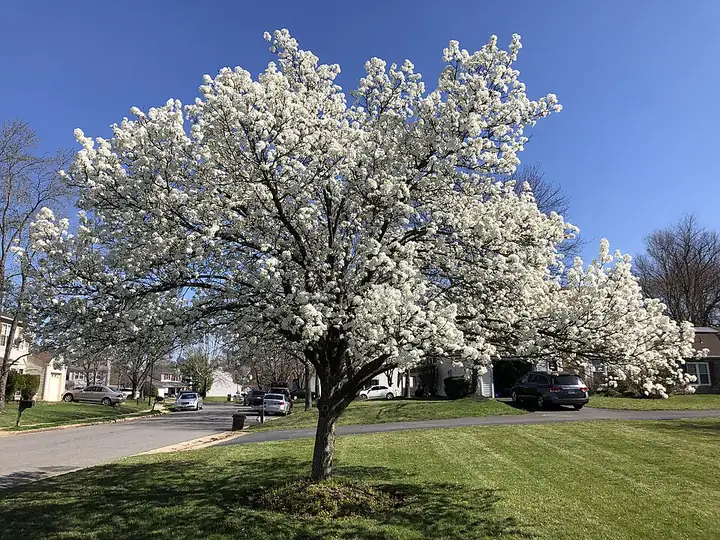
Bradford pear (Callery pear)
Pyrus calleryana (Callery pear; 'Bradford' and other cultivars) · Rose family (Rosaceae)
| Hardiness zones | 5 to 9 |
|---|---|
| Sun | full sun to part shade |
| Water | moderate |
| Life cycle | perennial |
| Frost | Hardy: takes frost |
About Bradford pear (Callery pear)
Bradford pear is a cultivar of Callery pear, an Asian tree once widely planted for white spring flowers and red fall color. It is now a serious invasive plant: different cultivars cross-pollinate, birds spread the fruit, and the wild, often thorny seedlings form dense thickets that crowd out native plants. The flowers smell bad and the weak branches split in wind and ice, so don't plant it; plant a native flowering tree instead.
Grows in zones 5-9 (NC State). INVASIVE: listed as invasive in North Carolina and elsewhere in the Southeast. Sale is banned in Ohio (since January 7, 2023) and South Carolina (since October 1, 2024), and Pennsylvania added it to its noxious weed list in 2021, with sale and planting fully banned there since February 2024. Plant instead: eastern redbud, serviceberry, flowering dogwood, American plum, fringetree or blackhaw viburnum.
When to plant
Timing is counted from your average last spring frost (and first fall frost). Sow & Tell works out the actual dates for your ZIP code.
Plant container or balled-and-burlapped trees. Container trees can go in any time the ground can be worked, but fall is the best season in the South because roots keep growing through mild weather (Clemson). Dig the hole no deeper than the root ball and at least twice as wide, keep the top roots level with the soil, and mulch 2-4 inches without touching the trunk. Don't plant it. Existing trees don't have to be removed (Ohio), but cutting them down and replacing them with natives helps; cut stumps resprout unless treated within about 15 minutes with an herbicide such as triclopyr or glyphosate (follow the label), and seedlings should be pulled (Oklahoma State). Clemson's Bradford pear bounty trades removed trees for free native trees at events.
Soil
Tolerates almost any soil plus compaction, drought, heat and pollution, which is part of why it spreads so easily (NC State).
Test the soil first. Loosen a wide planting area and mix 10-20 percent compost into the native soil you dig out; don't use uncomposted bark, and don't dig deeper than the root ball (Clemson).
Feeding
First-year watering matters far more than fertilizer: water daily for the first 1-2 weeks, every 2-3 days until week 12, then weekly, using about 1-1.5 gallons per inch of trunk diameter, until the tree is established, roughly 1.5 years per inch of trunk (UMN). Don't count on rain unless it was over an inch. Don't plant or feed it: Callery pear is invasive and its sale is banned in Ohio, South Carolina and Pennsylvania. Replace it with a native tree and care for that instead. Too much fertilizer can burn roots and push soft growth that pests and cold injure (Clemson).
Harvest
Foul-smelling white flowers open in early spring (April-May in NC), before or with the leaves (NC State).
Varieties (7)
Listed only to help identify trees already in yards. Every cultivar below is Callery pear, an invasive species.
| Variety | Type | Days | Notes |
|---|---|---|---|
| Aristocrat | Callery pear cultivar | Stronger branch angles but susceptible to fire blight. | |
| Autumn Blaze | Callery pear cultivar | Narrower form; cold hardy to zone 4. | |
| Bradford | Callery pear cultivar | Showy flowers and fire blight resistance, but branches split with age. | |
| Capital | Callery pear cultivar | Columnar; purple-red to bronze fall color. | |
| Chanticleer | Callery pear cultivar | Narrow column with reddish fall color; hardy to zone 4. | |
| Cleveland Select | Callery pear cultivar | Fewer broken limbs; red, orange or purple fall color. | |
| Redspire | Callery pear cultivar | Pyramidal; yellow to red fall color. |
Pests to watch for
Aphids, Scale insects
Diseases and problems
Fire blight, Girdling roots
In the kitchen
Safety: The small hard fruits are not edible (NC State).
Pets: Not on the ASPCA's toxic plant list for dogs.
Sources
- plants.ces.ncsu.edu
- bygl.osu.edu
- extension.psu.edu
- blogs.clemson.edu
- extension.okstate.edu
- extension.rutgers.edu
- aspca.org
- hgic.clemson.edu
- hgic.clemson.edu
- extension.umn.edu
Photo: Photo: Famartin / Wikimedia Commons, CC BY-SA 4.0 (CC BY-SA 4.0). Photo resized for the web.

Planting dates and advice are general guidance; check with your local Cooperative Extension office for your area.