
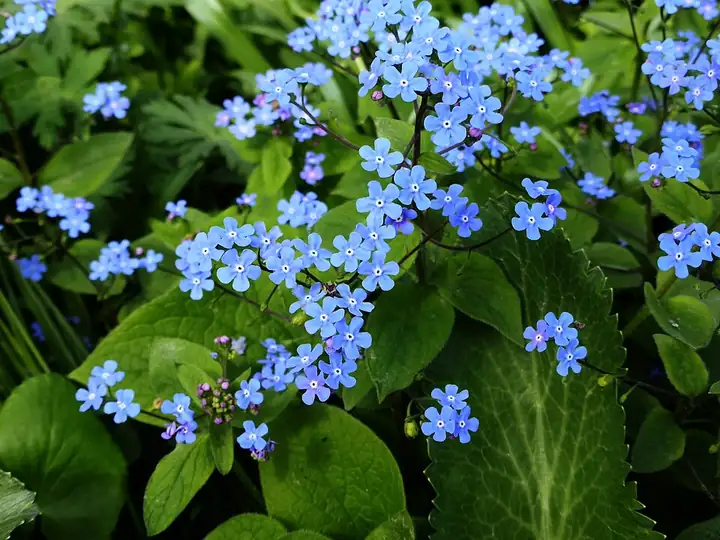
Brunnera (Siberian bugloss)
Brunnera macrophylla · Borage family (Boraginaceae)
| Hardiness zones | 3 to 8 |
|---|---|
| Sun | part shade |
| Water | moderate |
| Life cycle | perennial |
| Frost | Hardy: takes frost |
About Brunnera (Siberian bugloss)
Brunnera makes clumps of big heart-shaped leaves, often frosted silver in kinds like 'Jack Frost', with sprays of tiny sky-blue flowers in spring that look like forget-me-nots. Its rough leaves keep deer and rabbits away (NC State). It does best where nights are cool.
Hardy in zones 3-8, but NC State does not recommend it for the hot, humid Southeast.
When to plant
Timing is counted from your average last spring frost (and first fall frost). Sow & Tell works out the actual dates for your ZIP code.
Plant in spring or fall where it gets shade from afternoon sun, and mulch to keep the roots cool and moist (NC State). Divide clumps to make more; the species self-seeds, but patented kinds may not be propagated.
Soil
Fertile, moist, well-drained soil; it does not tolerate dry soil (NC State).
Choose fertile, moist, well-drained soil (NC State).
Feeding
Brunnera doesn't tolerate dry soil; water during dry spells, especially the first summer, and shade it from afternoon sun (NC State).
Harvest
Blooms early to mid spring, sometimes into early summer (NC State). Cut the flower stems off after bloom to tidy the plant.
Varieties (8)
NC State documents these 8 cultivars.
| Variety | Type | Days | Notes |
|---|---|---|---|
| Alchemy Silver | Silver leaves with dark green veins; up to 16 in. | ||
| Alexander's Great | Extra-large silvered leaves; 12-18 in tall. | ||
| Diane's Gold | Golden-yellow leaves; blue flowers. | ||
| Jack Frost | Frosted silver leaves with green veins and edges; light blue flowers; 12-15 in tall. | ||
| Jack of Diamonds | Large dark green leaves with a crackled silver pattern; 14-16 in. | ||
| Looking Glass | Almost solid metallic silver leaves. | ||
| Sterling Silver | Large metallic silver leaves. | ||
| Variegata | Dark green leaves with irregular cream-white edges; 12-15 in. |
Pests to watch for
Slugs, Brown garden snail
In the kitchen
Pets: Not listed as toxic by the ASPCA.
Sources
Photo: Photo: MartinThoma / Wikimedia Commons, CC0 (CC0). Photo resized for the web.

Planting dates and advice are general guidance; check with your local Cooperative Extension office for your area.