
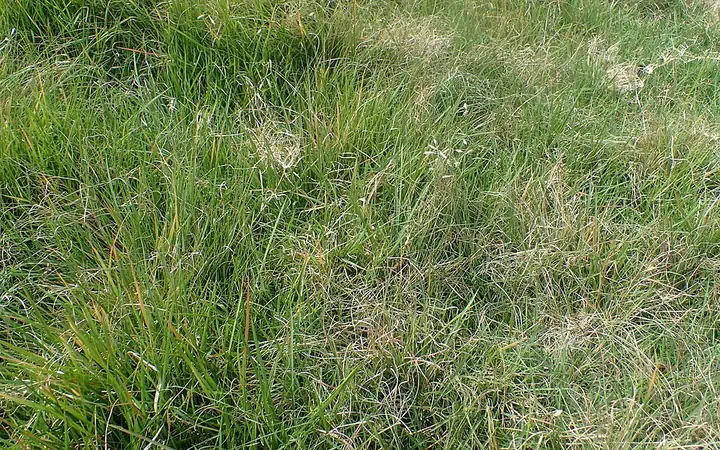
Buffalograss
Bouteloua dactyloides (formerly Buchloe dactyloides) · Grass family (Poaceae)
| Hardiness zones | 4 to 8 |
|---|---|
| Sun | full sun |
| Water | low |
| Life cycle | perennial |
| Frost | Hardy: takes frost |
| Spacing | 12 to 18 inches |
About Buffalograss
Buffalograss is a short, fine-leaved native prairie grass that makes a low-water lawn in sunny, dry places (K-State, NRCS). It spreads by runners into a soft, gray-green turf that naturally stays 4-8 inches tall, so it needs little mowing, and it browns and goes dormant from the first fall freeze until late spring. It is native to the short- and mixed-grass prairies of the Great Plains, from Montana and western Minnesota south to Arizona, Texas and Louisiana (USDA NRCS, wildflower.org). It does poorly in shade, sandy or soggy soil, and heavy foot traffic.
NC State lists zones 4-8. A warm-season native grass, not invasive, though its runners can creep into nearby beds (NC State); in Colorado it does best below about 7,000 ft (Colorado State).
When to plant
Timing is counted from your average last spring frost (and first fall frost). Sow & Tell works out the actual dates for your ZIP code.
Seed in late spring to midsummer: K-State says June-July with irrigation or April-May without; Colorado State allows March to mid-August. Use 1-2 lb of seed per 1,000 sq ft (K-State) to 3-5 lb (Colorado State, NRCS), 1/4-1/2 inch deep, and keep it moist; seedlings come up in 1-3 weeks. Set plugs 12-18 inches apart after the last spring frost or at least 6 weeks before the first fall frost; they spread in 8-12 weeks (NRCS). Kill or remove the old lawn first; it can't be overseeded into cool-season grass (UNL).
Soil
Well-drained loam or clay, including heavy, compacted, limy or caliche soils; it does poorly in sandy, wet or poorly drained soil (K-State, wildflower.org, NRCS).
Kill or strip off the old lawn and weeds first; avoid tilling, which brings up weeds, and get a soil test for phosphorus and potassium (Colorado State, K-State, NRCS).
Feeding
- Plugs: 6-7 weeks after planting: nitrogen fertilizer. NRCS suggests about 1 lb of nitrogen per 1,000 sq ft; first-season seedlings get only half rates, and only if needed (K-State).
- Established lawn: early to mid-June, after the grass greens up and runners start growing: nitrogen lawn fertilizer (K-State suggests a controlled-release type). About 1 lb of actual nitrogen per 1,000 sq ft a year suits most lawns, 0-3/4 lb for low-care areas, and never more than 2 lb; split it if you use more than 1 lb. Follow a soil test.
- Optional second feeding in mid-July: nitrogen lawn fertilizer. Use the second half of a split yearly amount (K-State, UNL); stop there.
Don't feed or water in early spring: it only helps cool-season weeds and won't wake the grass sooner (UNL, K-State). Frequent light watering, heavy feeding and very short mowing all invite weeds, and routine balanced fertilizers like 10-10-10 aren't needed (K-State).
Varieties (11)
Extension and USDA sources document these 11 lawn and range cultivars; most of the modern lawn types came from the University of Nebraska breeding program.
| Variety | Type | Days | Notes |
|---|---|---|---|
| Prairie | Lawn type | ||
| Bowie | Seeded lawn type | Medium green and fine-leaved, with good density, quicker establishment, winter hardiness and early spring green-up. | |
| Cody | Seeded lawn type | Widely adapted, with good density and drought tolerance; the standard other buffalograsses are compared to. | |
| Sundancer | Seeded lawn type | Darker green, faster to establish and denser than older seeded types, with early spring green-up. | |
| Texoka | Seeded range and forage type | Taller forage type that can reach about 12 in. | |
| Bison | Seeded type | ||
| Sharps Improved | Seeded type | ||
| Stampede | Vegetative lawn type | Very low, staying under about 4 in tall. | |
| 609 | Vegetative lawn type (plugs or sod) | ||
| Legacy | Vegetative lawn type (plugs or sod) | Female line with almost no pollen heads; dark green, low-growing and very dense. | |
| Prestige | Vegetative lawn type (plugs or sod) | Female line with almost no pollen heads; bright green, greens up earlier and stays green later, with better resistance to buffalograss chinch bug. |
Pests to watch for
Chinch bugs (lawn chinch bugs), White grubs, Mealybugs, Grasshoppers
Diseases and problems
Leaf spot, Brown patch, Summer patch
In the kitchen
Safety: No toxicity is reported in the sources we checked; USDA NRCS calls it a forage grass that all kinds of livestock eat.
Pets: Not listed by the ASPCA.
Sources
- plants.ces.ncsu.edu
- wildflower.org
- plants.sc.egov.usda.gov
- planttalk.colostate.edu
- bookstore.ksre.ksu.edu
- extensionpubs.unl.edu
- lancaster.unl.edu
- aspca.org
- aspca.org
Photo: Photo: Krzysztof Ziarnek, Kenraiz, CC BY-SA 4.0, via Wikimedia Commons (CC BY-SA 4.0). Photo resized for the web.

Planting dates and advice are general guidance; check with your local Cooperative Extension office for your area.