
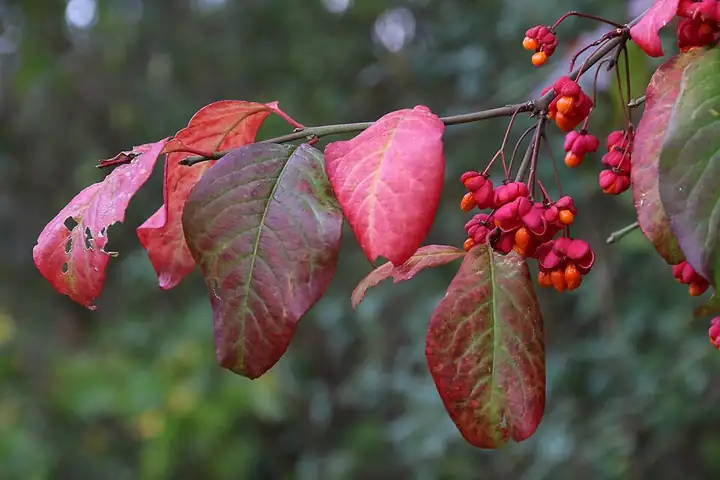
Burning bush
Euonymus alatus (winged euonymus) · Bittersweet family (Celastraceae)
| Hardiness zones | 4 to 8 |
|---|---|
| Sun | full sun to part shade |
| Water | moderate |
| Life cycle | perennial |
| Frost | Hardy: takes frost |
About Burning bush
Burning bush is an Asian shrub planted for its brilliant red fall color and corky-winged stems. It is invasive: birds and deer spread its seeds into woods across the eastern and central US, it is on the NC Invasive Plant Council list, and Minnesota bans its sale (NC State, University of Minnesota Extension). Plant a native shrub with good fall color instead, such as dwarf fothergilla, red or black chokeberry, Virginia sweetspire, fragrant sumac, highbush blueberry or arrowwood viburnum.
Hardy in zones 4-8 (NC State). Invasive from Connecticut to South Carolina and west to Wisconsin; a Restricted Noxious Weed in Minnesota, where it can't be sold, propagated or moved (UMN). Check your state's list before planting.
When to plant
Timing is counted from your average last spring frost (and first fall frost). Sow & Tell works out the actual dates for your ZIP code.
Not recommended for planting. To remove it, pull young plants by hand and dig larger ones with a hoe or root-wrenching tool; bigger infestations may need an herbicide applied to cut stumps, following the label (NC State).
Soil
Grows in almost any soil and pH and tolerates drought and compaction (NC State).
Test the soil before planting; mature shrubs in decent soil need little or no fertilizer (Clemson).
Feeding
Invasive: don't plant or feed it; see the plant page for native alternatives (NC State, UMN).
Harvest
Tiny greenish flowers in May-June are easy to miss; the show is red fall leaves and orange-red seeds that birds carry off (NC State, UMN).
Varieties (3)
Invasive; listed only so gardeners can recognize what is sold.
| Variety | Type | Days | Notes |
|---|---|---|---|
| Odum (Little Moses) | Burning bush | Dwarf, about 3.5 ft; fiery red fall color. | |
| Rudy Haag | Burning bush | Slow dwarf, 3-5 ft. | |
| Compactus | Burning bush (E. alatus) | 4-10 ft; bright red fall color. |
Pests to watch for
Euonymus scale, Twospotted spider mite
Diseases and problems
Twig blight, Road salt injury
In the kitchen
Safety: NC State lists all parts as poisonous, with low severity unless large amounts are eaten: stomach pain, vomiting, diarrhea and weakness. The bright fall fruit can tempt children.
Pets: ASPCA's 'burning bush' entry is the related native wahoo (Euonymus atropurpureus), listed as toxic to dogs, cats and horses (vomiting, diarrhea, weakness, heart rhythm problems with large doses); winged euonymus is not listed separately.
Sources
Photo: Photo: Sally V / Wikimedia Commons, CC BY-SA 4.0 (CC BY-SA 4.0). Photo resized for the web.

Planting dates and advice are general guidance; check with your local Cooperative Extension office for your area.