
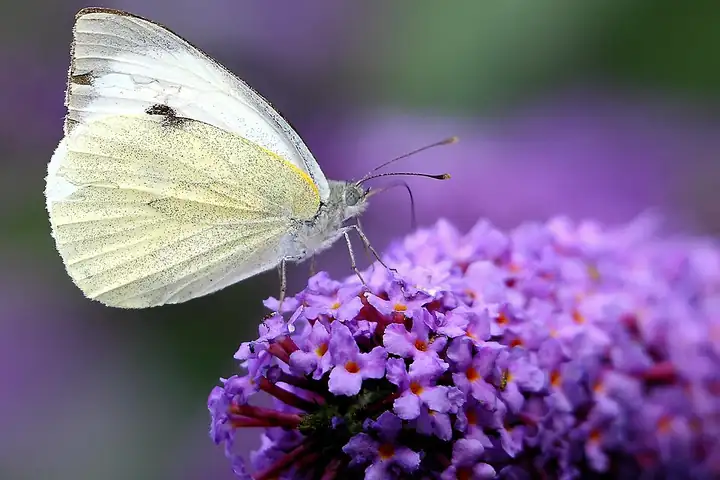
Butterfly bush
Buddleja davidii · Figwort family (Scrophulariaceae)
| Hardiness zones | 5 to 9 |
|---|---|
| Sun | full sun |
| Water | low |
| Life cycle | perennial |
| Frost | Hardy: takes frost |
| Spacing | 72 to 144 inches |
About Butterfly bush
Butterfly bush is a fast-growing shrub from China with long, scented flower spikes that draw butterflies and hummingbirds all summer. It is invasive: it seeds heavily into roadsides, riverbanks and forests, it is a listed noxious weed in Oregon and Washington (where selling it is banned except for approved sterile cultivars), and North Carolina lists it as invasive in its mountains and piedmont. If you want one, choose a sterile or low-seed cultivar (such as Lo & Behold, Flutterby, Miss Molly, Miss Ruby, Asian Moon or Inspired), deadhead it, and know that its leaves do not feed native caterpillars.
Zones 5-9, dying back to the ground in zones 5-6 (NC State). Invasive: noxious weed (Oregon List B, Washington Class B) with sale limited to sterile cultivars that make 2% or less viable seed; listed invasive by the NC Invasive Plant Council; Chicago Botanic Garden notes only 20 states did not list it as a weed problem.
When to plant
Timing is counted from your average last spring frost (and first fall frost). Sow & Tell works out the actual dates for your ZIP code.
Space 6-12 ft apart (NC State). One flower spike can hold about 40,000 seeds that stay alive 3-5 years in soil, and even cut stems can resprout, so pick a sterile cultivar and don't toss prunings where they can root (NC State, Washington NWCB).
Soil
Any well-drained soil, including clay, sand and rocky ground; it tolerates drought, heat and salt, but amend heavy clay so roots don't sit wet (NC State).
Any well-drained soil works; amend heavy clay so roots don't stay wet (NC State).
Feeding
- Late winter or early spring: pruning (no feeding schedule is documented). Cut stems back to about 12 inches for a neater plant and bigger flowers (Chicago Botanic Garden).
- All summer, as flower spikes fade: deadheading. Clip off spent spikes before they set seed to limit spread and keep blooms coming (Chicago Botanic Garden, Washington NWCB).
It is invasive in many states: don't let spikes go to seed, and don't dump prunings where stems can root (NC State, Washington NWCB).
Harvest
Blooms from early summer into fall on new growth. Cut plants back to about 12 inches in late winter or early spring for a neater shape and bigger flowers, and deadhead spent spikes to cut reseeding and keep flowers coming (Chicago Botanic Garden, NC State).
Varieties (19)
| Variety | Type | Days | Notes |
|---|---|---|---|
| Blue Chip Jr. | Buddleja hybrid; Sterile / low-seed (Oregon-approved) | About 2 ft; blue-purple. | |
| Flutterby Grande Blueberry Cobbler ('Podaras #4') | Buddleja hybrid; Sterile / low-seed (Oregon-approved) | About 2 ft tall, 5 ft wide; lavender-blue. | |
| Flutterby Petite Tutti Fruitti Pink ('Podaras #13') | Buddleja hybrid; Sterile / low-seed (Oregon-approved) | Very small, about 14 inches; fuchsia-pink. | |
| Flutterby Pink ('Podaras #9') | Buddleja hybrid; Sterile / low-seed (Oregon-approved) | About 4 ft; rose-pink. | |
| Inspired Violet ('ILVOargus2') | Buddleja hybrid; Sterile / low-seed (Oregon-approved) | About 3.5 ft; violet, drooping spikes. | |
| Bicolor | Buddleja x weyeriana | Flowers shift from lavender to orange. | |
| Adonis Blue ('Adokeep') | Butterfly bush (B. davidii) (seeds; invasive risk) | Blue-purple; compact and well branched. | |
| Attraction | Butterfly bush (B. davidii) (seeds; invasive risk) | Red-purple to magenta, fragrant 8-12 inch spikes; neater than 'Royal Red'. | |
| Black Knight | Butterfly bush (B. davidii) (seeds; invasive risk) | Very dark purple spikes; about 6 ft. | |
| Evil Ways | Butterfly bush (B. davidii) (seeds; invasive risk) | Yellow to chartreuse leaves, dark purple flowers; 2-5 ft. | |
| Harlequin | Butterfly bush (B. davidii) (seeds; invasive risk) | Variegated cream-edged leaves; reddish-purple to magenta flowers. | |
| Nanho Purple | Butterfly bush (B. davidii) (seeds; invasive risk) | Compact, 3-5 ft; lavender to magenta-purple. | |
| Royal Red | Butterfly bush (B. davidii) (seeds; invasive risk) | Magenta-purple spikes 6-14 inches. | |
| White Profusion | Butterfly bush (B. davidii) (seeds; invasive risk) | White; about 6 ft. | |
| Asian Moon | Butterfly bush (B. davidii); Sterile / low-seed (Oregon-approved) | Compact, about 2 ft; lavender. | |
| Lo & Behold 'Blue Chip' | Butterfly bush (B. davidii); Sterile / low-seed (Oregon-approved) | Compact, about 2.5 ft; lavender-blue. | |
| Lo & Behold 'Purple Haze' | Butterfly bush (B. davidii); Sterile / low-seed (Oregon-approved) | Low and wide, about 2 ft tall by 5 ft; purple-blue 7-inch spikes; reliably root-hardy in Chicago. | |
| Miss Molly | Butterfly bush (B. davidii); Sterile / low-seed (Oregon-approved) | Compact, about 2.5 ft; bright pink-red. | |
| Miss Ruby | Butterfly bush (B. davidii); Sterile / low-seed (Oregon-approved) | About 4.5 ft; bright rosy pink. |
Pests to watch for
Twospotted spider mite
In the kitchen
Pets: We found no ASPCA entry for butterfly bush, so we can't say it is pet-safe; discourage pets from chewing it.
Sources
Photo: Photo: Tim Felce (Airwolfhound), CC BY-SA 2.0, via Wikimedia Commons (CC BY-SA 2.0). Photo resized for the web.

Planting dates and advice are general guidance; check with your local Cooperative Extension office for your area.