
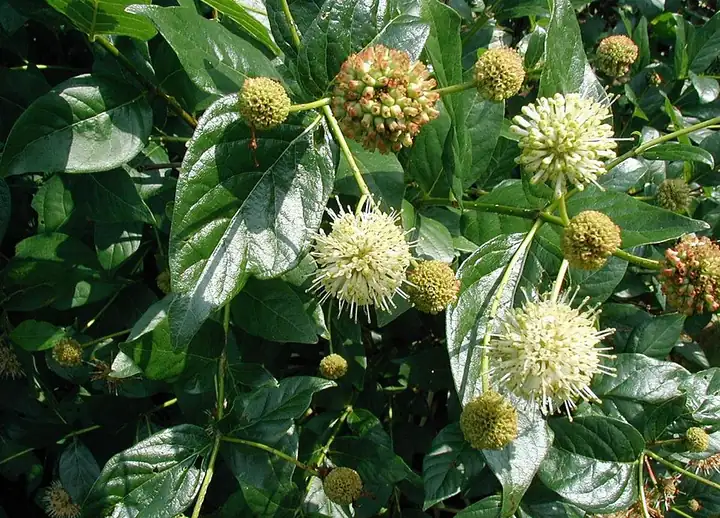
Buttonbush
Cephalanthus occidentalis · Madder family (Rubiaceae)
| Hardiness zones | 5 to 9 |
|---|---|
| Sun | full sun to part shade |
| Water | high |
| Life cycle | perennial |
| Frost | Hardy: takes frost |
About Buttonbush
Buttonbush is a native shrub of wet places across much of the US with round, fragrant white 'pincushion' flower balls in midsummer. Butterflies (especially swallowtails), bumble bees, honey bees, native bees and hummingbirds feed on it, and ducks eat the seeds. It is a natural pick for rain gardens and pond edges.
Hardy in zones 5-9; native, not invasive.
When to plant
Timing is counted from your average last spring frost (and first fall frost). Sow & Tell works out the actual dates for your ZIP code.
Sow fresh seed in fall with no pretreatment, or push cuttings into moist soil (USDA NRCS). Best bloom comes in full sun with steady moisture (Mt. Cuba). It gets leggy but takes hard pruning.
Soil
Moist to wet soil, from sand to clay; it tolerates standing water and compacted soil but not dry or strongly alkaline soil.
Plant in moist to wet, acid to neutral soil; no fertilizer is called for.
Feeding
Don't plant it in dry soil; it needs steady moisture.
Harvest
Blooms June to September. Leave the reddish-brown seed balls for winter birds; overgrown plants can be cut back hard.
Varieties (3)
Sources we opened document 3 cultivars.
| Variety | Type | Days | Notes |
|---|---|---|---|
| Keystone | More vigorous with more stems, leaves and flowers; released in 1996 by the USDA Big Flats Plant Materials Center. | ||
| Sputnik | Named by the Xerces Society as a popular buttonbush cultivar; traits not described. | ||
| Sugar Shack | Compact, about 4 ft tall, with 1-inch flower balls. |
In the kitchen
Safety: The bark and leaves contain cephalanthin; eating the bark can cause vomiting, convulsions and paralysis (NC State, USDA NRCS). Livestock avoid the bitter foliage.
Pets: Not listed by the ASPCA; NC State and USDA note the bark is poisonous if eaten, so keep pets and livestock from chewing it
Sources
Photo: Photo: Sten Porse, CC BY-SA 3.0, via Wikimedia Commons (CC BY-SA 3.0). Photo resized for the web.

Planting dates and advice are general guidance; check with your local Cooperative Extension office for your area.