
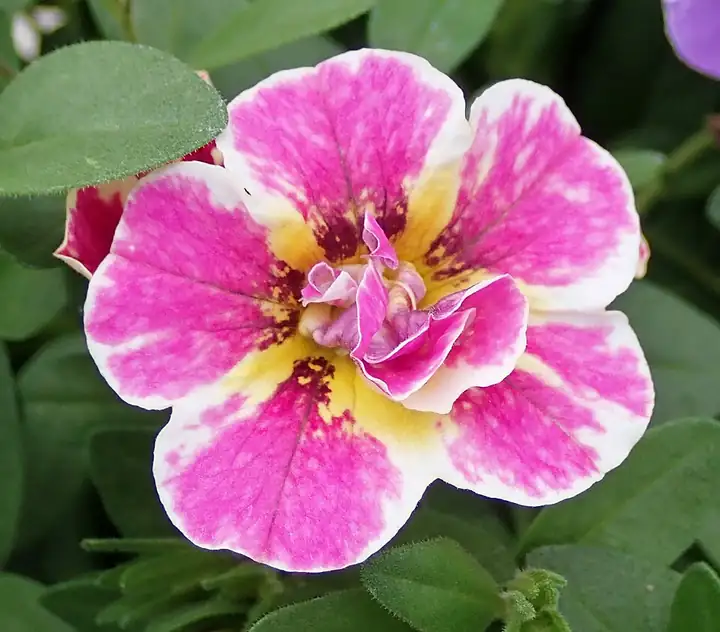
Calibrachoa (million bells)
Calibrachoa x hybrida · Nightshade family (Solanaceae)
| Hardiness zones | 7 to 11 |
|---|---|
| Sun | full sun |
| Water | high |
| Life cycle | tender perennial (grown as an annual) |
| Frost | Half-hardy: takes a light frost |
| Soil pH | 5.0–6.5 |
| Soil temperature to plant | at least 55°F |
About Calibrachoa (million bells)
Calibrachoa, sold as million bells or trailing petunia, covers itself in hundreds of small bell-shaped flowers from spring to frost. It's native to South America and only came to gardens in the 1990s, but it quickly became a favorite for hanging baskets and pots. It looks like a tiny petunia but is a separate plant, grown from cuttings, and it needs acidic potting mix to avoid iron deficiency.
Grown as a summer annual almost everywhere; NC State lists zones 7-11 and Oklahoma State zone 9. Illinois notes it often keeps blooming in fall until temperatures drop into the 20s.
When to plant
Timing is counted from your average last spring frost (and first fall frost). Sow & Tell works out the actual dates for your ZIP code.
- Set out plants: up to 2 weeks after the last frost
Buy plants: calibrachoa makes little or no seed and is grown from cuttings, and most named kinds are patented (NC State, UMN). Plant outdoors after frost once the soil is above 55 F (UMN). For a fuller plant, clip off the top 2 inches of the stems at planting (UMN).
Soil
Fast-draining, organic potting mix that stays moist but never soggy; it does best in containers and baskets rather than garden beds (UMN, NC State).
Use a fast-draining potting mix rich in organic matter, with a pH of about 5.0-6.5; above that, growth stalls (UMN). Kentucky stresses that it needs acidic potting soil.
Feeding
- Every other week from planting until fall: water-soluble fertilizer (diluted). Feed every other week at the label rate (UMN; NC State says every few weeks); Kentucky notes regular feeding matters for this plant.
High pH in the pot leads to iron deficiency and yellow leaves (Kentucky, UMN), and constantly soggy mix causes root rot; water daily in hot weather but use pots with drainage holes and let the mix dry slightly between waterings (UMN, NC State).
Harvest
Blooms nonstop from late spring until frost (May to October in Illinois). It's self-cleaning, so there's no need to deadhead; pinch back long stems now and then to keep plants compact (UMN, NC State, Illinois).
Varieties (21)
| Variety | Type | Days | Notes |
|---|---|---|---|
| MiniFamous Double Blue | Double | Double blue-purple flowers; stems about 10 in long. | |
| MiniFamous Uno Double PlumTastic | Double | ||
| Bloomtastic Yellow | |||
| Cabaret Goodnight Kiss | |||
| Cabaret Hot Pink | Bright pink; trailing stems about 8 in long. | ||
| Cabaret Purple Glow | Purple; about 12 in wide with 8 in trailing stems. | ||
| Callie series | Includes Apricot, Deep Yellow, Scarlet Red and White. | ||
| Celebration series | |||
| Eyeconic Purple | |||
| Kabloom Cherry | |||
| Kabloom Light Pink Blast | |||
| Liricashowers series | |||
| Million Bells series | |||
| Million Bells Terra Cotta | Orange streaked with red and gold; stems about 8 in long. | ||
| MiniFamous Neo Deep Orange | |||
| Superbells Double Chiffon | Double flowers. | ||
| Superbells Dreamsickle | |||
| Superbells Garden Rose | |||
| Superbells Pomegranate Punch | Velvety red flowers that darken toward the center; stems about 8 in long. | ||
| Superbells series | |||
| Superbells Watermelon Punch |
Pests to watch for
Aphids, Twospotted spider mite, Thrips
Diseases and problems
Iron chlorosis, Root rot, Phytophthora root and stem rot
In the kitchen
Safety: We found no toxicity listing for calibrachoa from NC State or the ASPCA, and it isn't on extension edible-flower lists, so don't eat it.
Pets: Not listed by the ASPCA (no entry on its toxic plant lists for dogs or cats).
Sources
- plants.ces.ncsu.edu
- extension.umn.edu
- extension.illinois.edu
- uky.edu
- extension.okstate.edu
- aspca.org
- aspca.org
- extension.umn.edu
Photo: Photo: James St. John / Wikimedia Commons, CC BY 2.0 (CC BY 2.0). Photo resized for the web.

Planting dates and advice are general guidance; check with your local Cooperative Extension office for your area.