
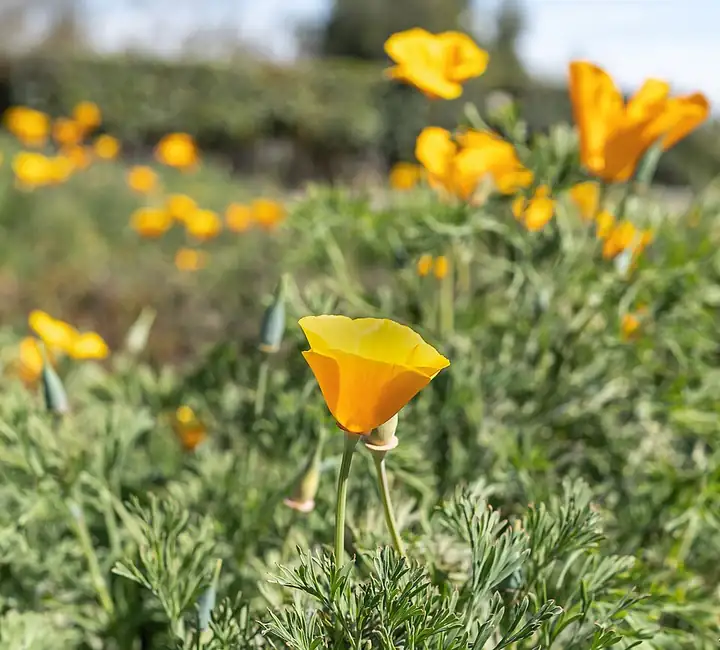
California poppy
Eschscholzia californica · Poppy family (Papaveraceae)
| Hardiness zones | 6 to 10 |
|---|---|
| Sun | full sun |
| Water | low |
| Life cycle | annual |
| Frost | Half-hardy: takes a light frost |
| Spacing | 12 to 36 inches |
About California poppy
California poppy is a low wildflower with silky orange to pale yellow petals, native from western Oregon to Baja California and the state flower of California. It thrives in poor, dry, sunny spots, and its flowers close at night and on cloudy days. Bumble bees, sweat bees and mining bees visit the flowers.
NC State lists zones 6-10; it lives a few years as a short-lived perennial in mild-winter areas (about zones 8-10) and acts as a reseeding annual where winters are cold.
When to plant
Timing is counted from your average last spring frost (and first fall frost). Sow & Tell works out the actual dates for your ZIP code.
- Start seeds indoors: 3 weeks before the last frost
Sow seed where it will grow in fall or early spring, barely covered (about 1/16 to 1/8 inch deep). It does not like being transplanted unless the plants are very young; NC State also says you can start seed indoors 3 weeks before the last frost.
Soil
Sandy to loamy, well-drained soil, even poor soil; it does poorly in soil rich in organic matter or where water pools.
No need to enrich the soil: California poppy grows in poor, sandy to loamy, well-drained soil and does poorly where the soil is high in organic matter.
Feeding
Rich, soggy soil works against it; it will not grow in shade or where water pools.
Harvest
Grown for its flowers, which bloom from spring into summer. Deadhead to keep it blooming, but leave a few pods if you want it to reseed; ripe pods pop open and can fling seed up to 6 feet.
Varieties (17)
| Variety | Type | Days | Notes |
|---|---|---|---|
| Apricot Chiffon | Double | Creamy yellow double flowers edged in coral-orange. | |
| Rose Chiffon | Double | Soft rose double flowers with yellow centers. | |
| Ballerina | Double mix | Frilly, semi-double to double flowers in yellow, orange, rose and scarlet. | |
| XL Jelly Beans | Mix | Mix of bright pink, lemon-yellow and red flowers over blue-green leaves; plants about 1-2 ft tall. | |
| Mission Bells | Semi-double mix | Mix of pastel yellow, pink and orange flowers with lightly ruffled, semi-double to double petals. | |
| Thai Silk | Semi-double mix | Compact plants about 8-10 in. tall with bronze-tinged leaves. Semi-double flowers about 1.5 in. across in yellow, orange, red, pink, rose, cream and white. | |
| Alba | Single | White flowers. | |
| Apricot Flambeau | Single | Lemon, cream and apricot flowers with coral edges over smoky gray-green leaves. | |
| Carmine King | Single | Red-pink flowers with white centers. | |
| Champagne and Roses | Single | Fluted flowers in two-toned pinks, from pale champagne to deep rose. | |
| Golden West | Single | Soft golden-yellow flowers. | |
| Orange King | Single | Glowing orange flowers; an improved form of the wild type. | |
| Purple Gleam | Single | Satiny pinkish-purple flowers with cream centers. | |
| Red Chief | Single | Scarlet to orange-red flowers. | |
| White Linen | Single | White flowers. | |
| Sugared Almonds | Single mix | Flowers range from scarlet-orange to cream with an apricot blush. | |
| Sunset | Single mix | A seed strain with single flowers. |
Pests to watch for
Aphids, Thrips
Diseases and problems
Powdery mildew, Gray mold, Aster yellows
In the kitchen
Safety: The USDA NRCS plant guide warns that California poppy may be toxic if eaten without proper preparation and may be toxic to livestock; the roots hold the most alkaloids. As an herbal remedy the European Medicines Agency says it is for adults only, is not recommended in pregnancy or while breastfeeding, and may make you too drowsy to drive; it lists no known drug interactions, but ask a doctor before combining it with sleep aids, sedatives or alcohol.
Pets: Not listed by the ASPCA
Sources
- plants.ces.ncsu.edu
- fs.usda.gov
- plants.sc.egov.usda.gov
- extension.oregonstate.edu
- ema.europa.eu
- ema.europa.eu
Photo: Photo: Rjcastillo / Wikimedia Commons, CC BY 4.0 (CC BY 4.0). Photo resized for the web.

Planting dates and advice are general guidance; check with your local Cooperative Extension office for your area.