
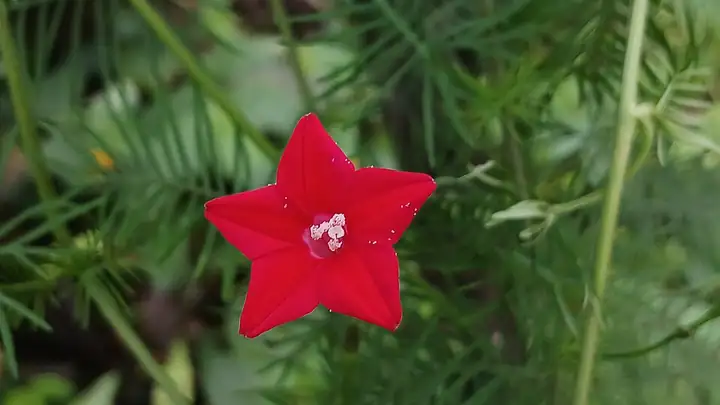
Cardinal climber and cypress vine
Ipomoea x multifida (cardinal climber) and Ipomoea quamoclit (cypress vine) · Morning glory family (Convolvulaceae)
| Hardiness zones | 2 to 12 |
|---|---|
| Sun | full sun |
| Water | moderate |
| Life cycle | annual |
| Frost | Tender: killed by frost |
About Cardinal climber and cypress vine
These fast, twining morning glory cousins carry small, bright red trumpet flowers that hummingbirds and butterflies visit (NC State, Illinois). Cypress vine has feathery, fern-like leaves; cardinal climber, a natural hybrid of cypress vine and red morning glory, has hand-shaped, deeply cut leaves and red flowers with a white or yellow throat, and it comes true from seed. Both come from tropical America; cypress vine reseeds freely and has naturalized in parts of the South and West, and as with other morning glories the seeds are poisonous.
Grown as a summer annual in every zone; perennial only in frost-free zones 10-12 (NC State). Arizona, Arkansas and Kansas seed laws restrict morning glory (Ipomoea) seed as a weed seed in seed for sale.
When to plant
Timing is counted from your average last spring frost (and first fall frost). Sow & Tell works out the actual dates for your ZIP code.
- Start seeds indoors: 6 weeks before the last frost
- Set out plants: up to 2 weeks after the last frost
- Sow seeds outdoors: up to 2 weeks after the last frost
Sow seed beside its support after the last frost, or start it indoors about 6 weeks before setting out (Iowa State). Nick the seed or soak it for 12-24 hours first (NC State); a University of Alaska chart has seed sprouting in about 5-7 days at 65-70 F and moves seedlings into 3-inch pots. No sourced count from sowing to first bloom.
Soil
Average, well-drained soil kept reasonably moist; lean soil is fine, and it needs fertilizer only if the soil is very poor (NC State, Illinois).
Average, well-drained soil is fine; keep fertility lean (NC State, Illinois).
Feeding
Fertilizer is unnecessary unless the soil is very poor (NC State), and Illinois Extension advises keeping fertility to a minimum for morning glories.
Harvest
Blooms from early summer until frost. There's no need to deadhead, but picking off seed pods before they dry and split cuts down on next year's volunteers (NC State).
Varieties (3)
These vines have few named cultivars; NC State and Iowa State document these 3 forms.
| Variety | Type | Days | Notes |
|---|---|---|---|
| Alba | Cypress vine (I. quamoclit) | White-flowered cypress vine. | |
| Cardinal climber (I. x multifida) | Hybrid of cypress vine and red morning glory | Red trumpets with a white or yellow throat and hand-shaped, deeply cut leaves; vines 10 ft or more. Comes true from seed. | |
| Cypress vine (I. quamoclit) | Species | Scarlet star-shaped flowers and feathery, fern-like leaves; vines 10-20 ft. Reseeds freely. |
In the kitchen
Safety: The seeds are poisonous (NC State: low severity): eating them can cause vomiting, and large amounts may cause hallucinations. Keep saved seed away from children.
Pets: Not listed by name, but the ASPCA lists morning glories (Ipomoea spp.) as toxic to dogs, cats and horses: indole alkaloids cause vomiting, and eating many seeds may cause hallucinations. NC State flags both vines as a problem for dogs, cats and horses.
Sources
- plants.ces.ncsu.edu
- plants.ces.ncsu.edu
- extension.illinois.edu
- extension.illinois.edu
- yardandgarden.extension.iastate.edu
- uaf.edu
- plantsservices.sc.egov.usda.gov
- ams.usda.gov
- aspca.org
Photo: Photo: Nativeplants garden, CC BY-SA 4.0, via Wikimedia Commons (CC BY-SA 4.0). Photo resized for the web.

Planting dates and advice are general guidance; check with your local Cooperative Extension office for your area.