
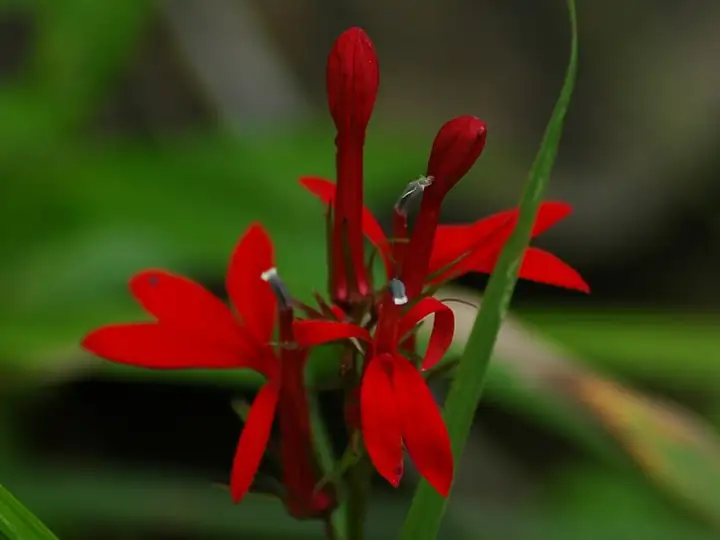
Cardinal flower
Lobelia cardinalis · Bellflower family (Campanulaceae)
| Hardiness zones | 3 to 9 |
|---|---|
| Sun | full sun to part shade |
| Water | high |
| Life cycle | perennial |
| Frost | Hardy: takes frost |
| Spacing | 8 to 12 inches |
About Cardinal flower
Cardinal flower is a native wildflower of stream banks and wet woods, with 3- to 5-foot spikes of brilliant red, tubular flowers in late summer. It is one of the strongest hummingbird plants in North America: UF/IFAS says it depends entirely on hummingbirds for pollination, and Penn State lists it among the best plants for ruby-throated hummingbirds. It is a short-lived perennial that needs soil that never dries out, which makes it a natural for rain gardens and pond edges.
Hardy in zones 3-9 (NC State; Wisconsin Extension); native across the eastern and central United States.
When to plant
Timing is counted from your average last spring frost (and first fall frost). Sow & Tell works out the actual dates for your ZIP code.
Seed does not need cold treatment but does need light, so sow it on the surface (USDA NRCS; Wisconsin Extension). Seedlings form a leafy rosette the first year and usually bloom the second (USDA NRCS). You can also divide the leafy offshoots in spring or fall; keep fallen leaves off the winter rosettes so they don't rot (USDA NRCS).
Soil
Rich, moist to wet soil high in organic matter that never dries out; afternoon shade helps in hot summers (NC State; USDA NRCS).
Work in plenty of organic matter such as compost or peat moss and choose a spot that stays moist; mulch well to keep the soil cool and damp (USDA NRCS).
Feeding
- each spring as growth begins: compost or a balanced granular fertilizer. USDA NRCS calls cardinal flower a heavy feeder; spread compost or a granular fertilizer around the plants when growth starts and water it in. Follow a soil test for amounts.
Letting the soil dry out, or burying the winter rosettes under fallen leaves, is the fastest way to lose plants (NC State; USDA NRCS).
Harvest
Flowers open from the bottom of the spike up over several weeks from July into fall (Wisconsin Extension; USFS). Leave some spikes to set seed, since plants are short-lived and self-sow to keep a patch going (USDA NRCS).
Varieties (4)
Extension sources we could open document only 4 cardinal flower cultivars. USDA NRCS recommends local, wild-type plants.
| Variety | Type | Days | Notes |
|---|---|---|---|
| Pink Flame | Cardinal flower selection | Bright pink flowers. | |
| Pink Flamingo | Cardinal flower selection | Soft pink flowers. | |
| Queen Victoria | Hybrid cardinal flower | Blood-red flowers over bronze foliage. | |
| Starship Rose | Hybrid lobelia (L. x speciosa) | Deep rose flowers. |
Pests to watch for
Slugs, Brown garden snail, Deer
In the kitchen
Safety: All parts contain lobelia alkaloids and are toxic if eaten in large amounts, causing nausea, vomiting, diarrhea and weakness, and in severe cases convulsions (NC State). Don't eat any part of it.
Pets: Toxic to dogs, cats and horses (ASPCA): it contains lobeline and can cause vomiting, diarrhea, drooling, depression and heart rhythm problems.
Sources
- plants.ces.ncsu.edu
- plants.ces.ncsu.edu
- plants.sc.egov.usda.gov
- fs.usda.gov
- hort.extension.wisc.edu
- gardeningsolutions.ifas.ufl.edu
- pollinators.psu.edu
- fs.usda.gov
- aspca.org
Photo: Photo: linnaeus, CC BY 3.0, via Wikimedia Commons (CC BY 3.0). Photo resized for the web.

Planting dates and advice are general guidance; check with your local Cooperative Extension office for your area.