
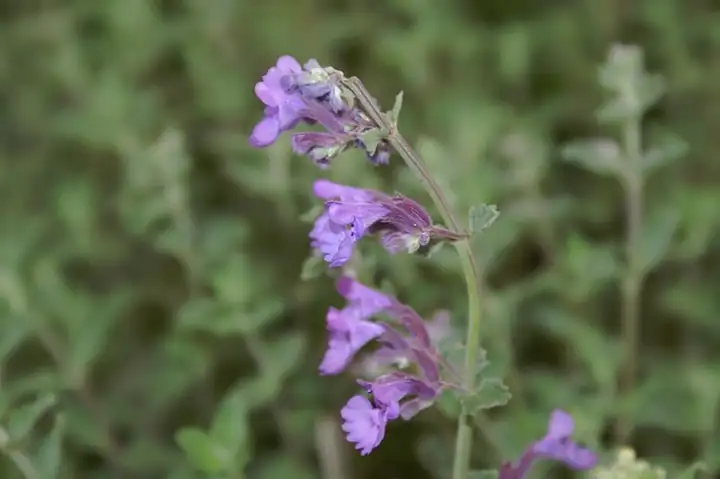
Catmint
Nepeta x faassenii and related garden catmints (N. racemosa, N. grandiflora, N. subsessilis and hybrids such as 'Walker's Low' and 'Six Hills Giant') · Mint family (Lamiaceae)
| Hardiness zones | 3 to 9 |
|---|---|
| Sun | full sun to part shade |
| Water | low |
| Life cycle | perennial |
| Frost | Hardy: takes frost |
About Catmint
Catmint is a tough, sprawling perennial with gray-green, scented leaves and clouds of small lavender-blue flowers from late spring into fall. It is not catnip: the common hybrid, Nepeta x faassenii, is a sterile cross first raised at a Dutch nursery, and Wisconsin Extension says cats usually ignore it. Bees love it, and deer and rabbits leave it alone.
Wisconsin rates 'Walker's Low' for zones 3-8 and NC State lists Nepeta x faassenii for 5-9; in Chicago trials, soggy soil, not cold, killed plants over winter.
When to plant
Timing is counted from your average last spring frost (and first fall frost). Sow & Tell works out the actual dates for your ZIP code.
Because 'Walker's Low' and most hybrid catmints set no seed, new plants come from spring division or from 3-inch non-flowering side shoots taken in June or July, which root in about 4 weeks (Wisconsin). Plant potted catmint in early spring or in fall, at least 6 weeks before a hard freeze (Clemson).
Soil
Any well-drained soil, from sand to clay loam; plants tolerate drought once rooted but rot in wet winter soil (NC State; Chicago Botanic Garden).
Any well-drained soil works; the key is drainage, since wet winter soil kills more catmint than cold (Chicago Botanic Garden).
Feeding
Skip routine fertilizer: Chicago Botanic Garden's top-rated catmints got none, and MSU notes some perennials respond badly to regular feeding with floppy, leafy growth. A 1-inch layer of compost is enough.
Harvest
The first big flush opens in late spring or early summer and many kinds keep going into September or October. When the first flush fades, cut plants back by a third to a half for fresh leaves and more flowers (Wisconsin; NC State); 'Walker's Low' and similar types rebloom even without it (Chicago Botanic Garden).
Varieties (22)
| Variety | Type | Days | Notes |
|---|---|---|---|
| Junior Walker | Faassen's catmint (N. x faassenii) | Compact, 1-1.5 ft tall, with lavender flowers. | |
| Kit Cat | Faassen's catmint (N. x faassenii) | Lavender-blue flowers on a plant about 8 in tall and 20 in wide in Chicago's trial. | |
| Kitten Around | Faassen's catmint (N. x faassenii) | ||
| Select Blue | Faassen's catmint (N. x faassenii) | Lavender flowers on a plant about 14 in tall and 30 in wide in Chicago's trial. | |
| Blue Whisper | Hybrid catmint | Very pale lavender flowers on a plant about 16 in tall and 33 in wide in Chicago's trial. | |
| Dropmore | Hybrid catmint | Lavender-blue flowers on a plant about 18 in tall and 36 in wide in Chicago's trial. | |
| Ice Blue | Hybrid catmint | Very pale blue flowers on a plant about 12 in tall and 30 in wide in Chicago's trial. | |
| Joanna Reed | Hybrid catmint | Lavender-blue flowers on a plant about 24 in tall and 48 in wide in Chicago's trial. | |
| Six Hills Giant | Hybrid catmint | Lavender-blue flowers on a plant about 30 in tall and 48 in wide in Chicago's trial. | |
| Walker's Low | Hybrid catmint (listed under N. x faassenii or N. racemosa) | Lavender-blue flowers on a plant about 30 in tall and 36 in wide in Chicago's trial. | |
| Bramdean | N. grandiflora | Blue flowers on a plant about 32 in tall and 40 in wide in Chicago's trial. | |
| Dawn to Dusk | N. grandiflora | Pale pink flowers on a plant about 43 in tall and 36 in wide in Chicago's trial. | |
| Pool Bank | N. grandiflora | Lavender-blue flowers on a plant about 52 in tall and 52 in wide in Chicago's trial. | |
| Blue Ice | N. racemosa | Very pale lavender flowers on a plant about 10 in tall and 30 in wide in Chicago's trial. | |
| Blue Wonder | N. racemosa | Lavender-blue flowers on a plant about 18 in tall and 38 in wide in Chicago's trial. | |
| Little Titch | N. racemosa | Purple-blue flowers on a plant about 10 in tall and 30 in wide in Chicago's trial. | |
| Snowflake | N. racemosa | White-flowered catmint. | |
| Superba | N. racemosa | Lavender flowers on a plant about 24 in tall and 40 in wide in Chicago's trial. | |
| Souvenir d'André Chaudron | N. sibirica | Lavender-blue flowers on a plant about 36 in tall and 36 in wide in Chicago's trial. | |
| Candy Cat | N. subsessilis | Light violet flowers on a plant about 14 in tall and 27 in wide in Chicago's trial. | |
| Cool Cat | N. subsessilis | Lavender flowers on a plant about 30 in tall and 36 in wide in Chicago's trial. | |
| Sweet Dreams | N. subsessilis | Pink flowers on a plant about 30 in tall and 36 in wide in Chicago's trial. |
Good neighbors
Wisconsin Extension suggests catmint with roses, bee balm, Shasta daisies and ornamental grasses for looks; no extension trial tests it as a pest-control companion.
Diseases and problems
Powdery mildew, Root rot
In the kitchen
Safety: The sources we checked list no toxic parts for garden catmint and no research-based guidance on pregnancy, drug interactions or allergies.
Pets: Garden catmint (Nepeta x faassenii) is not listed by the ASPCA. Its cousin catnip (Nepeta cataria, which the ASPCA also calls catmint or catswort) is listed as toxic to cats: it can cause vomiting and diarrhea and makes some cats sleepy and others wound up (ASPCA).
Sources
- plants.ces.ncsu.edu
- hort.extension.wisc.edu
- chicagobotanic.org
- hgic.clemson.edu
- aspca.org
- aspca.org
- homesoiltest.msu.edu
Photo: Photo: David J. Stang, CC BY-SA 4.0, via Wikimedia Commons (CC BY-SA 4.0). Photo resized for the web.

Planting dates and advice are general guidance; check with your local Cooperative Extension office for your area.