
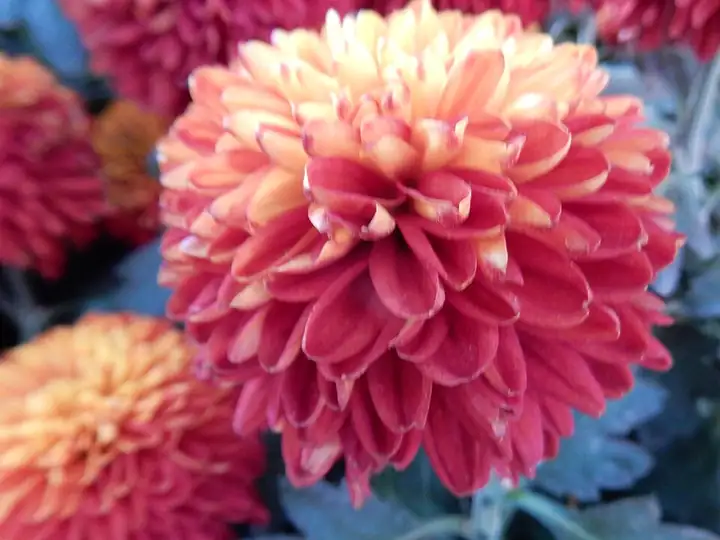
Chrysanthemum (garden mum)
Chrysanthemum x morifolium · Daisy family (Asteraceae)
| Hardiness zones | 5 to 9 |
|---|---|
| Sun | full sun |
| Water | moderate |
| Life cycle | perennial |
| Frost | Hardy: takes frost |
| Spacing | 18 to 24 inches |
About Chrysanthemum (garden mum)
Garden mums are bushy perennials that cover themselves in daisy, pompon or button flowers from late summer until a hard freeze, giving butterflies a late nectar source. They bloom when nights get long, so they are the classic fall flower. The natural insecticide pyrethrin comes from a different plant, the pyrethrum daisy (Tanacetum cinerariifolium); we found no extension or research source showing that planting garden mums keeps pests away.
NC State lists zones 5-9. Hardy garden mums often die in cold winters because their roots are shallow, so in the North plant in spring, pick hardy types such as University of Minnesota introductions, and mulch in late fall (Iowa State). Florist (gift) mums rarely survive outdoors.
When to plant
Timing is counted from your average last spring frost (and first fall frost). Sow & Tell works out the actual dates for your ZIP code.
Set out nursery plants in spring for the fullest plants and best winter survival; fall-planted mums often die over winter in cold areas (Iowa State, Clemson). Plant at the same depth as the pot. Divide every one to three years in spring (Clemson, SDSU).
Soil
Fertile, well-drained soil rich in organic matter that stays evenly moist; work 2-3 inches of compost into poor soil (Clemson, Iowa State).
Work 2-3 inches of compost or other organic matter into poor soil so it drains well but stays moist (Iowa State).
Feeding
- Early spring, when new growth starts: slow-release fertilizer. Scatter it around the plant as growth begins and water it in (Iowa State).
- Through the growing season until buds form: water-soluble fertilizer. Clemson calls mums heavy feeders and suggests a soluble fertilizer about once a week; follow the label rate.
Too much fertilizer gives lanky, floppy plants, and pinching after early July (early August on the Southeast coast) cuts down fall flowers (Iowa State, Clemson).
Harvest
Mums bloom from late summer or fall until freezing weather; early types can open in mid-August (SDSU). For bushy plants with more buds, pinch off the top half inch to an inch of each shoot once it is 6 inches tall, repeating every few weeks, but stop by early July in the North or early August on the Southeast coast (Iowa State, Clemson). Cut stems for vases when flowers are open.
Varieties (29)
| Variety | Type | Days | Notes |
|---|---|---|---|
| Kermit | Button/pompon | Unusual green flowers. | |
| Minngopher | Cushion (UMN) | First University of Minnesota mum with the low, rounded cushion habit. | |
| Flame | Daisy | Large flame-orange daisies on a compact, even plant. | |
| Oriole | Daisy | Long-lasting burnt-orange daisies. | |
| Salsa | Daisy | Red daisies with a light green eye on a mounding plant. | |
| Stargazer | Daisy | Dark lavender daisies. | |
| Tripoli | Daisy | Bright pink daisies with golden centers. | |
| Yellow Jacket | Daisy | Heavy-blooming, uniform yellow daisies on a well-shaped plant. | |
| Allure | Daisy (cushion habit) | Bright yellow daisies with a green eye on a cushion-shaped plant; heat tolerant. | |
| Bravo | Decorative | Dark red decorative flowers on strong, compact plants. | |
| Chablis | Decorative | White decorative flowers with a creamy center. | |
| Cheyenne | Decorative | Large bronze decorative flowers with a button-like center. | |
| Eclipse | Decorative | Peach-and-cream decorative flowers on a compact, spreading plant. | |
| Grenadine | Decorative | Coral decorative flowers on a compact plant. | |
| Ruby Mound | Decorative | Large maroon-red flowers. | |
| Yellow Sarah | Decorative (quilled) | Yellow quilled decorative flowers on a well-shaped plant. | |
| Tracy | Double daisy | White double daisies on a spreading plant. | |
| Duluth | Hardy garden mum (UMN) | ||
| Garnet | Pompon | Bright crimson pompons that age to bronze. | |
| Patriot | Pompon | Pure white pompons on a spreading plant. | |
| Mammoth Coral Daisy | Shrub cushion (UMN Mammoth series) | Coral single daisies with gold centers on big mounds 20-36 in tall and up to 4 ft wide. | |
| Mammoth Dark Bronze Daisy | Shrub cushion (UMN Mammoth series) | Bronze single daisies with gold centers on large mounds. | |
| Mammoth Dark Pink Daisy | Shrub cushion (UMN Mammoth series) | Deep pink single daisies with gold centers on large mounds. | |
| Mammoth Lavender Daisy | Shrub cushion (UMN Mammoth series) | Lavender single daisies with gold centers on large mounds. | |
| Mammoth Red Daisy | Shrub cushion (UMN Mammoth series) | Red daisies with gold centers on large mounds. | |
| Mammoth Twilight Pink | Shrub cushion (UMN Mammoth series) | Pink single daisies with a gold center and purple eye; mound 20-36 in tall. | |
| Mammoth White Daisy | Shrub cushion (UMN Mammoth series) | White semi-double daisies with gold centers; mound 20-36 in tall, up to 4 ft wide. | |
| Mammoth Yellow Quill | Shrub cushion (UMN Mammoth series) | Yellow single daisies with quilled (tube-shaped) petals; mound 20-36 in tall. | |
| Gethsemane Moonlight | Creamy to bright yellow flowers about 3 in across. |
Pests to watch for
Aphids, Thrips, Twospotted spider mite, Lace bugs (azalea and chrysanthemum lace bugs), Four-lined plant bug, Tobacco budworm (geranium or petunia budworm), Foliar nematodes
Diseases and problems
Powdery mildew, Gray mold (Botrytis), Leaf spot, Rust, Root and crown rot, Verticillium wilt, Aster yellows
In the kitchen
Safety: NC State lists the leaves, roots and sap as mildly poisonous: eating them can cause stomach upset and vomiting, and handling the foliage can cause a skin rash in sensitive people.
Pets: Toxic to dogs, cats and horses (ASPCA): sesquiterpene lactones and pyrethrins can cause vomiting, diarrhea, drooling, poor coordination and skin irritation.
Sources
- plants.ces.ncsu.edu
- hgic.clemson.edu
- yardandgarden.extension.iastate.edu
- extension.sdstate.edu
- mnhardy.umn.edu
- aspca.org
- aspca.org
- npic.orst.edu
- maxapress.com
Photo: Photo: Shuvaev, CC BY-SA 4.0, via Wikimedia Commons (CC BY-SA 4.0). Photo resized for the web.

Planting dates and advice are general guidance; check with your local Cooperative Extension office for your area.