
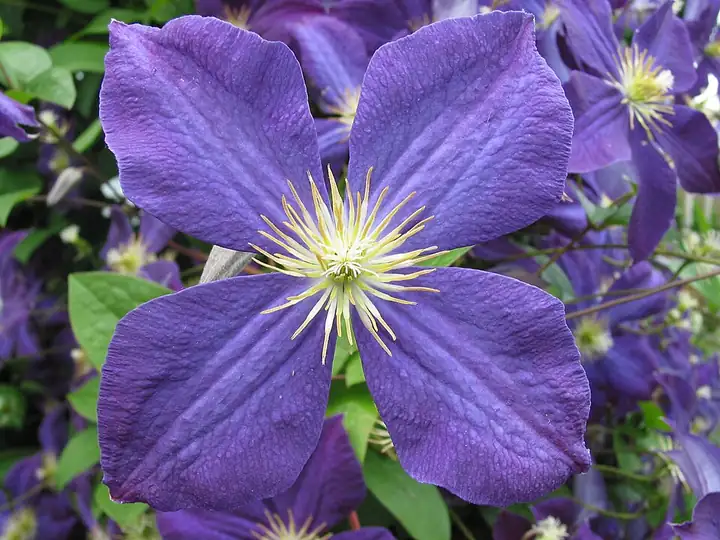
Clematis
Clematis spp. and hybrids · Buttercup family (Ranunculaceae)
| Hardiness zones | 3 to 9 |
|---|---|
| Sun | full sun to part shade |
| Water | moderate |
| Life cycle | perennial |
| Frost | Hardy: takes frost |
About Clematis
Clematis are mostly climbing vines (plus a few bushy kinds) with flowers from small bells to 7-inch stars in purple, blue, pink, red, white and yellow. Bees, butterflies and hummingbirds visit them. Sweet autumn clematis (Clematis terniflora) is invasive in at least 10 states, and old man's beard (C. vitalba) is a Washington noxious weed; choose the native virgin's bower (C. virginiana) instead.
Zones 3-9 depending on the kind. Sweet autumn clematis is invasive in at least 10 states (Clemson) and old man's beard is a Class C noxious weed in Washington.
When to plant
Timing is counted from your average last spring frost (and first fall frost). Sow & Tell works out the actual dates for your ZIP code.
Plant in early spring (potted plants any time in the growing season) with the crown about 1-2 inches below the soil, 1-2 ft from its support, and cut it back to about 12 inches (Iowa State, Clemson). New plants can take up to three years to settle in and bloom well.
Soil
Rich, moist, well-drained soil with plenty of organic matter; keep the roots cool with 2-3 inches of mulch or low plants over them.
Dig a hole about 18 inches deep and wide and mix in compost (about 20% by volume); test the soil first.
Feeding
- Spring, as new growth starts: All-purpose fertilizer with low numbers, such as 10-10-10 or 5-10-5. Scatter around the plant following the label and a soil test, then water in (Iowa State).
- During the growing season, every 4-6 weeks, but not while in full bloom: Low-nitrogen, slow-release fertilizer. NC State calls clematis a heavy feeder; Clemson says skip feeding during bloom and don't overdo nitrogen.
Too much nitrogen and feeding during bloom are common mistakes; give at least 1 inch of water a week in dry spells.
Harvest
Spring, summer or fall bloom depending on the pruning group. Group 1 (spring bloomers): prune right after flowering. Group 2 (repeat bloomers): trim lightly in late winter to the top plump buds. Group 3 (summer-fall bloomers): cut back to 6-24 inches in late winter.
Varieties (20)
| Variety | Type | Days | Notes |
|---|---|---|---|
| Clematis virginiana (virgin's bower) | Native species, pruning group 3 | Native white-flowered vine; Clemson recommends it in place of invasive sweet autumn clematis (tell them apart by the toothed leaflets). | |
| Bees Jubilee | Pruning group 2 | Pink flowers. | |
| Cardinal Wyszynski | Pruning group 2 | Large crimson flowers. | |
| Henryi | Pruning group 2 | Large white flowers. | |
| Marie Boisselot | Pruning group 2 | White flowers. | |
| Nelly Moser | Pruning group 2 | Rosy-mauve flowers with a darker bar, up to about 8 inches across. | |
| Niobe | Pruning group 2 | Dark ruby-red flowers. | |
| Rouge Cardinal | Pruning group 2 | Red flowers. | |
| The President | Pruning group 2 | Purple flowers. | |
| Betty Corning | Pruning group 3 | Blue flowers. | |
| Comtesse de Bouchaud | Pruning group 3 | Vigorous vine with pink flowers. | |
| Duchess of Albany | Pruning group 3 | Pink flowers. | |
| Ernest Markham | Pruning group 3 | Red flowers. | |
| Gipsy Queen | Pruning group 3 | Purple flowers. | |
| Hagley Hybrid | Pruning group 3 | Pink flowers. | |
| Jackmanii | Pruning group 3 | Classic purple large-flowered vine; blooms June-July with some repeat. | |
| Rooguchi | Pruning group 3 | Deep plum-purple nodding bells over a long season. | |
| Ville de Lyon | Pruning group 3 | Red flowers. | |
| Stand by Me | Pruning group 3 (bush type) | Non-climbing bush clematis with blue flowers. | |
| Guernsey Cream | Compact vine with creamy-white flowers barred in green. |
Pests to watch for
Aphids, Twospotted spider mite, Slugs
Diseases and problems
Clematis wilt, Powdery mildew
In the kitchen
Safety: All clematis are poisonous, and NC State rates the severity high: the leaves and sap cause severe mouth pain and blisters if chewed, and the sap can redden and burn skin, so wear gloves (NC State).
Pets: Toxic to dogs, cats and horses (ASPCA): an irritant (protoanemonin) causes drooling, vomiting and diarrhea
Sources
- plants.ces.ncsu.edu
- hgic.clemson.edu
- yardandgarden.extension.iastate.edu
- extension.illinois.edu
- hgic.clemson.edu
- nwcb.wa.gov
- aspca.org
Photo: Photo: Scott Feldstein, CC BY 2.0, via Wikimedia Commons (CC BY 2.0). Photo resized for the web.

Planting dates and advice are general guidance; check with your local Cooperative Extension office for your area.