
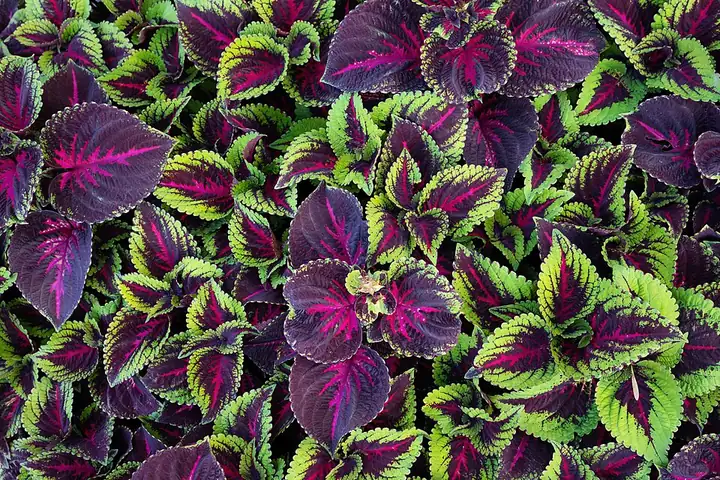
Coleus
Coleus scutellarioides (syn. Plectranthus scutellarioides, Solenostemon scutellarioides) · Mint family (Lamiaceae)
| Hardiness zones | 10 to 11 |
|---|---|
| Sun | part shade |
| Water | moderate |
| Life cycle | tender perennial (grown as an annual) |
| Frost | Tender: killed by frost |
About Coleus
Coleus is a tender tropical plant grown as a summer annual for its loud leaves in red, burgundy, pink, lime, orange and near-black. Most grow best in part shade, but several newer kinds take full, hot sun (Clemson). It's easy in beds, pots and hanging baskets.
Perennial only in zones 10-11 (NC State); everywhere else it is a summer annual killed by the first frost (Clemson).
When to plant
Timing is counted from your average last spring frost (and first fall frost). Sow & Tell works out the actual dates for your ZIP code.
Set out plants after frost danger is past; coleus is killed by frost (Clemson). From seed, sow on the surface at 70-75 F: seeds sprout in 10-15 days and reach transplant size in 6-8 weeks. Cuttings root easily in water or potting mix, but don't propagate patented kinds.
Soil
Moist, rich, loose soil with good drainage; wet feet cause stunting, muddy brown leaves and scorched edges (NC State, Clemson).
Use rich, loose, well-drained soil or a very well-drained potting mix (NC State, Clemson).
Feeding
- June: all-purpose soluble fertilizer such as 24-8-16 or 17-4-17. Feed in June, July and August per the label (Clemson).
- July: all-purpose soluble fertilizer such as 24-8-16 or 17-4-17. Same as June.
- August: all-purpose soluble fertilizer such as 24-8-16 or 17-4-17. Last feeding of the season.
Avoid bloom-booster (high-phosphorus) fertilizers; they make coleus leggy and push flowers (Clemson). Water when the top inch of soil is dry; soggy soil causes root and stem rot.
Varieties (17)
| Variety | Type | Days | Notes |
|---|---|---|---|
| Black Magic | Part shade | Mahogany-purple leaves with scalloped green edges. | |
| Dark Star | Part shade | The darkest near-black coleus. | |
| Fishnet Stockings | Part shade | Lime leaves netted with dark purple veins. | |
| India Frills | Part shade | Compact, finely cut leaves in ochre, pink and purple. | |
| Kong series | Seed-grown, shade | Very large leaves in many colors; up to 20 in; likes full shade. | |
| Wizard series | Seed-grown, shade | Tidy bedding plants 12-14 in tall; single colors or mix. | |
| Chocolate Covered Cherry | Seed-grown, sun-tolerant | Pink center shading to burgundy with green edges; up to 14 in. | |
| Rebel Rouser | Shade and heat tolerant | Tolerates shade and heat (NC State). | |
| Color Blaze Wicked Witch | Sun | Placed 2nd in NC State's 2019 annual color trials (in-ground). | |
| Alabama Sunset | Sun-tolerant | Brick-red leaves with a thin yellow edge; a long-time favorite. | |
| Burgundy Sun | Sun-tolerant | Large deep burgundy leaves; 2-2.5 ft; slow to flower. | |
| Inferno | Sun-tolerant | Large, wrinkled, bright orange leaves. | |
| Pineapple | Sun-tolerant | Lime-gold leaves, burgundy stems; seldom blooms. | |
| Redhead | Sun-tolerant | Bright red leaves that hold color in sun or shade; vigorous. | |
| Saturn | Sun-tolerant | Burgundy with a lime-gold center and lime scalloped edge; about 2 ft. | |
| Wasabi | Sun-tolerant | Deeply lobed chartreuse leaves; sun or shade. | |
| Trailing Rose | Trailing | Burgundy leaves with rose-pink centers; for baskets. |
Pests to watch for
Mealybugs, Aphids, Whiteflies, Twospotted spider mite
Diseases and problems
Downy mildew, Stem rot, Root rot
In the kitchen
Safety: NC State rates coleus as mildly poisonous; don't eat it.
Pets: Toxic to dogs, cats and horses (ASPCA): its essential oils can cause vomiting, diarrhea (sometimes bloody), depression and loss of appetite.
Sources
Photo: Photo: Wilfredor / Wikimedia Commons, CC0 (CC0). Photo resized for the web.

Planting dates and advice are general guidance; check with your local Cooperative Extension office for your area.