
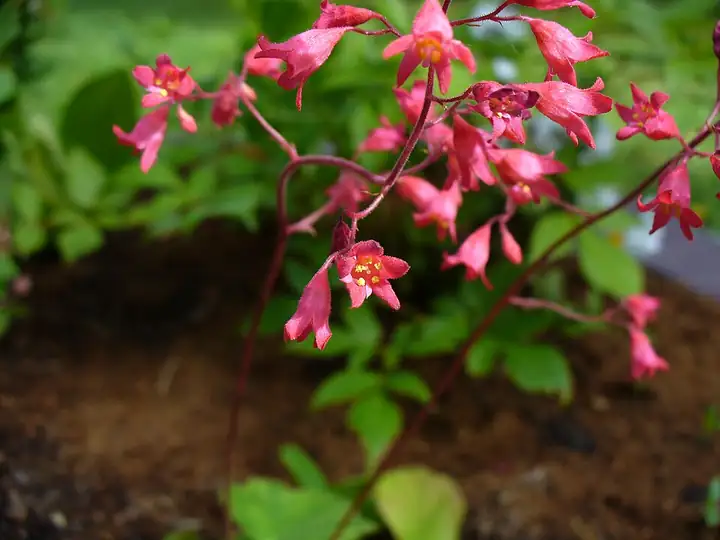
Coral bells (heuchera)
Heuchera spp. (incl. H. sanguinea, H. americana, H. villosa and hybrids) · Saxifrage family (Saxifragaceae)
| Hardiness zones | 3 to 9 |
|---|---|
| Sun | part shade |
| Water | moderate |
| Life cycle | perennial |
| Frost | Hardy: takes frost |
About Coral bells (heuchera)
Coral bells are low, mounding native perennials grown for leaves in purple, silver, peach, lime and near-black, with wiry stems of tiny bell flowers above. For hummingbirds, choose kinds with red or pink flowers, like the southwestern coral bells H. sanguinea, whose nectar draws them (NC State); many modern foliage hybrids flower only sparsely (Mt. Cuba Center trial). Hairy alumroot (H. villosa) and its hybrids take heat and humidity better than most.
Hardy in zones 3-9 (NC State); H. sanguinea 3-8.
When to plant
Timing is counted from your average last spring frost (and first fall frost). Sow & Tell works out the actual dates for your ZIP code.
Most foliage types burn in full sun; in Mt. Cuba Center's Delaware trial the best ones wanted no more than about 4 hours of sun. Divide plants every 3-4 years to keep them going, since they are otherwise short-lived, and mulch to protect roots in winter (NC State).
Soil
Moist but well-drained soil rich in organic matter, slightly acidic; coral bells dislike heavy clay (NC State).
Work compost or other organic matter into the bed for moist, well-drained, slightly acidic soil; avoid heavy clay (NC State). Follow a soil test; Clemson suggests a pH of 6.0-6.5 for most perennials.
Feeding
- early spring, just before new shoots come up (only if growth is weak or a soil test calls for it): complete slow-release fertilizer such as 12-6-6 or 10-10-10. Clemson uses 1-2 lb of 12-6-6 per 100 sq ft of bed, scattered around the plants and watered in; Illinois Extension says most perennials need only light feeding in well-prepared soil.
Heavy clay and wet soil lead to root rot, and most foliage types scorch in full sun (NC State; Mt. Cuba Center).
Harvest
Flowers rise on thin stems from late spring through summer. Deadhead to get more blooms, and trim ragged leaves to push out fresh ones (NC State).
Varieties (15)
| Variety | Type | Days | Notes |
|---|---|---|---|
| Bronze Wave | Hairy alumroot (H. villosa) | Large glossy bronze leaves shaped like sycamore leaves; creamy white flowers en masse by the third year. | |
| Apple Crisp | Hybrid alumroot | Small, ruffled, silver-veiled green leaves; about 6 in tall with about 20 white flower wands in early summer. | |
| Berry Smoothie | Hybrid alumroot | Purple and red lobed leaves with red veins. | |
| Cajun Fire | Hybrid alumroot | Plum-purple to reddish-purple, puckered leaves; creamy flowers on wine-red stems. | |
| Caramel | Hybrid alumroot | Fuzzy peach leaves aging to pale orange-yellow; white flowers. | |
| Citronelle | Hybrid alumroot | Electric-yellow spring leaves turning chartreuse; large, vigorous mound about 14 in by 30 in; white flowers blend in. | |
| Color Dream | Hybrid alumroot | Silver leaves with blue-green undertones and dark veins. | |
| Frosted Violet | Hybrid alumroot | Purple leaves with silver highlights; light pink flowers mid-June to late July. | |
| Georgia Peach | Hybrid alumroot | Peachy pink leaves. | |
| Palace Purple | Hybrid alumroot | Leaves olive to bronze-green to deep purple with wine-red undersides. | |
| Plum Pudding | Hybrid alumroot | Shiny deep purple leaves with pinkish-white flowers. | |
| Pretty Pistachio (Primo) | Hybrid alumroot | Chartreuse to lime-green leaves and bright pink flowers. | |
| Southern Comfort | Hybrid alumroot | Large peach leaves maturing to amber; sparse creamy flowers. | |
| Spellbound | Hybrid alumroot | Pure silver leaves with near-black veins and pink tints in cool weather; pale yellow flowers. | |
| Steel City | Hybrid alumroot | Silvery, blue-green leaves; pink flowers late May to early July; dense, even mound. |
Pests to watch for
Mealybugs, Japanese beetle
Diseases and problems
Powdery mildew, Rust, Bacterial leaf spot, Root rot, Phytophthora blight
In the kitchen
Safety: The sources we checked list no toxic parts. The leaves are high in tannin, which is why deer and rabbits usually leave them alone (NC State).
Pets: Non-toxic to dogs, cats and horses (ASPCA).
Sources
- plants.ces.ncsu.edu
- plants.ces.ncsu.edu
- mtcubacenter.org
- mtcubacenter.org
- aspca.org
- hgic.clemson.edu
- extension.illinois.edu
Photo: Photo: Neelix, Public domain, via Wikimedia Commons. Photo resized for the web.

Planting dates and advice are general guidance; check with your local Cooperative Extension office for your area.