
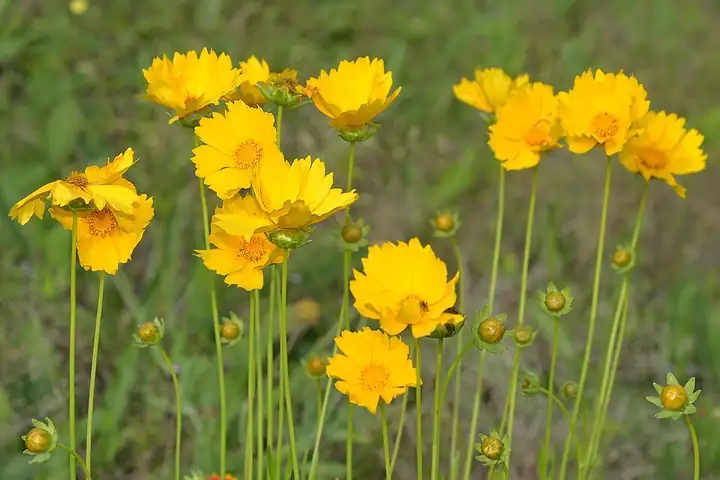
Coreopsis (tickseed)
Coreopsis lanceolata and other Coreopsis species · Daisy family (Asteraceae)
| Hardiness zones | 4 to 9 |
|---|---|
| Sun | full sun |
| Water | low |
| Life cycle | perennial |
| Frost | Hardy: takes frost |
| Spacing | 12 to 36 inches |
About Coreopsis (tickseed)
Coreopsis, or tickseed, is a cheerful native with golden daisy-like flowers that thrives in sandy or rocky soil, heat and drought. Pollinators visit the flowers and birds eat the seeds.
Lanceleaf coreopsis is hardy in zones 4-9 (NC State).
When to plant
Timing is counted from your average last spring frost (and first fall frost). Sow & Tell works out the actual dates for your ZIP code.
Grow from seed or division, and divide clumps every 2-3 years (NC State). It can self-seed aggressively.
Soil
Well-drained sandy, loamy or rocky soil; crown rot can set in where soil stays wet.
Plant in full sun in well-drained soil; average or even poor soil is fine.
Feeding
- as needed, usually spring: compost. Top-dress lightly with compost instead of feeding with fertilizer.
Too-rich soil or too much fertilizer makes coreopsis sprawl and flop.
Harvest
Deadhead spent flowers to limit self-seeding (NC State), or leave some seed heads for birds.
Varieties (26)
| Variety | Type | Days | Notes |
|---|---|---|---|
| Golden Dream | Coreopsis grown as an annual (Mt. Cuba annual trial) | ||
| Jive | Coreopsis grown as an annual (Mt. Cuba annual trial) | ||
| Limerock Dream | Coreopsis grown as an annual (Mt. Cuba annual trial) | ||
| Little Penny | Coreopsis grown as an annual (Mt. Cuba annual trial) | ||
| Mango Punch | Coreopsis grown as an annual (Mt. Cuba annual trial) | ||
| Pineapple Pie | Coreopsis grown as an annual (Mt. Cuba annual trial) | ||
| Salsa | Coreopsis grown as an annual (Mt. Cuba annual trial) | ||
| Last Dance | Fringeleaf coreopsis (C. integrifolia) | Golden 2-inch flowers in October on a compact, spreading 2 ft plant; takes light frosts. Prone to mild leaf spot. | |
| Gilded Lace | Hybrid coreopsis | Lacy, fine leaves and 1.5-inch flowers for about 18 weeks, mid-June to October. Tall (about 4 ft) and stems lean. No disease seen. | |
| Early Sunrise | Large-flowered coreopsis (C. grandiflora) | Semi-double 2-inch yellow flowers with darker centers on 18-inch plants. | |
| SunKiss | Large-flowered coreopsis (C. grandiflora) | Yellow flowers with burgundy centers. | |
| Sunray | Large-flowered coreopsis (C. grandiflora) | Semi-double yellow flowers. | |
| Heaven's Gate | Pink threadleaf-type coreopsis | Large pink flowers with red centers on 18-24 inch plants. | |
| Rosea | Pink threadleaf-type coreopsis | Pink flowers on a vigorous, spreading 12-15 inch plant. | |
| Mahogany Midget | Plains coreopsis (C. tinctoria), annual | Very dwarf, 8-12 inches, with 2-inch deep red flowers and yellow centers. | |
| Mardi Gras | Plains coreopsis (C. tinctoria), annual | Very dwarf, about 8 inches; red petals tipped yellow around yellow centers. | |
| Seashells | Plains coreopsis (C. tinctoria), annual | Golden yellow flowers with tube-shaped petals. | |
| Tiger | Plains coreopsis (C. tinctoria), annual | Dark red flowers with a yellow pattern on the petals. | |
| Summer Sunshine | Swamp coreopsis (C. palustris) | Golden flowers with dark centers from late September through October; dense, sturdy 30-inch plant. Disease-free in the trial. | |
| Flower Tower | Tall coreopsis (C. tripteris) | The tallest in the trial, about 8 ft, with the largest flowers (2.5 inches); thick, sturdy stems; about 5 weeks of bloom. No disease seen. | |
| Gold Standard | Tall coreopsis (C. tripteris) | Yellow flowers with dark centers for about 9 weeks from late July; nearly 6 ft tall but stems never flopped. No disease seen. Spreads by rhizomes. | |
| Golden Gain | Threadleaf coreopsis (C. verticillata) | ||
| Golden Showers | Threadleaf coreopsis (C. verticillata) | Dark yellow flowers on 2-3 ft plants. | |
| Hot Paprika | Threadleaf coreopsis (C. verticillata) | Red-orange flowers. | |
| Moonbeam | Threadleaf coreopsis (C. verticillata) | Soft pale yellow flowers on 12-18 inch plants. | |
| Zagreb | Threadleaf coreopsis (C. verticillata) | Bright yellow, 1.5-inch flowers for about 6 weeks, mid-June to mid-July; dense, fine-textured mat about 20 inches tall that spreads slowly. Gets some powdery mildew, but it is hard to see on the thin leaves. |
Pests to watch for
Leafhoppers, Four-lined plant bug
Diseases and problems
Root and crown rot, Aster yellows
In the kitchen
Pets: Not toxic to dogs, cats or horses (ASPCA)
Sources
Photo: Photo: William L. Farr, CC BY-SA 4.0, via Wikimedia Commons (CC BY-SA 4.0). Photo resized for the web.

Planting dates and advice are general guidance; check with your local Cooperative Extension office for your area.