
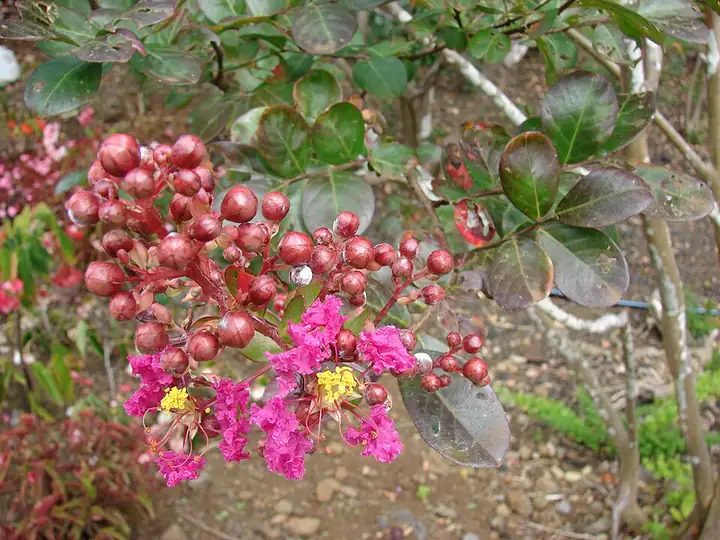
Crape myrtle
Lagerstroemia indica and hybrids · Loosestrife family (Lythraceae)
| Hardiness zones | 6 to 9 |
|---|---|
| Sun | full sun |
| Water | low |
| Life cycle | perennial |
| Frost | Hardy: takes frost |
| Soil pH | 5.0–6.5 |
About Crape myrtle
Crape myrtle is the classic Southern summer-flowering shrub or small tree, with crinkled flower clusters in white, pink, red and lavender and smooth, peeling bark. Cultivars range from 2-ft miniatures to 30-ft trees, and bees (honey, bumble, carpenter and small native bees) gather from the flowers. Don't top it ('crape murder'): pick a cultivar that fits the space instead.
Best in zones 7-9; in zones 5-6 the tops often winter-kill and plants regrow from the ground as shrubs (NC State).
When to plant
Timing is counted from your average last spring frost (and first fall frost). Sow & Tell works out the actual dates for your ZIP code.
Choose the cultivar by its mature size and space it by that size. Water regularly for the first two years; after that it is drought tolerant. Shade and poor air flow mean fewer flowers and more mildew.
Soil
Well-drained loam, clay or sand; slightly acid soil suits it, and very alkaline soil can yellow the leaves.
Plant in well-drained, slightly acid soil in full sun; follow a soil test.
Feeding
- Spring and summer: Complete (balanced) fertilizer, lightly. Light feedings are enough (Clemson); follow a soil test and water in.
Heavy nitrogen cuts flowering and pushes soft growth that winter can damage (Clemson). Never top the tree.
Harvest
Blooms early summer into fall on new growth. On small plants, cut off faded clusters right away for a second flush. Prune lightly in late winter: remove crossing, dead or twiggy branches and keep 3-5 trunks. Never top it; 'crape murder' ruins the form and gives weak branches.
Varieties (22)
| Variety | Type | Days | Notes |
|---|---|---|---|
| Velma's Royal Delight | Dwarf | Purple flowers; about 4 ft; hardy to zone 6. | |
| Chickasaw | Miniature | Pinkish-lavender flowers on a dense 1-3 ft mound; disease resistant. | |
| Pocomoke | Miniature | Deep rose-pink flowers on a 2-5 ft plant; mildew resistant. | |
| Acoma | National Arboretum hybrid | White flowers on semi-weeping branches; 10-16 ft; mildew resistant. | |
| Apalachee | National Arboretum hybrid | Light lavender flowers; about 12 ft; favored by bumble bees in a Georgia study. | |
| Biloxi | National Arboretum hybrid | Pale pink flowers; vase-shaped, 15-25 ft; mildew resistant. | |
| Comanche | National Arboretum hybrid | Coral-pink flowers; mildew resistant. | |
| Lipan | National Arboretum hybrid | Medium lavender flowers and nearly white bark; 13-20 ft. | |
| Muskogee | National Arboretum hybrid | Pale lavender flowers, brown bark; about 23 ft; mildew resistant. | |
| Natchez | National Arboretum hybrid | Pure white flowers and cinnamon-brown bark; mildew resistant. | |
| Sioux | National Arboretum hybrid | Medium pink flowers on a narrow, upright tree 15-20 ft; gray-brown bark. | |
| Tonto | National Arboretum hybrid | Fuchsia flowers on a rounded 4-11 ft plant; mildew resistant. | |
| Tuscarora | National Arboretum hybrid | Dark coral-pink flowers, light brown bark; about 16 ft. | |
| Yuma | National Arboretum hybrid | Bicolor lavender flowers; 12-18 ft; mildew resistant. | |
| Carolina Beauty | Scarlet-red flowers and tan bark; 15-20 ft. | ||
| Catawba | Dark purple flowers August-October; 12-15 ft; mildew resistant. | ||
| Dynamite | Cherry-red flowers, crimson new leaves; about 20 ft. | ||
| Early Bird White ('JD900') | Pure white flowers from mid-May with rebloom into fall; 5-8 ft. | ||
| Glendora White | Snowy white flowers; hardy to zone 6. | ||
| Red Rocket | Cherry-red flowers; 10-15 ft; mildew resistant. | ||
| Rhapsody in Pink | Soft pink flowers and purple leaves; 10-15 ft; high mildew resistance. | ||
| Seminole | Medium pink flowers on a rounded 8 ft shrub; drew the most bees in a Georgia study. |
Pests to watch for
Aphids, Scale insects, Crapemyrtle bark scale, Granulate ambrosia beetle, Flatheaded appletree borer
Diseases and problems
Powdery mildew, Leaf spot, Sooty mold
In the kitchen
Safety: The ASPCA lists crape myrtle as non-toxic. Soil-applied systemic insecticides for bark scale can get into the flowers that bees visit (NC State).
Pets: Non-toxic to dogs, cats and horses (ASPCA, listed as Lagerstroemia indica).
Sources
- plants.ces.ncsu.edu
- plants.ces.ncsu.edu
- hgic.clemson.edu
- hgic.clemson.edu
- gardeningsolutions.ifas.ufl.edu
- fieldreport.caes.uga.edu
- content.ces.ncsu.edu
- aspca.org
Photo: Photo: Forest and Kim Starr, CC BY 3.0, via Wikimedia Commons (CC BY 3.0). Photo resized for the web.

Planting dates and advice are general guidance; check with your local Cooperative Extension office for your area.