
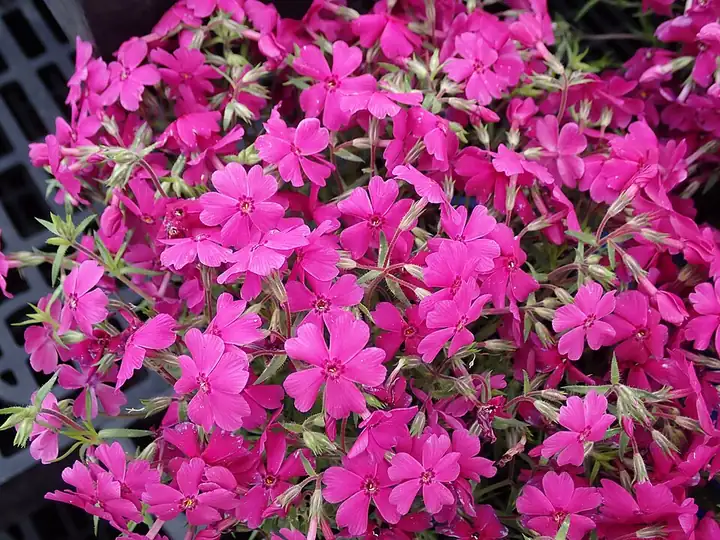
Creeping phlox (moss phlox)
Phlox subulata · Phlox family (Polemoniaceae)
| Hardiness zones | 3 to 9 |
|---|---|
| Sun | full sun |
| Water | moderate |
| Life cycle | perennial |
| Frost | Hardy: takes frost |
About Creeping phlox (moss phlox)
Creeping phlox is a native, low mat of needle-like evergreen leaves that turns into a sheet of pink, purple, lavender or white flowers in spring (NC State). It's at home on slopes, rock walls and bed edges, and it feeds early bees and butterflies.
Hardy in zones 3-9 (NC State); native to eastern and central North America, including the NC mountains.
When to plant
Timing is counted from your average last spring frost (and first fall frost). Sow & Tell works out the actual dates for your ZIP code.
Plant in spring or fall in full sun; a little dappled shade helps in hot, humid summers (NC State). Divide, or take stem or root cuttings, to make more.
Soil
Well-drained, sandy or rocky soil; it takes some dryness once settled (NC State).
Well-drained, sandy or rocky soil (NC State).
Feeding
Water until established; afterward it handles dry spells. Shear back by half after bloom (NC State). Hot, dry weather invites spider mites.
Harvest
Blooms late April to early May (NC State). After flowering, cut the stems back by about half to keep the mat dense.
Varieties (5)
NC State names only 5 cultivars.
| Variety | Type | Days | Notes |
|---|---|---|---|
| Alba | White flowers. | ||
| Fort Hill | Good resistance to phytophthora. | ||
| Red Wing | Named by NC State. | ||
| Vivian White Blanket | Named by NC State. | ||
| White Delight | White flowers; good resistance to southern blight. |
Pests to watch for
Twospotted spider mite, Rabbits
Diseases and problems
Southern blight
In the kitchen
Pets: Non-toxic to dogs, cats and horses (ASPCA, listed as moss phlox).
Sources
Photo: Photo: James St. John / Wikimedia Commons, CC BY 2.0 (CC BY 2.0). Photo resized for the web.

Planting dates and advice are general guidance; check with your local Cooperative Extension office for your area.