
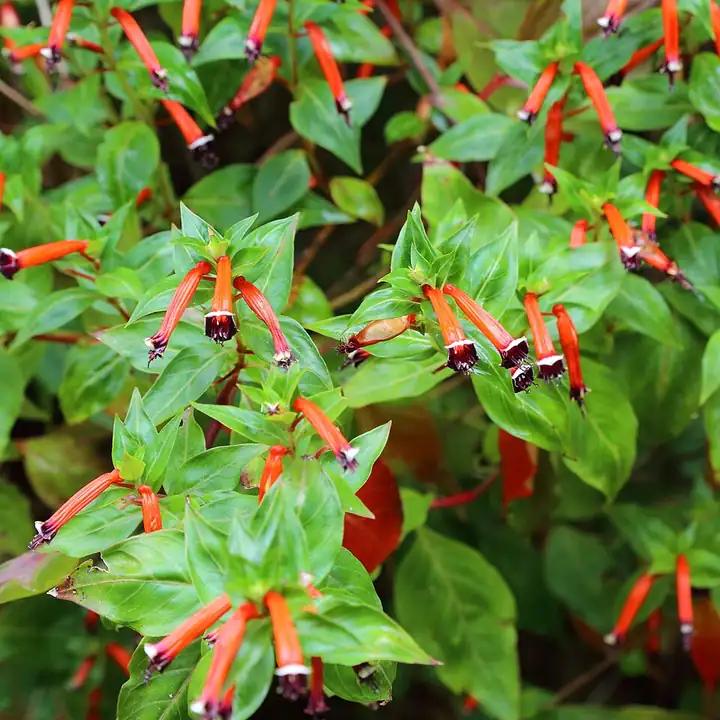
Cuphea (cigar plant and kin)
Cuphea spp. (cigar plant C. ignea, bat-face cuphea C. llavea, Mexican heather C. hyssopifolia and hybrids) · Loosestrife family (Lythraceae)
| Hardiness zones | 9 to 12 |
|---|---|
| Sun | full sun to part shade |
| Water | moderate |
| Life cycle | tender perennial (grown as an annual) |
| Frost | Tender: killed by frost |
About Cuphea (cigar plant and kin)
Cupheas are heat-loving plants from Mexico and Central America with small tubular flowers that bloom nonstop from spring to frost. Cigar plant has red tubes tipped in white, and bat-face cuphea has a purple calyx with two red "ears"; both are very attractive to hummingbirds and butterflies, and bees visit too (NC State; Clemson). Mexican heather is a tidy little shrub with tiny lavender flowers. Flowers drop cleanly, so no deadheading is needed.
Perennial only in zones 9-12 (Mexican heather 9-11, cigar plant 10-12, NC State); grown as a summer annual elsewhere. Mexican heather and cigar plant have naturalized in Hawaii, though Hawaii's weed risk screen rates both low risk.
When to plant
Timing is counted from your average last spring frost (and first fall frost). Sow & Tell works out the actual dates for your ZIP code.
- Start seeds indoors: 8 to 10 weeks before the last frost
Start Mexican heather seed indoors 8-10 weeks before the last frost, or root cuttings (NC State). Plant out after frost; give afternoon shade in hot climates, but deep shade means few flowers (Clemson). Pinch bat-face cuphea and cigar plant to keep them bushy (Clemson; NC State).
Soil
Organically rich, well-drained soil kept evenly moist; plants tolerate some drought but bloom best with regular water, and you should avoid overwatering (Clemson; NC State).
Plant in organically rich, well-drained soil (Clemson).
Feeding
- every 2-4 weeks through the season (if you did not use slow-release fertilizer): water-soluble fertilizer. Clemson feeds cupheas with a water-soluble fertilizer every 2-4 weeks at the label rate.
Avoid overwatering, and don't expect many flowers in deep shade (Clemson).
Harvest
Blooms continuously from late spring until the first frost. The flowers are self-cleaning, so there's no need to deadhead; cut leggy plants back to keep them compact (Clemson; NC State).
Varieties (6)
Extension sources we could open document only 6 cuphea cultivars.
| Variety | Type | Days | Notes |
|---|---|---|---|
| Diablo | Bat-face cuphea (C. llavea) | Hot red flowers. | |
| Torpedo | Bat-face cuphea (C. llavea) | Larger flowers. | |
| Cubano Presidente | Hybrid cuphea | About 1 ft tall with orange tubular flowers. | |
| Honeybells | Hybrid cuphea | Weeping plant about 1 ft tall with 1-in pinkish-red tubular flowers rimmed in yellow. | |
| Allyson | Mexican heather (C. hyssopifolia) | Compact, with larger leaves and more flowers. | |
| Mexican Heather White | Mexican heather (C. hyssopifolia) | White flowers. |
Pests to watch for
Mealybugs, Thrips, Whiteflies, Flea beetles
In the kitchen
Safety: The sources we checked list no toxic parts.
Pets: Not listed as toxic by the ASPCA (cuphea has no ASPCA entry).
Sources
- hgic.clemson.edu
- plants.ces.ncsu.edu
- plants.ces.ncsu.edu
- plants.ces.ncsu.edu
- plantpono.org
- plantpono.org
- aspca.org
Photo: Photo: C T Johansson, CC BY-SA 4.0, via Wikimedia Commons (CC BY-SA 4.0). Photo resized for the web.

Planting dates and advice are general guidance; check with your local Cooperative Extension office for your area.