
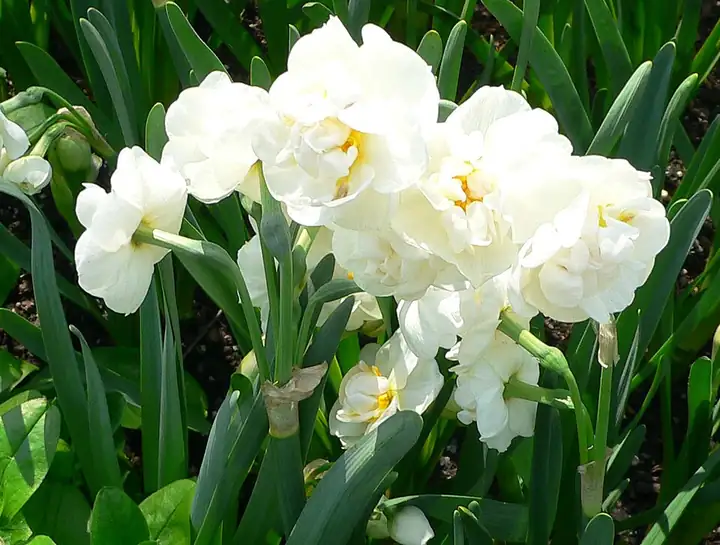
Daffodil
Narcissus species and hybrids · Amaryllis family (Amaryllidaceae)
| Hardiness zones | 4 to 8 |
|---|---|
| Sun | full sun to part shade |
| Water | moderate |
| Life cycle | perennial |
| Frost | Hardy: takes frost |
| Soil pH | 6.0–7.0 |
| Spacing | 3 to 6 inches |
About Daffodil
Daffodils are tough spring bulbs with trumpet- or cup-shaped flowers in yellow, white, orange and pink, many of them fragrant. They come back and spread for years and are the most reliable spring bulb for naturalizing, even in the South (Clemson). Every part is poisonous, so deer, rabbits and rodents leave them alone (NC State, Iowa State, Clemson).
NC State lists zones 4-8; some fragrant tazetta types, such as Chinese sacred lily, are hardy only in mild coastal areas (Clemson).
When to plant
Timing is counted from your average last spring frost (and first fall frost). Sow & Tell works out the actual dates for your ZIP code.
Plant bulbs in fall: October to November in the Carolinas and October in Iowa, as late as December if the ground isn't frozen (Clemson, Iowa State). Waiting until the soil cools keeps leaves from sprouting in fall; set bulbs 6-8 inches deep (about three times their height), small kinds like 'Tete-a-Tete' 4-6 inches.
Soil
Almost any well-drained soil; they need moisture while growing but rot in soggy ground, so add compost to poor soil (NC State, Iowa State).
Well-drained soil with compost worked in; Iowa State says fertilizer usually isn't needed unless a soil test shows poor fertility.
Feeding
- Early spring, as shoots come up: balanced fertilizer such as 10-10-10. Missouri Extension says feed lightly each spring; Clemson gives 1-2 lb per 100 sq ft in fall and again as shoots emerge. Follow a soil test.
Never braid, bundle or cut the leaves before they turn brown in early summer, which starves next year's flowers (Iowa State), and don't feed once flowering starts (Rutgers).
Harvest
Daffodils bloom from late winter to spring (late March through April in Iowa), and each kind flowers for 2-3 weeks. You don't need to deadhead. For bouquets, cut when the buds bend down at about 45 degrees and stand them in their own water first, since the sap they ooze harms other cut flowers (Iowa State).
Varieties (20)
| Variety | Type | Days | Notes |
|---|---|---|---|
| Baby Moon | Jonquilla daffodil | Very fragrant lemon-yellow miniature, about 8 inches tall. | |
| Bell Song | Jonquilla daffodil | White petals with a rose-pink cup; about 12 inches tall. | |
| Pipit | Jonquilla daffodil | Yellow and white, with a long bloom season; about 12 inches tall. | |
| Sundial | Jonquilla daffodil | Fragrant golden-yellow flat flowers with a deep gold cup; about 8 inches tall. | |
| Sweetness | Jonquilla daffodil | Fragrant yellow flowers about 2 inches across, usually one per stem. | |
| Trevithian | Jonquilla daffodil | Very fragrant deep yellow flowers. | |
| Waterperry | Jonquilla daffodil | White petals and a pale yellow cup that blushes peachy pink; about 12 inches; best color in part shade. | |
| Carlton | Large-flowered daffodil | Clemson lists it among large-flowered daffodils that come back reliably in the South. | |
| Ice Follies | Large-flowered daffodil | Clemson lists it among large-flowered daffodils that come back reliably in the South. | |
| Mount Hood | Large-flowered daffodil | Clemson lists it among large-flowered daffodils that come back reliably in the South. | |
| Scarlet O'Hara | Large-flowered daffodil | Clemson lists it among large-flowered daffodils that come back reliably in the South. | |
| Tete-a-Tete | Miniature daffodil | Small daffodil; plant 4-6 inches deep and 4 inches apart in drifts of 25 or more. | |
| Actaea | Poeticus daffodil | White petals with a yellow eye rimmed in red; about 18 inches. | |
| Pheasant's Eye | Poeticus daffodil (Narcissus poeticus var. recurvus) | Old variety with creamy white petals and an orange cup. | |
| Jonquil | Species (Narcissus jonquilla) | 2-3 richly scented deep yellow flowers per stem; about 6 inches. | |
| Campernelle | Species hybrid (Narcissus x odorus) | 2-3 fragrant golden flowers per stem; about 12 inches. | |
| Avalanche | Tazetta daffodil | Clusters of up to 20 white flowers with yellow cups on 16-inch stems; naturalizes well. | |
| Geranium | Tazetta daffodil | 3-5 very fragrant flowers per stem, white with an orange-red cup; about 16 inches. | |
| Grand Soleil d'Or | Tazetta daffodil | Yellow petals around an orange cup, fruity scent; about 12 inches. | |
| Erlicheer | Tazetta daffodil (double) | 15-20 creamy white and gold double flowers per stem; 12-14 inches; one of the best doubles for the South. |
Pests to watch for
Slugs, Brown garden snail, Aphids, Narcissus bulb fly
Diseases and problems
Bulb rot
In the kitchen
Safety: Every part is poisonous to people, the bulbs most of all: eating them causes vomiting and diarrhea and sometimes trembling or convulsions. Handling stems, flowers and bulbs can cause a skin rash (NC State).
Pets: Toxic to dogs, cats and horses (ASPCA): lycorine and other alkaloids cause vomiting, drooling and diarrhea, and large amounts (mostly from bulbs) can cause tremors, seizures, low blood pressure and heart rhythm problems.
Sources
- plants.ces.ncsu.edu
- hgic.clemson.edu
- yardandgarden.extension.iastate.edu
- hort.extension.wisc.edu
- extension.umn.edu
- extension.missouri.edu
- chicagobotanic.org
- aspca.org
- aspca.org
- njaes.rutgers.edu
Photo: Photo: Mark Pellegrini, CC BY-SA 2.5, via Wikimedia Commons (CC BY-SA 2.5). Photo resized for the web.

Planting dates and advice are general guidance; check with your local Cooperative Extension office for your area.