
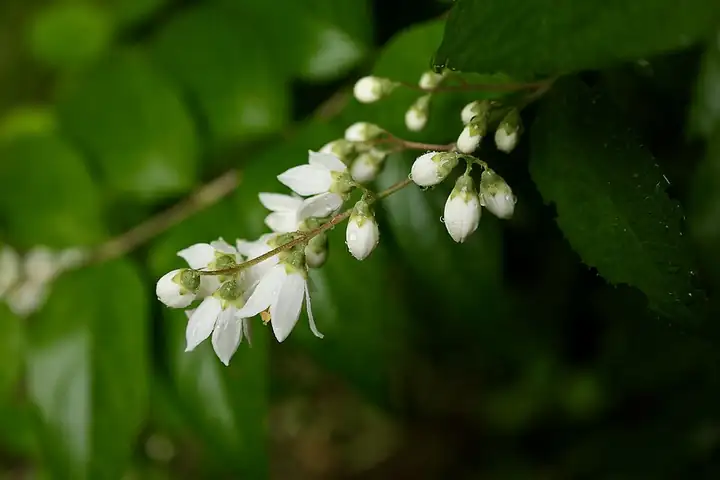
Deutzia
Deutzia gracilis (slender deutzia) and its cultivars and hybrids; also fuzzy deutzia or Pride-of-Rochester (D. scabra) · Hydrangea family (Hydrangeaceae)
| Hardiness zones | 4 to 8 |
|---|---|
| Sun | full sun to part shade |
| Water | moderate |
| Life cycle | perennial |
| Frost | Hardy: takes frost |
About Deutzia
Slender deutzia is a small, mounding shrub from Japan whose arching stems are covered in white, lightly fragrant flowers in spring; compact kinds like 'Nikko' fit foundation beds and small gardens (NC State, Morton Arboretum). The taller fuzzy deutzia (D. scabra, 6-10 ft) self-seeds and can crowd out native plants: the National Park Service and the Mid-Atlantic Exotic Pest Plant Council report it as invasive, and Kentucky, Virginia and New Jersey advisory lists include it, so NC State urges caution and suggests natives such as Carolina silverbell instead. Slender deutzia is not on those lists.
Slender deutzia is hardy in zones 4-8 (Morton Arboretum; NC State says 5-8). Fuzzy deutzia (D. scabra) is hardy in 5-8 and is listed as invasive by advisory groups in Kentucky, Virginia and New Jersey.
When to plant
Timing is counted from your average last spring frost (and first fall frost). Sow & Tell works out the actual dates for your ZIP code.
Plant container shrubs in spring or fall and water deeply until established, at least two growing seasons (UMN). Full sun gives the most flowers; in hot climates afternoon shade helps, and early buds may need protection from late spring frosts (NC State).
Soil
Moist, well-drained soil of almost any texture or pH; it tolerates occasional drought once settled, but high-pH soil can yellow the leaves (NC State, Morton Arboretum).
Test the soil first; deutzia takes most soils and pH levels if they drain well, but very alkaline soil can yellow the leaves (NC State, Morton Arboretum, Clemson).
Feeding
- Spring to early summer after new growth starts, only if a soil test shows a need: slow-release complete fertilizer in a 3:1:2 ratio, or what the soil test calls for. Spread it evenly from the stems out to the drip line and water it in; a typical soil-test rate for shrubs is about 2 lb of 12-6-6 per 100 sq ft (Clemson). Follow a soil test.
Pruning later than right after bloom cuts off next year's flowers (NC State). For new plants, water daily for 2 weeks, every 2-3 days through week 12, then weekly until established, at least two growing seasons (UMN).
Harvest
Slender deutzia blooms in mid spring (March-April in the South); fuzzy deutzia follows in late spring to early summer for about two weeks (NC State, Morton Arboretum). Flowers form on old wood, so prune every year right after blooming; later pruning cuts off next year's flowers, and unpruned plants get unkempt (NC State).
Varieties (7)
NC State and the Morton Arboretum document these 7 cultivars: 3 of slender deutzia and 4 of fuzzy deutzia. Fuzzy deutzia (D. scabra) is listed as invasive by advisory groups in Kentucky, Virginia and New Jersey.
| Variety | Type | Days | Notes |
|---|---|---|---|
| Fortunei | Fuzzy deutzia (D. scabra) | Large white flowers on a tall shrub, 6-10 ft. | |
| Plena | Fuzzy deutzia (D. scabra) | Double white flowers tinged rosy purple on a tall shrub, 6-10 ft. | |
| Rosea | Fuzzy deutzia (D. scabra) | Pink flowers on a tall shrub, 6-10 ft. | |
| Watereri | Fuzzy deutzia (D. scabra) | White flowers tinged carmine on the outside, on a tall shrub, 6-10 ft. | |
| Chardonnay Pearls ('Duncan') | Slender deutzia (D. gracilis) | Compact, about 2-2.5 ft, with pearl-like buds, white flowers and lime-yellow leaves. | |
| Nikko | Slender deutzia (D. gracilis) | Dwarf, dense and rounded, 2-4 ft, with lots of white flowers, blue-green leaves and deep burgundy fall color. | |
| Nikko Dawn | Slender deutzia (D. gracilis) | Low-growing, with lightly scented white flowers and green leaves edged in white. |
Pests to watch for
Aphids, Leafminers
Diseases and problems
Leaf spot, Iron chlorosis in high-pH soil
In the kitchen
Safety: NC State lists slender deutzia as non-toxic. It is grown for looks, not food.
Pets: Not listed by the ASPCA (no deutzia entry on its dog, cat or horse plant lists); NC State's plant page lists slender deutzia as non-toxic to cats, dogs and horses.
Sources
- plants.ces.ncsu.edu
- plants.ces.ncsu.edu
- mortonarb.org
- eddmaps.org
- gardenclubky.org
- vnps.org
- extension.umn.edu
- aspca.org
- aspca.org
- aspca.org
- extension.rutgers.edu
- hgic.clemson.edu
Photo: Photo: 26D, CC BY-SA 4.0, via Wikimedia Commons (CC BY-SA 4.0). Photo resized for the web.

Planting dates and advice are general guidance; check with your local Cooperative Extension office for your area.