
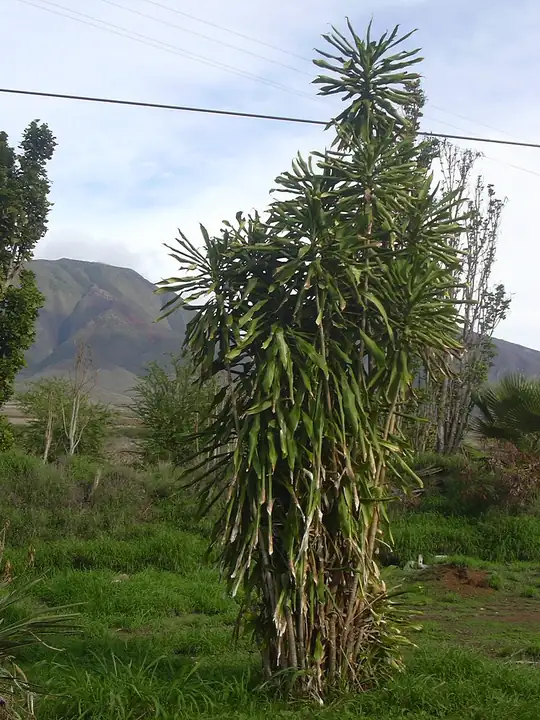
Dracaena (corn plant, dragon tree)
Dracaena fragrans (corn plant, including the 'Janet Craig' and 'Warneckii' types once called D. deremensis); Dracaena marginata (dragon tree, now D. reflexa var. angustifolia) · Asparagus family (Asparagaceae)
| Hardiness zones | 10 to 12 |
|---|---|
| Sun | part shade |
| Water | moderate |
| Life cycle | perennial |
| Frost | Tender: killed by frost |
| Soil pH | 6.0–6.5 |
About Dracaena (corn plant, dragon tree)
Dracaenas are slow, woody-stemmed foliage plants from tropical Africa and Madagascar that give a room a small tree (NC State). The corn plant carries broad, arching, corn-like leaves, often with a yellow center stripe, on a thick cane; the dragon tree has thin red-edged leaves in tufts on slender, often braided stems. Both put up with low light and dry air but are very sensitive to fluoride in tap water and fertilizer, which shows as brown leaf tips (Clemson).
Hardy outdoors only in zones 10-12 (NC State); it is grown indoors everywhere and can summer outdoors in shade once nights stay above 50 F.
When to plant
Timing is counted from your average last spring frost (and first fall frost). Sow & Tell works out the actual dates for your ZIP code.
Usually bought as a nursery plant, often as a rooted cane; it can also be started from a tip or stem cutting (Clemson).
Growing it indoors
- Light: Most kinds tolerate low light, though leaves grow narrower and thinner; direct sun leaves round dry patches and streaks on the leaves (NC State, Clemson).
- Water: Water thoroughly once the surface is dry to the touch and let it dry slightly between waterings, using room-temperature water; the corn plant likes a bit more moisture in the growing season, and both need less in winter (Clemson, NC State). Dracaenas are very sensitive to fluoride, so if tips brown switch to distilled or rain water and flush the salts out monthly.
- Humidity: Mist or run a humidifier when winter humidity drops below 30-40%; dry air browns the leaf tips (Clemson, NC State).
- Temperature: Keep it above 50 F; it thrives at 70-80 F (NC State), and Clemson suggests 60-70 F days with nights about 10 F cooler. Sudden loss of many leaves follows drafts and temperature swings.
- Feeding: A liquid foliage-plant fertilizer once a month in spring and summer, or time-release pellets, and none in winter; never use a fertilizer containing superphosphate, which is often high in fluoride (Clemson). NC State says the dragon tree needs little feeding.
- Repotting: Repot when the plant starts lifting out of its pot or roots grow out the drainage holes (NC State), one size up in a standard mix without much perlite (Clemson).
Soil
A standard houseplant mix with good drainage, kept near pH 6.0-6.5 and without a high share of perlite, which can carry fluoride (Clemson).
Pot in a standard houseplant mix without a high share of perlite, kept at pH 6.0-6.5 to limit fluoride uptake (Clemson).
Feeding
- Spring and summer: liquid foliage-plant fertilizer, or time-release pellets. Once a month, watered in (Clemson); the dragon tree needs little and does fine on a controlled-release feeding in spring, summer and fall (NC State).
- Fall and winter: none. Stop feeding and let the mix dry a little more between waterings (Clemson, NC State).
Never use a fertilizer containing superphosphate, which often carries fluoride and burns the leaf tips; over-feeding also yellows the tips and margins (Clemson).
Varieties (14)
NC State and Clemson Extension name 14 cultivars of the corn plant and dragon tree; the most common are listed.
| Variety | Type | Days | Notes |
|---|---|---|---|
| Massangeana (mass cane) | Corn plant (D. fragrans) | The classic corn plant: broad leaves with a yellow-lime center stripe on a thick cane; about 4-5 ft tall and 2 ft wide indoors (Clemson). | |
| Bausei | Corn plant (D. fragrans, deremensis type) | A white center band down each leaf; about 4 ft (Clemson). | |
| Compacta (Janet Craig Compacta) | Corn plant (D. fragrans, deremensis type) | Dense rosettes of short, wavy-edged dark green leaves about 5 in long; 3-6 ft tall and very slow. | |
| Dorado | Corn plant (D. fragrans, deremensis type) | Thick dark green leaves edged lime green that curl downward. | |
| Hawaiian Sunshine | Corn plant (D. fragrans, deremensis type) | Compact, glossy dark green leaves with light and dark green stripes. | |
| Janet Craig | Corn plant (D. fragrans, deremensis type) | Solid dark green, glossy leaves; tough in low light and can reach 10 ft (Clemson). | |
| Lemon Lime | Corn plant (D. fragrans, deremensis type) | Sword-shaped leaves striped cream, greenish-yellow and lime. | |
| Limelight | Corn plant (D. fragrans, deremensis type) | Glossy yellow-green leaves that lighten with age. | |
| Warneckii | Corn plant (D. fragrans, deremensis type) | Gray-green leaves striped white; about 4 ft and good in low light (Clemson). | |
| Colorama | Dragon tree (D. marginata) | Leaves mostly pink with white and green stripes; 5-6 ft tall and needs good light to hold its color. | |
| Dragon tree (D. marginata, plain) | Dragon tree (D. marginata) | Thin green leaves edged in red in tufts on slender, often braided stems; to about 6 ft indoors and tolerant of low light. | |
| Magenta | Dragon tree (D. marginata) | Green leaves with magenta-red margins on a palm-like stem. | |
| Tarzan | Dragon tree (D. marginata) | Wide, thick, spiky green leaves that are tougher than the species. | |
| Tricolor | Dragon tree (D. marginata) | Green leaves striped cream and edged pink to red. |
Pests to watch for
Thrips, Mealybugs, Scale insects, Twospotted spider mite
Diseases and problems
Root and crown rot, Leaf spot, Fluoride leaf-tip burn
In the kitchen
Safety: All parts contain saponins; eating it irritates the mouth and stomach and can cause nausea, vomiting and diarrhea, and the sap may irritate skin (NC State rates it low severity). Keep it from small children.
Pets: Toxic to dogs, cats and horses (ASPCA, corn plant, Dracaena fragrans): saponins cause vomiting, sometimes with blood, depression, loss of appetite, drooling and, in cats, dilated pupils. NC State lists the dragon tree as toxic the same way.
Sources
Photo: Photo: Forest and Kim Starr, CC BY 3.0, via Wikimedia Commons (CC BY 3.0). Photo resized for the web.

Planting dates and advice are general guidance; check with your local Cooperative Extension office for your area.