
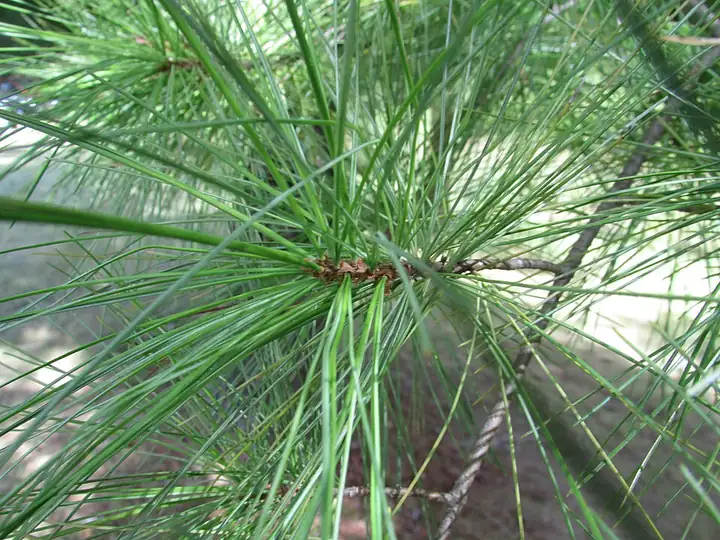
Eastern white pine
Pinus strobus · Pine family (Pinaceae)
| Hardiness zones | 3 to 8 |
|---|---|
| Sun | full sun to part shade |
| Water | moderate |
| Life cycle | perennial |
| Frost | Hardy: takes frost |
About Eastern white pine
Eastern white pine is a fast-growing native evergreen with soft, blue-green needles in bundles of five and long, curved cones. It makes a graceful screen or specimen in cool, humid climates. It is hurt by road salt, air pollution, alkaline soil and wind, and it is highly flammable.
Zones 3-8 (NC State); it prefers cool, humid climates.
When to plant
Timing is counted from your average last spring frost (and first fall frost). Sow & Tell works out the actual dates for your ZIP code.
Plant container or balled-and-burlapped trees. Container trees can go in any time the ground can be worked, but fall is the best season in the South because roots keep growing through mild weather (Clemson). Dig the hole no deeper than the root ball and at least twice as wide, keep the top roots level with the soil, and mulch 2-4 inches without touching the trunk. Keep it away from salted roads and walks. Where wildfire is a risk, NC State advises keeping it out of a home's defensible space. Inner needles drop after about two years, which is normal.
Soil
Moist, well-drained, acidic sandy loam or loam; it doesn't tolerate salt, alkaline soil, sulfur dioxide or ozone (NC State).
Test the soil first. Loosen a wide planting area and mix 10-20 percent compost into the native soil you dig out; don't use uncomposted bark, and don't dig deeper than the root ball (Clemson).
Feeding
- Spring to early summer, after the tree is established, and only if a soil test or pale leaves and weak twig growth show a need: slow-release nitrogen fertilizer with a ratio near 3-1-1 or 3-1-2 (3-0-1 or 3-0-2 if the soil test shows enough phosphorus). Spread it evenly from just outside the trunk flare to the dripline and water it in. Clemson cites 2-4 lb of slow-release nitrogen per 1,000 sq ft per year, split into a spring and a late-summer feeding; follow your soil test.
- Late summer to early fall, the second half of the year's split feeding (only if a soil test calls for it): slow-release nitrogen fertilizer, same as spring. Apply the rest of the year's amount over the root zone and water in. Don't feed a drought-stressed tree in summer (Clemson).
First-year watering matters far more than fertilizer: water daily for the first 1-2 weeks, every 2-3 days until week 12, then weekly, using about 1-1.5 gallons per inch of trunk diameter, until the tree is established, roughly 1.5 years per inch of trunk (UMN). Don't count on rain unless it was over an inch. Keep it away from road and sidewalk salt and don't plant in alkaline soil (NC State). Conifers can take late-season feeding (Clemson). Too much fertilizer can burn roots and push soft growth that pests and cold injure (Clemson).
Varieties (6)
NC State documents 6 cultivars.
| Variety | Type | Days | Notes |
|---|---|---|---|
| Alba | Color | Whitish-green spring needles turning green in summer. | |
| Fastigiata | Columnar | About 40 ft tall and 8 ft wide. | |
| Nana | Dwarf | Slow-growing dwarf. | |
| Sea Urchin | Dwarf | Compact dwarf shrub with thin blue needles. | |
| Umbraculifera | Dwarf | Known as dwarf white pine. | |
| Pendula | Weeping | Semi-dwarf with weeping branches. |
Pests to watch for
Pine sawflies (European, introduced and redheaded pine sawflies), Scale insects, Aphids, Twospotted spider mite, Sawflies (garden sawflies), Spruce spider mite
Diseases and problems
White pine blister rust, Canker, Deicing salt injury, Ozone injury, Normal needle drop, Overwatering and waterlogged soil, Leaf scorch, Winter injury, Girdling roots
In the kitchen
Pets: Not on the ASPCA's toxic plant list for dogs.
Sources
Photo: Photo: Chris Light / Wikimedia Commons, CC BY-SA 4.0 (CC BY-SA 4.0). Photo resized for the web.

Planting dates and advice are general guidance; check with your local Cooperative Extension office for your area.