
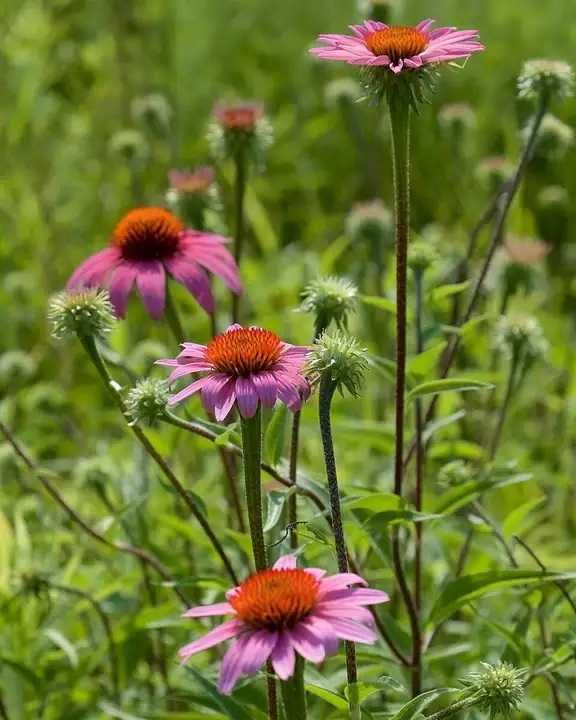
Purple coneflower (echinacea)
Echinacea purpurea · Daisy family (Asteraceae)
| Hardiness zones | 3 to 8 |
|---|---|
| Sun | full sun to part shade |
| Water | low |
| Life cycle | perennial |
| Frost | Hardy: takes frost |
| Soil pH | 6.0–8.0 |
| Spacing | 12 to 36 inches |
About Purple coneflower (echinacea)
Purple coneflower is a tough, drought-tolerant perennial with daisy-like purple flowers and a raised center cone. Bees and butterflies work the flowers, and goldfinches eat the seeds in winter.
NC State lists purple coneflower as hardy in zones 3-8.
When to plant
Timing is counted from your average last spring frost (and first fall frost). Sow & Tell works out the actual dates for your ZIP code.
Fall is the best time to plant, though spring planting works (Clemson). From seed, sow indoors at 65-70 F, barely covered (the seed likes light and a few weeks of cold, damp chilling first); seedlings appear in 10-20 days and take two or more years to reach full size.
Soil
Evenly moist, well-drained soil; drought tolerant once established, but sensitive to salt near the coast.
Plant in evenly moist, well-drained soil in full sun; coneflower tolerates rocky or clay soil. Follow a soil test.
Feeding
- late March or early April, just before new leaves come up: slow-release fertilizer such as 12-6-6. Coneflowers are not heavy feeders; scatter about 1 lb per 100 sq ft around the plants and water it in.
Coneflower evolved in poor soil; in rich garden soil it can grow too lush and flop over.
Harvest
Leave some seed heads standing for birds, and cut dead stems back to 12-24 inches so native bees can nest in the hollow stems.
Varieties (23)
| Variety | Type | Days | Notes |
|---|---|---|---|
| Cheyenne Spirit | Hybrid coneflower | 24-32 in tall with 4 in flowers in a mix of orange, yellow, red, pink, purple and white. | |
| Glowing Dream | Hybrid coneflower | About 25-32 in tall with 3.5 in watermelon-pink flowers and orange cones. | |
| Harvest Moon | Hybrid coneflower | Golden-yellow petals around an orange cone. | |
| Hot Papaya | Hybrid coneflower | About 3 ft tall with drooping, chili-red double flowers with a pompom center. | |
| Kismet Raspberry ('TNECHKR') | Hybrid coneflower | Compact 24-32 in plants with 4 in magenta-pink flowers with flat, horizontal petals. | |
| Kismet White | Hybrid coneflower | About 25 in tall with large pure white flowers and green cones. | |
| Mellow Yellows | Hybrid coneflower | Seed-grown strain about 24 in tall with flowers in pale, lemon and golden yellow. | |
| Postman ('POST301') | Hybrid coneflower | About 34 in tall and 32 in wide; blooms late June to mid-July. | |
| Purple Emperor | Hybrid coneflower | About 34 in tall and 25 in wide; blooms late June to mid-July. | |
| Santa Fe (Lakota Fire) | Hybrid coneflower | About 24 in tall and 26 in wide with red-orange flowers from late June to late July. | |
| Sensation Pink | Hybrid coneflower | 24-31 in tall with 3 in glowing magenta-pink flowers on dark burgundy stems. | |
| Snow Cone | Hybrid coneflower | Compact plant about 24 in tall and 19 in wide; blooms late June to late July. | |
| Sombrero series | Hybrid coneflower | Compact, bushy plants about 21-27 in tall with 3.5-4 in flowers; colors include white ('Blanco'), deep orange-red ('Flamenco Orange'), coral ('Hot Coral') and coral-to-burgundy ('Tres Amigos'). | |
| Tiki Torch | Hybrid coneflower | Hybrid coneflower with bright orange flowers. | |
| Alba | Purple coneflower (E. purpurea) | White-flowered form of purple coneflower. | |
| Conekim (PANTHER PINK) | Purple coneflower (E. purpurea) | Very short, 15-18 in at three years, with rose-pink to purple-pink flowers for about 12 weeks from late June. | |
| Fragrant Angel | Purple coneflower (E. purpurea) | About 38 in tall and 34 in wide with clean white petals and a strong fragrance. | |
| Kim's Knee High | Purple coneflower (E. purpurea) | Dwarf form of purple coneflower. | |
| Magnus | Purple coneflower (E. purpurea) | 2-4 ft plants with rose-purple flowers whose petals stay flat instead of drooping. | |
| Pica Bella | Purple coneflower (E. purpurea) | About 34 in tall and 30 in wide with deep pink 3.5 in flowers. | |
| PowWow Wild Berry | Purple coneflower (E. purpurea) | Well-branched 20-24 in plants with 3-4 in deep rose-purple flowers that hold their color. | |
| Ruby Star | Purple coneflower (E. purpurea) | Red-purple petals around a dark brown cone. | |
| White Swan | Purple coneflower (E. purpurea) | White-flowered coneflower with large flowers and slightly drooping petals. |
Pests to watch for
Japanese beetle, Aphids, Leafhoppers
Diseases and problems
Aster yellows, Powdery mildew, Stem rot
In the kitchen
Safety: Allergic reactions can occur and may be severe, especially in people allergic to daisy-family plants such as ragweed; stomach upset is common. Evidence on drug interactions is conflicting, and pregnancy safety data are limited (NCCIH).
Pets: Not listed as toxic by the ASPCA
Sources
Photo: Photo: Eric Hunt, CC BY-SA 4.0, via Wikimedia Commons (CC BY-SA 4.0). Photo resized for the web.

Planting dates and advice are general guidance; check with your local Cooperative Extension office for your area.